by Christopher Carson (February 2026)
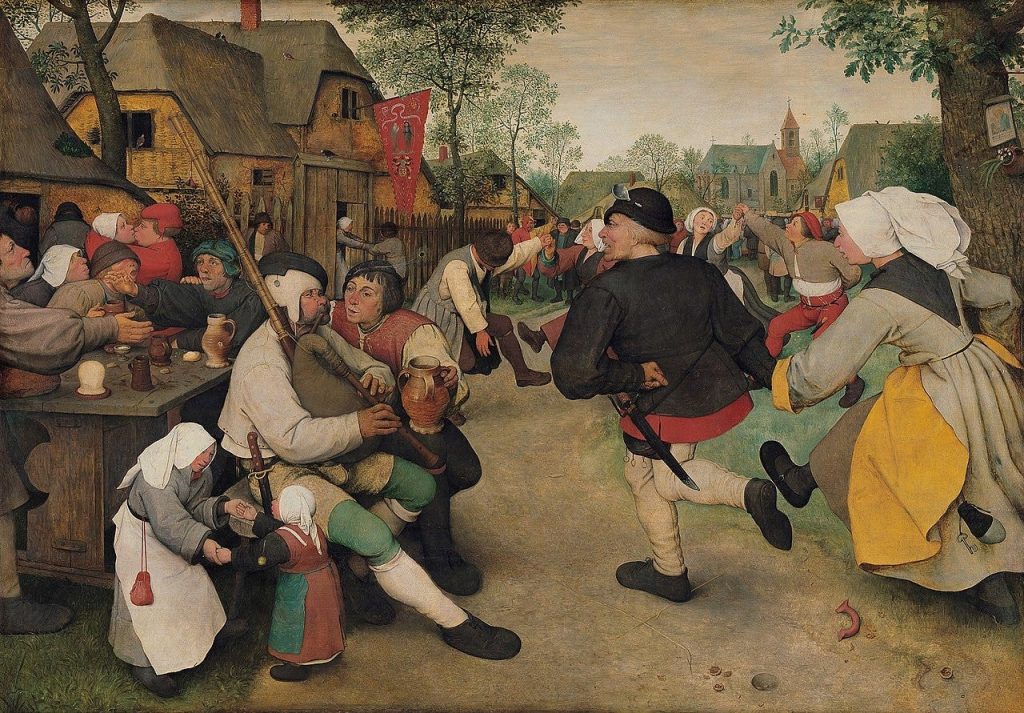
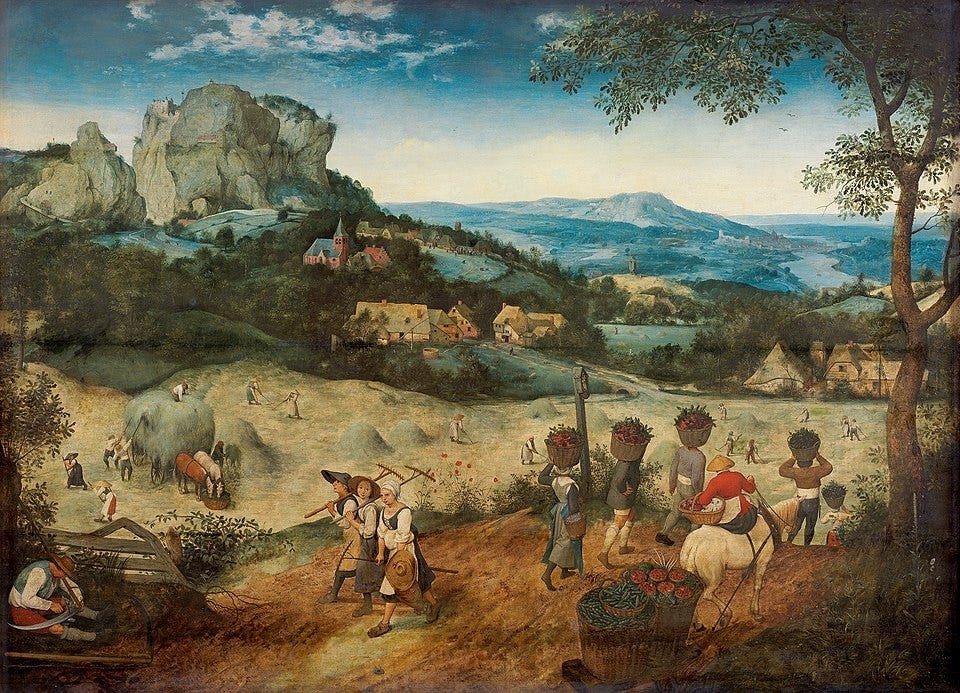
It is tempting, and distinctly modern, to look at Pieter Bruegel’s Peasant Dance and conclude that religion has receded, leaving behind a purely secular scene of rustic exuberance. The Medieval dancers surge, stamp, clasp, and sway with an assurance that seems bodily rather than devotional. And yet this apparent absence is misleading, because the sacred in Bruegel’s village is suffused within its themes.
The scene Bruegel paints is actually a church dedication festival, a Kirchweihfest, what the Low Countries knew as a kermis; the word itself binds church and Mass together. What later observers would call a “fair” begins, historically, as a parish event tied to a saint, a consecrated building, and a specific date in the liturgical year. The commoners’ dancing and feasting may be outside the Church’s physical confines but lie mentally within it, and because of it. They are permitted precisely because time, in this world, carries weight, and that weight authorizes joy.
Bruegel depicts the opening dance of such a festival, a formal beginning before general release. Two couples take the floor first, establishing the pattern that the rest of the village will soon inhabit. At the edge of the scene, a beggar or pilgrim interrupts the forward motion of appetite, drawing attention to charity amid celebration. Nothing is exaggerated. Nothing is sermonized. Yet the moral ecology is fully present. Pleasure, obligation, embarrassment, generosity, and physical delight occupy the same space without canceling one another.
Look closely and the painting begins to behave like a piece of music. The bagpiper is a kind of communal engine, an embodied metronome with lungs. Bodies cluster in knots that suggest social gravity rather than mere crowding. Faces turn along small vectors of attention, toward partners, toward food and drink, toward the spectacle of other motions. The dance reads as a repeated figure into which newcomers can step without explanation. The choreography is legible in its very redundancy. The village does not need virtuosity to achieve ecstasy. It needs a shared pattern, a pulse that can absorb difference in age, skill, sobriety, and mood, then still hold together. That is why the scene feels confident. The joy is communal and synchronized.
This is the texture of medieval Catholic life as it was actually lived, not parodied by Enlightenment philosophies. The peasants’ religion distinguishes one day from another, regulates when bodies may fast and when they may feast, when restraint is demanded and when exuberance is licensed. The village receives the Church’s implicit and explicit signals week by week and year by year, from a calendar shaped by saints’ days, harvest cycles, and the recurring gravity of the Mass.
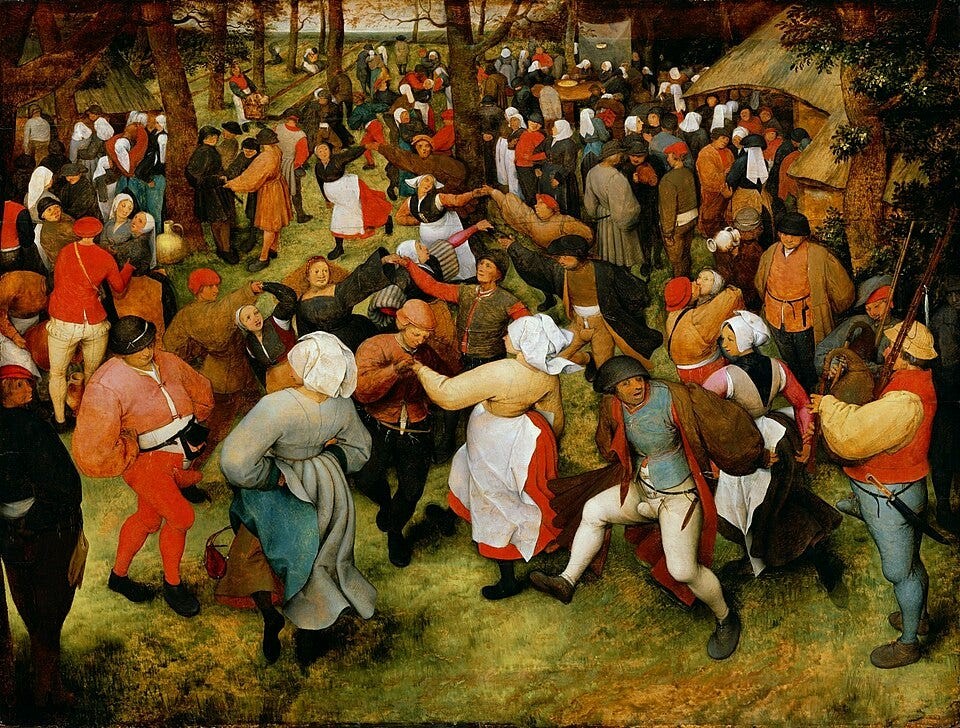
The Eucharist, though unseen, is the quiet center of this world. A culture formed by the Eucharist binds ultimate meaning to bread and wine, to cultivation and fermentation, to hunger and satisfaction. Wheat is a symbol but also a material reality of labor, weather, risk, and survival. When such a culture gathers weekly to receive bread as something more than bread, it trains its people to experience matter itself as charged. Feast days, processions, and parish celebrations are all how a seemingly abstract metaphysics becomes habitable.
A reader may reasonably object that one cannot prove Bruegel intended a Eucharistic thesis in a village dance. That is fair, and it is also not fatal to the argument. A painting can be structurally shaped by the religious ecology that produced it even if the artist does not consciously announce that shaping. Bruegel’s scenes were the organic representation of Medieval life, and the center of this communal experience was always the bread and wine made flesh and blood.
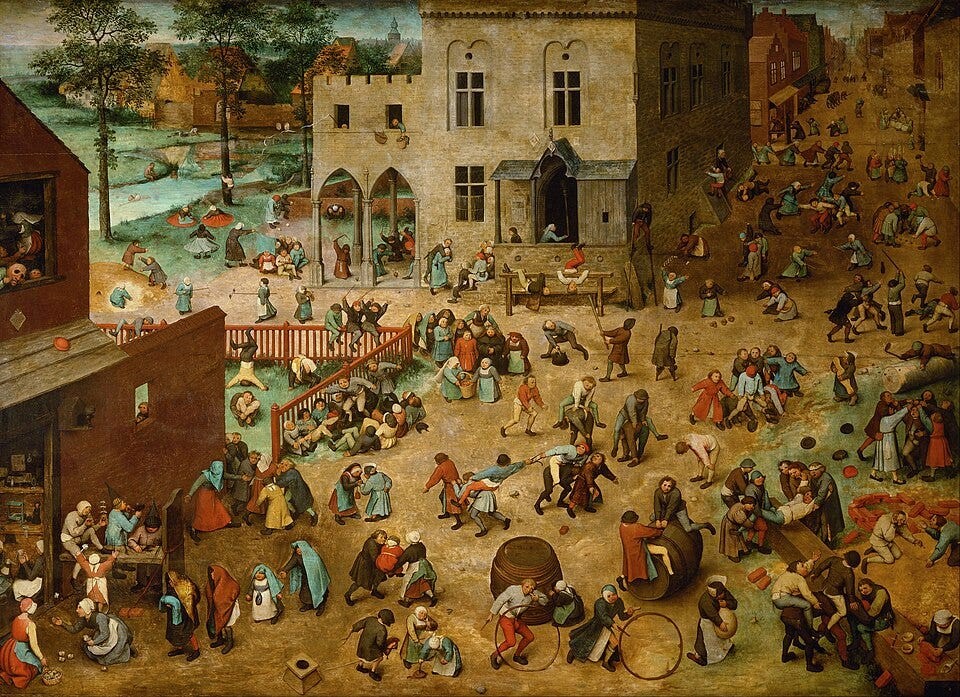
This is why Eamon Duffy’s The Stripping of the Altars remains indispensable for understanding what Bruegel shows without explaining. Duffy’s reconstruction of pre-Reformation English religion is less nostalgia than anthropology; he demonstrates that late medieval Catholicism was a rich web of practices that organized ordinary life. His treatment of Candlemas is exemplary. Blessed candles, carried in procession and taken home, turn light itself into a communal object. Doctrine becomes tactile. Memory becomes seasonal. The feast is handled, repeated, and incorporated into domestic life.
The Church’s calendar of saint’s days, marked in time to the agricultural sowings and harvests, made a place for the sacredness of the body, and the body answered with movement, labor, sexual intercourse, feasting, music, and dance. This reciprocity creates what might be called Kairos, meaning civilizational confidence: the sense that life unfolds within a meaningful order, that joy is not an act of rebellion, and that repetition is personal and collective reassurance.
The music one instinctively hears behind Peasant Dance confirms this. The association that comes to my mind is with the fast, repetitive French village dances later collected by Michael Praetorius in Terpsichore. In this suite of ebullient revelry, Praetorius curated and fixed into notation a repertory already circulating in France and beyond, material shaped by generations of communal movement. His village branles are built on repetition and predictable ground, designed to synchronize bodies rather than to astonish virtuosi. They are musical engines for collective coherence.
Paint and sound perform the same work here. Bruegel captures the kinetic grammar of village life at the moment of its release. Praetorius preserves the musical scaffolding that makes such release possible. Both are acts of cultural memory, both create the Medieval Kairos. They arrest a living tradition just long enough to let it travel.
Seen this way, Bruegel’s village scenes take on a quiet poignancy. They depict the medieval synthesis not so much at its 13th Century intellectual apex in cathedral stonemasonry or scholastic disputation, but at ground level, where most people actually lived it. Soil and saints, work and feast, charity and excess, chastity and unchastity. The living and the dead were held together by shared time and shared expectation of an afterlife that was a public horizon.
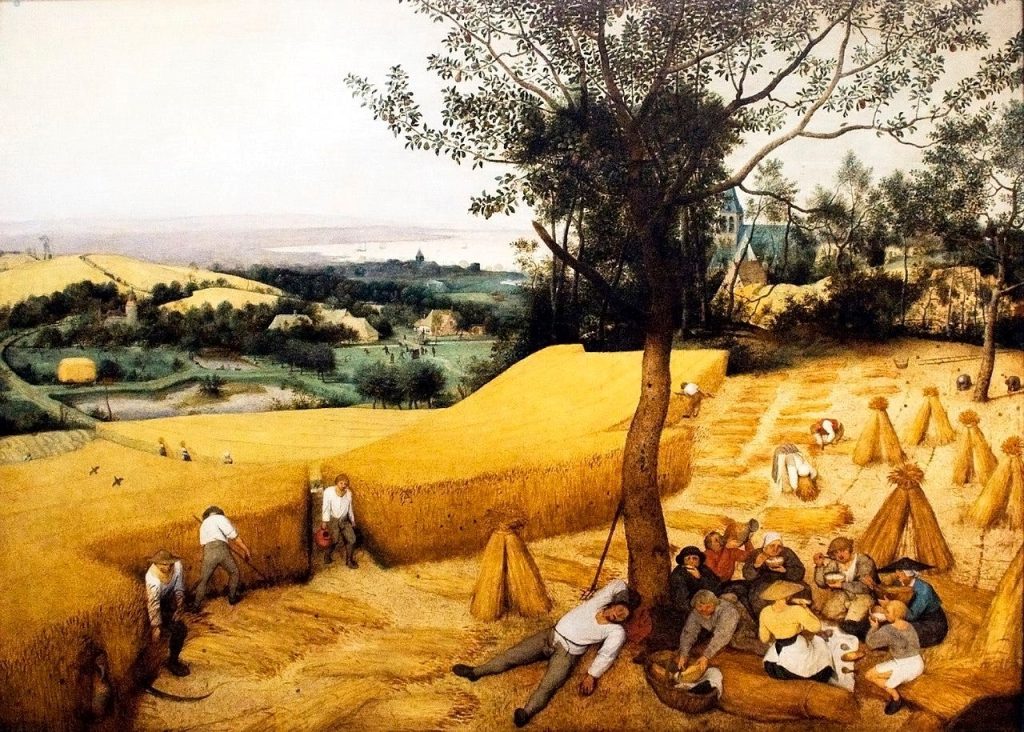
This synthesis was already under strain when Bruegel painted it. Confessional conflict, iconoclasm, and the tightening grip of centralized power would soon fracture the village’s symbolic autonomy. After the 1560s, shared meaning increasingly becomes contested meaning, and contested meaning is rarely allowed to remain local. The Counter-Reformation would retrieve and intensify medieval sacramental realism, often magnificently, but with a harder edge and a more explicit polemical posture. What Bruegel shows belongs to an earlier moment, before belief fully hardened into identity, when communal meaning could still be inhabited without constant declaration.
That is why the painting feels like a last bright season. Not because faith disappears afterward, but because shared time becomes less secure. A calendar that once arrived as a communal inheritance began, in the wake of the Reformation, the Wars of Religion, the English Civil War, and the Thirty Years War to feel like either an affront to your Protesant neighbors or a painful protestation of your Catholicism. To the Reformer, festivity itself became suspect; The repetitions of dance became vulnerable to reinterpretation and even condemnation on moral grounds. In modern times, increasingly administrative, atomized and deracinated, collective ritual is either erased or thinned out, until its recurrence feels like nostalgia rather than necessity. Even the Roman Catholic Church today has largely suppressed the ancient Latin Mass in favor of 1970s- style “folk” norms.
But the enduring power of Peasant Dance lies in its refusal to argue. It shows a world in motion, confident enough to repeat itself. The dancers do not know they are near a historical shift. They are simply moving as people move when time still belongs to them. The Danse Doree’ (the Golden Dance) is in the repetition itself, in the assurance that the step will return, the feast will return, the year will return, and that meaning, like the dance, can be entered again, world without end.
Table of Contents
Christopher S. Carson, J.D., M.A., formerly of the American Enterprise Institute, is a criminal defense attorney in private practice in Milwaukee.
Follow NER on Twitter @NERIconoclast






One Response
Thanks again for an illuminating discussion.