by Kendra Mallock (December 2025)
 Most British consumers assume they can trust the labels in their supermarkets. If meat carries the Red Tractor logo, they believe it signals humane treatment and proper stunning. If meat is labelled halal, they know it follows religious rules. And if meat carries no religious designation at all, they reasonably assume it comes from a fully stunned, unconscious animal. In reality, none of these assumptions hold true. The modern UK meat supply chain has become so blended and opaque that even the most careful shopper cannot tell whether the animal they are eating was fully stunned, partially stunned, or completely conscious at slaughter.
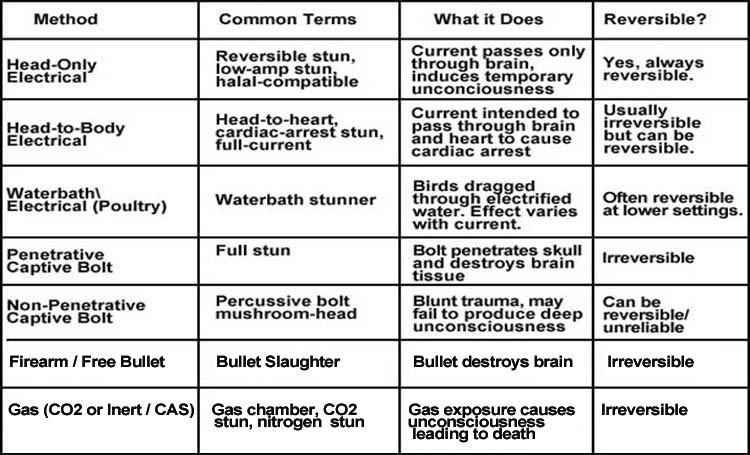
The welfare difference is significant. Under UK legislation and mainstream scientific consensus, full irreversible stunning—rendering an animal genuinely unconscious before cutting its throat—is universally recognised as the most humane method. Reports from the Farm Animal Welfare Council (FAWC) and the Royal Society for the Prevention of Cruelty to Animals (RSPCA) consistently warn that conscious slaughter causes considerable pain, fear, and prolonged suffering before the animal loses consciousness.[1][2] Religious slaughter, however, operates on a different premise: the animal must be alive at the cut. Some halal certifiers allow reversible or low-voltage stuns, but these do not reliably produce unconsciousness. The animal may be disoriented, but still aware. Kosher slaughter forbids any form of stunning altogether. The government itself acknowledges that non-stun or partial/reversible stun slaughter causes pain and should be avoided whenever possible. The science is clear enough—but the labels are not.[3]
What has made matters worse is the quiet integration of religiously compliant slaughter into the general food chain. When Parliament first carved out a religious exemption in the Slaughter of Animals Act 1933—later reiterated in 1958, 1995, 2007, and 2015—it was intended only as a narrow accommodation for small Jewish and Muslim communities. It was never meant to shape the entire national supply of meat. Yet as abattoirs consolidated, and as halal-compliant slaughter became commercially convenient, the exemption expanded in practice. Today, meat from animals killed without full stunning flows into supermarkets, restaurants, schools, hospitals, and takeaways—unlabelled and undisclosed. Even MPs in recent debates have acknowledged that what was originally a limited exemption has effectively become a loophole affecting the entire British public. This has implications not only for animal welfare, but also for consumer conscience, including religious conscience among Christians.
For many religious consumers, the issue is not only animal welfare but also conscience. Christians, for example, may wish to avoid halal meat—not because they believe the food is spiritually tainted, since the New Testament makes clear that “an idol has no real existence” and that “food will not commend us to God” (1 Corinthians 8:4, 8)—but because halal slaughter is overtly a religious act. The spoken invocation “Bismillah, Allahu Akbar” (In the name of Allah, Allah is the Greatest) is understood within Islam as worship, and Paul advises believers in 1 Corinthians 10:28 to abstain from foods explicitly linked to another religion’s rituals “for conscience’ sake.” For these Christians, the concern is not contamination but the appearance of participating in, endorsing, or materially supporting worship directed toward a god they do not follow.
For many Sikhs and Hindus, concerns about meat consumption are rooted in their faith. The Sikh Rehat Maryada strictly forbids Sikhs from consuming “kutha” meat, which includes halal and kosher slaughter methods that involve ritual invocation or slow bleeding. Many Hindus also avoid halal meat due to its association with non-Hindu deities and slaughter methods that may conflict with principles like ahimsa (non-violent compassion). Both Sikhs and Hindus who eat meat often prefer jhatka, a quick and non-ritualistic method of slaughter, as it aligns with their values of minimizing animal suffering. Due to the complexity of food labeling and sourcing, Sikhs, Hindus, and Christians face challenges in making informed choices about the meat they consume.
The expansion of the religious-slaughter exemption into the general meat supply has been made possible by the structure of modern abattoirs. Many abattoirs run several slaughter lines within the same building: one for fully stunned production, one for halal with reversible stunning, and sometimes a temporary line for kosher shechita. A single plant may therefore appear in public records as “halal-approved,” even though it also processes fully stunned, standard meat. Consumers who check an abattoir code on their packaging discover only where the animal was killed—not how. There is no requirement to disclose slaughter method. A facility may fully stun cattle in the morning, perform non-stun halal sheep slaughter at noon, and run reversibly stunned poultry later on—all under the same approval number. The system is deliberately structured so that the method of slaughter is hidden.
This opacity extends to welfare conditions. In March 2025, undercover footage from a halal-approved abattoir in Arley, Warwickshire reportedly showed sheep being hurled onto concrete floors, subjected to recordings of predator noises, and left conscious while being cut or dismembered. Police opened an investigation into unnecessary suffering. A similar 2015 Animal Aid exposé at a North Yorkshire abattoir documented sheep being kicked, thrown, stood on, and slaughtered while fully conscious. These examples illustrate a broader problem: whenever exemptions apply, and whenever religiously certified personnel operate within abattoirs, there is no automatic guarantee of humane handling. Without mandatory labelling and without transparency about welfare violations, consumers have no way to avoid supporting facilities with troubling records.
All of this feeds another public concern: the suspicion that halal-approved plants supplying mainstream retailers might simply apply halal methods across the board, yet package them without the halal label. Legally, they are required to separate production streams. Commercially, it would be disastrous to breach standards for supermarket contracts (not to mention that it’s difficult to find out this information from most supermarkets. They either don’t really know, or are purposely vague when responding to enquiries). But from the consumer’s point of view, the lack of transparency makes the distinction meaningless. The packaging reveals nothing beyond an approval code; the method is invisible. Trust is demanded where information is withheld.
This confusion is most evident in the debate over the Red Tractor scheme. For years, Red Tractor has used the phrase “effectively stunned”[4] without defining what “effective” meant in practice. Because many halal-certifying bodies describe reversible, non-unconscious or partial stuns as “effective,” consumers were understandably unsure whether Red Tractor permitted such methods. Red Tractor has never clearly defined “effective stunning” as irreversible unconsciousness. There is no second sentence declaring that the stun must produce permanent insensibility or that reversible halal-compatible stuns are excluded. As a result, despite public assumptions, the scheme leaves room for ambiguity—an ambiguity made worse by the fact that halal meat itself can sometimes carry the Red Tractor logo.
The practical consequence is stark: Red Tractor does not guarantee full, irreversible stunning in a way the public can trust. The scheme relies on its own audits and standards, but nowhere does it codify a definition that excludes reversible stunning. Consumers therefore cannot rely on the logo to distinguish between fully stunned and partially stunned meat.
Kosher slaughter introduces yet another layer of complexity. Because the UK has no dedicated kosher-only abattoirs, shechita is performed within mixed-use facilities on specific contracted batches. Only the front section of the carcass is typically used for kosher markets. The rest—hindquarters and any carcasses deemed unfit after rabbinic inspection (over half of all kosher slaughtered cattle are rejected on inspection)—enter the general food chain without labelling. These products cannot be sold as kosher and cannot carry Red Tractor branding, but there is no legal requirement to inform the public that they came from conscious slaughter. Though kosher volumes are smaller than halal, the underlying problem is identical: meat from animals killed without stunning can be sold to ordinary consumers with no indication whatsoever.
The end result is a labelling structure detached from reality. Parliament has repeatedly rejected proposals for mandatory slaughter-method labelling, most recently in June 2025.[3] MPs acknowledged the public’s welfare concerns but ultimately declined to require disclosure of whether an animal was fully stunned, partially stunned, or not stunned at all. The system remains as opaque as ever.
And so the situation today is simple—and troubling. Even the most conscientious British shopper cannot reliably avoid meat from animals that were killed while fully conscious. Meat without religious labels may come from a fully stunned animal, a reversibly stunned animal, or a non-stunned animal. Nothing on the package will say. In restaurants, schools, hospitals, and takeaways, the consumer’s ability to make ethical choices is even more limited. If the UK truly values its animal welfare standards, then honest labelling should be the minimum expectation, not a political impossibility.
Until mandatory transparency is enacted, reform can only come from public pressure. Two active petitions call for precisely the labelling clarity and welfare protection that consumers overwhelmingly support. The first—submitted to Parliament—demands disclosure of meat from religiously slaughtered animals:
https://petition.parliament.uk/petitions/740004
The second, on Change.org, calls for a complete prohibition of non-stun slaughter in the UK (Denmark, Sweden, Norway, Iceland, Slovenia, and Flanders and Wallonia, Belgium have all banned religious slaughter):
https://www.change.org/p/prohibit-non-stun-animal-slaughter-in-the-united-kingdom
The underlying principle is not radical. Labels should tell the truth. Consumers should know what they are buying. And animals should not suffer in ways concealed by silence and loophole. The British public deserves better than a system where the most basic fact about their food—the state of the animal at the moment of death—is deliberately hidden from view.
Notes
[1] Farm Animal Welfare Council (FAWC), 2003: “Report on the Welfare of Farmed Animals at Slaughter or Killing: Part 1: Red Meat Animals.” Concludes that slaughter without stunning causes “significant pain and distress.” PDF: https://assets.publishing.service.gov.uk/media/5a7ed35f40f0b62305b836b2/ FAWC_report_on_the_welfare_of_farmed_animals_at_slaughter_or_killing_part_one_red_meat_animals.pdf
[2] DEFRA: Welfare of Animals at the Time of Killing (WATOK) collection & government guidance on halal/kosher slaughter.
WATOK collection: https://www.gov.uk/government/collections/welfare-of-animals-at-the-time-of-killing. Halal and kosher guidance: https://www.gov.uk/guidance/halal-and-kosher-slaughter
[3] House of Commons Library Briefing CBP-8435 (2021) and Parliamentary Debate (June 2025). Explains that non-stun meat regularly enters the general food chain unlabelled and summarises parliamentary rejection of mandatory labelling. Briefing PDF: https://researchbriefings.files.parliament.uk/documents/CBP-8435/CBP-8435.pdf
Parliamentary debate summary: https://commonslibrary.parliament.uk/research-briefings/cdp-2025-0117/
[4] Red Tractor Assurance Scheme: Stunning Standards Update, 19 September 2025. Statement: https://redtractor.org.uk/news/red-tractor-standards-on-stunning-before-slaughter/
Stunning & killing methods (PDF): https://redtractorassurance.org.uk/wp-content/uploads/2020/01/MP_Animal-Welfare-Stunning-and-Killing-Methods.pdf
Traceability & segregation rules (PDF): https://redtractorassurance.org.uk/wp-content/uploads/2022/04/Traceability-and-Integrity-module.pdf.
Table of Contents









4 Responses
Very well-written! Was not aware of any of this.
Fascinating and troubling article. Thank you.
“All of this feeds another public concern: the suspicion that halal-approved plants supplying mainstream retailers might simply apply halal methods across the board, yet package them without the halal label.”
This concern comes from the understanding that, to be halal, meat cannot be produced in a building using non-halal methods. All animals there need to be slaughtered under halal-compliant conditions.
This, of course, would rule out the possibility of “several slaughter lines within the same building: one for fully stunned production, one for halal with reversible stunning, and sometimes a temporary line for kosher shechita.”
And this, the suspicion must be, is the reason the system is opaque. It is intended to conceal the fact that a great deal of the meat sold in UK supermarkets is halal. If true, the meat industry would be following the well-established pattern observable in the UK according which Islamic norms are slowly––sometimes, as here, covertly––becoming mainstreamed.
Lastly, Kendra, I enjoyed your elegant explanation for why, although for genuine religious reasons they might wish to avoid halal meat, Christians don’t believe it’s “spiritually tainted”: ‘the New Testament makes clear that “an idol has no real existence”’.
Would we could brush away the current threat to humanity with the same ease!
This is enlightening.
Thanks, Kendra. Stuff that needs to be known about.