by Christopher Carson (July 2026)
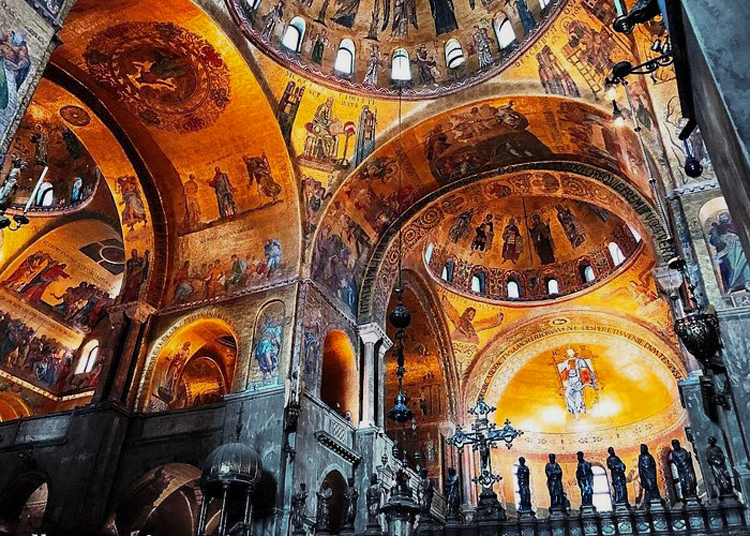
Venice gave Europe a way of hearing architecture. In San Marco, sound entered a building already prepared to answer it. Galleries, choir lofts, vaults, stone chambers, and pools of resonant air shaped the musical act from within. The basilica became an acoustic intelligence. A note sung there acquired distance, origin, and destiny; it seemed to travel through a sacred geography before arriving at the ear. The reverberation of the empty modern church approaches seven seconds, and even after the textiles and bodies of a full congregation are accounted for, a sound released into that space communed with the air more than it crossed it. The composer learned, by long discipline, to write toward this answering body of air, knowing that what he committed to the parts would be only half-sounded by his musicians and completed by the building. The score is half the work. The other half is the basilica.
This helps explain the special dignity of brass in the Venetian imagination. The sackbut and cornetto, and later the trombone choir of the mid-seventeenth century, possessed an unusual freedom of character. At times they entered the common sonority so completely that their presence was felt as weight, warmth, and solemnity rather than as display; their grandeur lay in their disappearance, in the way they thickened a chord by becoming continuous with it, the way a buttress is felt in the stability of a wall it does not appear to be supporting. At other moments they stepped forward with the gravity of persons, assuming the role of herald, witness, mourner, or angelic intelligence, and the same instruments that had been masonry a moment before now spoke as agents, as though the building itself had begun to address its inhabitants. Venetian sacred music gradually discovered how to move between these conditions without breaking the unity of worship. That discovery, more than any single device of polychoral writing or any innovation in instrumental specification, is the deepest gift of Venice to the European ear.
It is worth pausing on the political situation in which this sacral confidence was achieved, because the obvious reading is the wrong one. One imagines that a music of such ceremonial assurance must have issued from an expanding empire, the soundtrack of conquering galleys and merchant fleets. The opposite is closer to the truth. By the time Giovanni Gabrieli was composing for San Marco, Venice had already entered the long evening of her commercial dominance. The Atlantic trade routes, opened by the Portuguese and exploited by the Spanish, English, and Dutch, had drawn the world’s commerce away from the Mediterranean. The defeat of the Ottoman fleet at Lepanto in 1571, in which Venetian ships and Venetian galleasses had supplied the heart of the Christian line, was won in the same year that Venice lost Cyprus, and the victory itself was strategically less decisive than the smoke of burning Turkish galleys at the time suggested. Within six months of the battle the Sultan had launched a rebuilt fleet of some two hundred and fifty ships, larger than the one destroyed at Lepanto, presenting a graver threat to the Republic than before the supposed Christian triumph. Cervantes might call Lepanto the greatest day’s work of centuries, but Venetian admirals understood what they had won and what they had not. By 1597, when the first Sacrae Symphoniae appeared, the state was already living on the inherited capital of an age that was ending.
The deeper crisis, however, was ecclesial rather than commercial. In the spring of 1606 Pope Paul V placed the Republic under interdict, excommunicating the Doge and the Senate and forbidding the clergy throughout Venetian territory to perform their offices, after the Republic refused to surrender two priests to ecclesiastical jurisdiction and refused to repeal civil restrictions on the alienation of property to the Church. Counselled by the Servite friar Paolo Sarpi, the Senate defied the interdict. The Venetian clergy, with the conspicuous exception of the Jesuits (who were expelled), continued to celebrate the Mass and the Divine Office throughout the year of the interdict. The crisis was settled in April 1607 by a French-brokered compromise that salvaged papal dignity but conceded the substance of the Venetian position, and Sarpi himself was stabbed in a Roman-suspected assassination attempt that October. The Catholic world had watched its most ostentatiously devout republic continue to sing the liturgy under the formal censure of the Holy See. The faith of Venice was not in question; the question was who had jurisdiction over its expression.
What makes the music of this period extraordinary is that it sounds nothing like the sound of crisis. The sacral confidence audible in Gabrieli, and continuing through Rigatti and Cavalli into the years after the catastrophe of the 1630–31 plague, was the confidence of a state whose temporal power was waning, whose population was being scythed, and whose ecclesial obedience had been publicly contested, yet whose conviction of the holiness of its own worship had grown, if anything, more emphatic. The cori spezzati of San Marco gave voice to a particular form of Catholic political consciousness: that the local church, in the splendor of its sung liturgy, was itself a sufficient witness, neither dependent upon the favor of Rome nor identical with the fortunes of the Republic. The brass that step forward in the basilica herald no conquest. They proclaim a sacred order that the Republic understood itself to be conserving against time, against contraction, against the wider unraveling of Mediterranean Catholic power. Whether the composers themselves grasped this fully I would not venture to say. But there is, beneath the manifest ceremonial confidence of their scores, the perceptible undertone of defiance and valediction, the gestures of men maintaining a rite of magnificence in a city they sensed, half-knowingly, to be passing.
A skeptic will object that ceremonial confidence was the native register of Counter-Reformation worship, audible in Rome and Madrid and Vienna no less than in Venice, and that it owed nothing to any particular civic fortune. The objection has force, and the confident idiom was indeed common property. What distinguishes the Venetian case is where that confidence is pointed. Roman magnificence sang from the center of a Church that had survived its northern losses, and Habsburg splendor accompanied a power still expanding; Venetian magnificence grew more emphatic as the temporal grounds for it fell away, in the very decades when the trade was lost, the fleet outbuilt, the obedience to Rome publicly broken, and the lazarettos filled. The confidence one hears elsewhere as the natural voice of strength is heard here as something rarer, a confidence held against the evidence and lodged in the one possession the Republic would not concede to be failing, the holiness of its own rite. That is the Venetian difference, and it is why the same sumptuous idiom can mean something other on the lagoon than it means on the Tiber.
The Rigatti and Cavalli movements are framed by a particular kind of trial, the plague that struck Venice in the summer of 1630 and persisted into 1631. The disease, brought by Mantuan soldiers fleeing the campaigns of the Thirty Years’ War, killed nearly a third of the city’s population, some 46,000 of its roughly 140,000 inhabitants. On October 22, 1630, with deaths in the thousands each month, Doge Nicolò Contarini stood before the Senate in San Marco and vowed that, should the Virgin spare the city, the Republic would raise to her a great church under the title of Salute, of health, of salvation. The cornerstone of Longhena’s basilica was laid on March 25, 1631, the Feast of the Annunciation, deliberately invoking the typology of salvation begun in Mary. The Doge did not live to see the disease abate. He died of plague in April 1631, months before the contagion finally lifted. It is in the decade following these events that Rigatti composed his Messa e Salmi, and Cavalli his Messa Concertata came a quarter-century after, while the Republic was again losing a long war in the eastern Mediterranean, the War of Candia, in which Venice would, over twenty-four years, lose Crete to the same Ottoman power.
Rigatti’s Dixit Dominus, from the Messa e Salmi of 1640, shows the first condition of brass with great refinement. In Paul McCreesh’s recording with the Gabrieli Consort and Players, the brass seem absorbed into the living fabric of the work. Voices, strings, brass, and continuo share one ceremonial bloodstream. The brass answer, steady, darken, and enrich. One can attend to a verse closely and lose track of which instruments are sounding; the cornetti shadow the upper voices in long ceremonial lines, the trombones sit beneath the tenors and basses with a fused, almost organlike body, and the moments at which one consciously hears a brass tone are isolated thresholds, a held note slightly more burnished than what surrounds it, a cadence given a final weight that the voices alone could not have summoned. The effect resembles light entering stained glass. The ray loses its separateness and gains splendor through surrender. Rigatti’s brass direct attention toward the completed body of sound. Their office is almost sacramental. They vanish so that the whole may appear. Composed within a decade of the plague, in a city that had buried a third of itself, this is music of recovered ceremony, of the corporate confidence of worship rebuilt over open graves.
Cavalli offers a more intimate mystery, and one that the score itself rewards close reading. In the Qui tollis peccata mundi of the Messa Concertata (1656), the structure of the gesture is more pointed than my first telling allowed. The chorus has been speaking the title of Christ, filius, filius, filius Patris, in three rising entries that climb toward a fermata at Patris. There the voices halt. The texture goes silent at a held breath, and into the silence comes the threshold gesture: three trombones, separately marked in the score for Alto II, Tenore II, and Basso II, enter together, while the strings simultaneously begin what Cavalli labels Sinfonia. What enters is the audible act of intercession, fitted into the moment after the Son has been named and before the petition for mercy can be made.
What follows in the bass line is, to my hearing, the load-bearing detail of the whole movement. The figured bass moves in an unbroken chain of suspensions, 6/5 over 4/3, again 6/5 over 4/3, then 7/6, then a tightening 3/4/3, each dissonance prepared and resolved, each weight assumed and laid down. This is the harmonic emblem of peccata being absorbed: the strings and trombones do more than escort the words; they enact what the words name. The trombones rise from below, in close imitation with the strings; the violins cast a brighter surface above; and beneath them the continuo carries the burden of suspension after suspension, the very rhetorical figure that Renaissance theorists had long associated with sorrow and supplication, now made the engine of release. The ear receives the ascent as relief because the harmony has paid for the relief, dissonance by dissonance, before the voices return.
And the voices, when they do return at measure 379, enter underneath the Sinfonia without interrupting it. Qui tollis peccata mundi, miserere nobis, the petition is sung now into a texture already prepared to receive it, antiphonally distributed between Alto I, Tenore I, Basso I, and only afterward the Canto I, so that the soprano line is held back as a kind of last word. The brass have made the air in which the prayer becomes audible.
Then comes the figure that gives the movement its architectural character. At measure 402 the Sinfonia returns. The same strings, the same trombones, the same shape of ascent, with the bass restating its chain of suspensions, and the chorus, after this second arrival of the instrumental rite, begins the Qui tollis a second time. The ascent has become a sign, and the return gives it the character of a load-bearing arch: the brass-and-string sinfonia is now revealed as a recurring member of the structure, supporting the second utterance of the petition as it had prepared the first. One hears the figure first as motion, then as memory, then as a kind of vault. The old Greek word anabasis comes naturally to mind, a going upward, a passage toward height, but here it is an anabasis of grace, returned upon itself as a colonnade returns its arches. Each arch performs the same act, and the building is the act repeated. The text has named the burden, and the instruments perform its removal twice over, because the rite of removal is what the music is for.
That this is Cavalli’s deliberate art, and no happy accident of the part-writing, the score makes plain. The fermatas before each Sinfonia entrance are explicit thresholds, marked in every part. The trombones are named as trombones at their first entry, distinguished from the cornetti that had carried the upper voices. The Sinfonia label is given only at the two points of brass-string ascent, and at no other. Cavalli has built into the score the very thing the listener experiences in the basilica: a sacred geography of weight assumed, weight lifted, weight assumed again, weight lifted again, until at last the chorus can begin the Suscipe and the mass moves on. That this rite of removal should be composed and performed in 1656, while Venetian galleys were fighting and losing in the Aegean and Cretan waters, and while the Republic was bleeding men and treasure into the Cretan defense, gives the Qui tollis a further weight. The burden the music names and removes is the peccata mundi of the abstract theological sense, and beyond it the burden of a particular Catholic polity that needed, in the basilica of its patron saint, to know that the act of intercession had been performed, regardless of what the morning’s dispatches from Candia might bring.
If Rigatti shows the brass as the sounding fabric of common worship, and Cavalli shows them as the instruments of intercession, then Gabrieli, whom I take last though he composed first, shows them as the consummation of the Venetian century and the threshold of what would come after. In ecclesiis, from the posthumous Symphoniae Sacrae of 1615, is the work in which the polychoral tradition of San Marco arrives at its summit and, at the same moment, sees its own ending. Andrea Gabrieli’s generation had imported the Netherlandish style and pressed it into the divided choirs of the basilica. Giovanni inherited that practice and, over the course of his career, transformed it utterly. By the time he came to compose the works gathered into the Symphoniae Sacrae of 1615, he had begun to write sections marked Sinfonia for instruments alone, to specify particular instruments for particular parts (a near-novel discipline in 1615), to write florid monodic lines for soloists accompanied only by continuo, and to organize whole works around recurring refrains in the manner that would, within a generation, become the rondo of the early Baroque cantata. In ecclesiis contains all of these. The Renaissance polychoral motet has been opened from within and is in the act of becoming something else.
The scoring tells the whole story at a glance: four soloists, four-part choir, three cornetts, two trombones, violin, and organ continuo, distributed among the multiple lofts and balconies of San Marco. Its structure is a rondo, A–B–C–B–Sinfonia–D–B–E–B–F–B, with the triple-time Alleluia refrain returning between the verses in different combinations of forces. Within this structure the brass live the full Venetian double life. In the Alleluia refrains they sit inside the chorus, doubling and warming, lending the great refrain its characteristic Venetian breadth; here they are masonry, indistinguishable in office from the choir they support. But at measure 31, after the soloists have presented the opening verses, Gabrieli writes a Sinfonia: the cornetts, trombones, and violin step forward and speak alone, in dotted-rhythm canzona figures, with a definiteness that has nothing of accompaniment about it. The basilica, which had been answering voices, now answers brass; the building, in effect, lets the instruments speak in its own register, and for the space of the Sinfonia the brass become persons.
The most extraordinary moment, however, is the vivifica nos passage at bars 85 to 95, where the soloists’ supplication Libera nos, vivifica nos, deliver us, give us life, is met by intricate ornamental writing in which the brass figures interleave with the solo voices in ways that earlier composers had reserved for voices alone. The cornetti, with their vocal flexibility, take florid lines as though they were singers; the trombones answer with the gravity of older men; the soloists are surrounded by, then absorbed into, then released from a society of instrumental presences. One does not hear an ensemble. One hears a gathered company, each member with a face. The Alleluia that returns afterward carries something more than refrain about it; it is a corporate response to an utterance that has been answered by the architecture and the instruments together.
When Heinrich Schütz arrived in Venice in 1609 to study with Gabrieli, he carried back to Saxony three years later something small in compass and immense in consequence, a handful of compositional habits and a particular ear for sounding space, from which the German Baroque was to grow. Through Schütz and his successors the line ran to Bach. Gabrieli died in August 1612, and the Symphoniae Sacrae of 1615 reached print after his death. The volume gathers, as if by providence, the last achievements of a century and the first sketches of the one to follow. Reading the score now, one has the sense of a great master taking leave of the Renaissance with his hand upraised in blessing, and pointing forward to a music his own ear would never hear. That the Symphoniae Sacrae of 1615 should appear in the very years after the Interdict, in the Venice that had just sung its way through papal censure, gives the volume a further character: a public testament that the city’s worship needed no permission to be magnificent, that the Alleluia would continue to be sung in its proper place, by its proper persons, in the basilica that had been built to hold it.
The Aristotelian and Thomistic tradition called aevum the mode of duration proper to the angels and to glorified souls, a middle kingdom between the unmoving eternity of God and the restless succession of earthly time, in which there is real before-and-after yet no perishing. This is the deepest Venetian discovery. Music can become a place. In the great works of this tradition, the listener ceases to follow a line and begins to inhabit an order. Sound arrives from height, distance, shadow, and stone. The clock continues in the piazza outside, among footsteps, merchants, bells, and water. Within the sounding architecture, time loosens. The listener enters something nearer to aevum. Sound passes, and yet for a moment it seems to dwell.
Table of Contents
Christopher S. Carson, J.D., M.A., is a practicing attorney of 34 years in Milwaukee, Wisconsin, and holds a masters degree in International Security Studies from Georgetown. Formerly with the American Enterprise Institute, his essays on sacred music, Thomistic aesthetics, and cultural criticism have also appeared in The Hedgehog Review, National Review, among others, along with two essays now accepted for publication in the Athenaeum Review.
Follow NER on Twitter @NERIconoclast