by Roger Watson (April 2026)
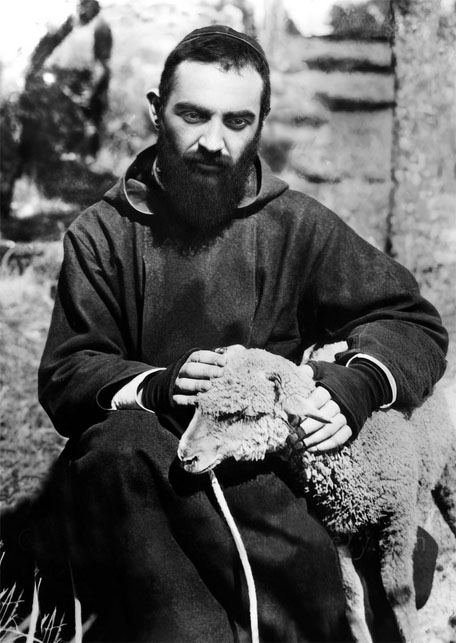
Many biographies and other books have been published about the remarkable phenomenon that was Padre Pio. Now canonised as St Pio of Pietrelcina, the Italian mountain village of his birth, Francesco Forgione was born of pious Catholic parents in 1887 who sacrificed much to support their son through his novitiate to become a Franciscan friar and priest. Pio died in 1968 and controversy continues to haunt his memory.
Several biographies are based on historical documents and Vatican archives. Several books have been written about the investigations he underwent as his reputation for holiness and, especially, his claim to bear the stigmatic marks of the crucifixion which were conducted at the behest of his detractors. Other books focus on specific miracles attributed to Pio and to testimonies, continuing to the present day, of his interventions on behalf of the sick and sinners.
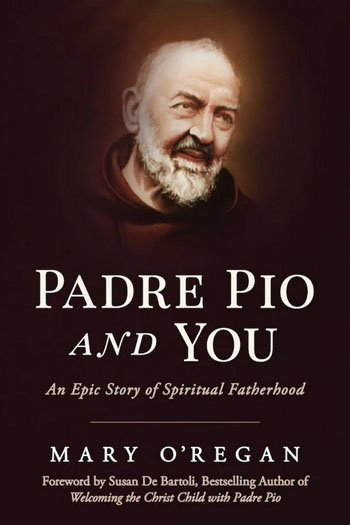
Mary O’Regan, a journalist who writes at The Path Less Taken, is the latest biographer. O’Regan, a traditional Catholic who writes a regular column in Mass of Ages, the organ of the Latin Mass Society, has authored Padre Pio and You: an Epic Story of Spiritual Fatherhood (2025, Sophia Institute Press, Manchester, NH). The book roughly follows a timeline related to the life of Padre Pio, but the story is told through the witness of many whose lives were transformed by meeting him.
The investigations undergone by Pio, which involved virtual imprisonment and restriction of his priesthood, are presented as persecutions and suffering which caused him great distress but which he also bore with obedience. The remarkable story of his vision for, construction, staffing and operation of a hospital next to his friary (which he never left) in San Giovanni Rotondo is also told.
Blood and Roses
 For those unfamiliar with Padre Pio, he was notable for two features: bearing the stigmata; and the odour of sanctity which, allegedly, accompanied him or was experienced by people who sensed his presence. Few Catholic religious have displayed the stigmata, and some have been exposed as frauds. But Pio bore them from an early age, they bled profusely, caused him considerable pain and, while never healing, they never became infected.
That Pio underwent surgery several times from which the wounds healed normally, leaving scars, suggests he did not have a disorder that prevented healing. The stigmata, which were medically examined at the behest of the Vatican several times, began to heal as he approached death and were healed without trace at the point of his death.
The odour of sanctity, sometimes described as the smell of roses, was frequently reported both by people in his physical presence and by those to whom he apparently bilocated. Pio was often encountered in locations far from San Giovanni Rotondo and in extraordinary circumstances. For example, people reported having him hear their Confession in churches that were nowhere near his friary. Others had visits from him where lucid and prolonged conversations were held only for him to disappear.
Stopping the Bombers
The most remarkable bilocation was reported by United States airmen during the Second World War when Italy, as part of the Axis with Nazi Germany, was being bombed. On several occasions bomber pilots, with no prior knowledge of Pio, saw him in the air above San Giovanni Rotondo. As a result, they did not bomb the mountain village or priory. Padre Pio had, seemingly, protected the place.
Some of these pilots made their way to San Giovanni Rotondo to investigate and meet the friar, confirming that it was the same person they had seen in the clouds. Some converted to the Catholic faith; others returned to it. Some of these pilots spread, in the United States, the news about what was happening at San Giovanni Rotondo and the remarkable friar they had met there.
Padre Pio, already a celebrity (a description he would have hated) in Italy, began to develop international celebrity and to accumulate devotees from many countries. People came to catch sight of him and to hear him say Mass. But the main reason people came was to have him hear their Confession. Padre Pio was able to tell if people were being truthful in Confession and often reminded people of things they had forgotten.
Reading Souls
Frequently, people had no sooner knelt in front of him than he would recount their sins to them, often telling them things that he could not possibly have known about without some supernatural assistance. Such stories were, and continue to be, recounted by thousands of penitents. The sheer volume of incidents makes it hard not to believe that Padre Pio had a special gift of being able to read people’s souls.
Pio often heard hundreds of Confessions daily, thousands weekly and, in his lifetime, may have heard millions. People queued for days to confess to him. Some were sent away without absolution if he considered them unrepentant.
Naturally Pio’s growing reputation and the claims surrounding him of miracle cures and conversions did not sit easily among some of the local episcopate. Complaints of financial irregularities surrounding the funding of the hospital ensued. Pio underwent two major persecutions, one under Pius XI and another under Pope John XXIII, the pope who initiated the Second Vatican Council, which many traditionalists believe damaged the Church.
Pio had been greatly loved by Pope Pius XII who had convinced his predecessor Pius XI to release him from his first term of virtual imprisonment and restrictions to his priesthood. Pius XII admired the work Pio was doing to build the hospital (never referred to as such by Pio who always referred to it as the ‘Casa’) next to the friary. But inevitably Pius XII died and Pio’s fortunes changed again.
Persecution and Vindication
Pope John XXIII (recently canonised by the late and very liberal Pope Francis) was not one of Pio’s fans. A second period of persecution ensued, this time with lurid claims about inappropriate behaviour towards women, including sexual relations, being made. Pio’s cell was bugged and recordings were presented in evidence against him that kissing sounds could be heard indicating that he was kissing the women who came to seek his blessing.
The sounds were, almost certainly, kissing. But Pio’s devotees often kissed his stigmatised hands. The fact that the women were only permitted to speak to him there through an iron grill and a wall that was several feet thick, which would have precluded Pio and the women from kissing, was largely ignored.
Thankfully for Pio, Pope John XXIII’s successor, Pope Paul VI, was more positively disposed towards him. The persecution stopped and his detractors were shown to have made false accusations, obtained evidence by nefarious means and to have been motivated by jealousy. It is notable that Pope Paul VI ended the damaging proceedings of the Second Vatican Council and, it is alleged, that he may have been prompted to by a letter from Padre Pio.
Padre Pio suffered for most of his life. He had poor health and various afflictions in addition to the stigmata. Towards the end of his life his health deteriorated markedly, he was in almost continual pain and often expressed the wish to die. Mostly, he bore his trials with fortitude, but he was only human and, at times, became depressed and seemingly despaired.
The Difficult Saint
It is not easy to summarise the character of Padre Pio. As indicated above, he could be seemingly severe towards penitents. It is very rare for a priest to withhold absolution to someone in Confession, unless they wilfully refuse to express sorrow for a mortal sin. But Pio was renowned for this practice, even dismissing some penitents as soon as they had entered the confessional where he was often heard to shout and lose his temper.
Naturally, some felt harshly treated and left angry and disappointed. Naturally, also, Pio received criticism from fellow friars who thought he may be putting souls at risk. But Pio never wavered or apologised for his actions. Moreover, a remarkable number of these penitents returned to confess to Pio and received absolution. We only know these stories because the penitents themselves reported them; Pio being bound by the seal of the confessional not to divulge what people confessed.
He could be severe with his fellow friars if he considered them to be compromising in any way with their calling or if they, or visiting religious and clergy, displayed any kind of arrogance or vanity. There must have been times when he was an uncomfortable companion.
Pio loved his parents, but he was known to admonish them occasionally. He claimed to see the destination of the souls of the dead and, while he confirmed that his father had gone directly to heaven, he claimed that his mother had spent time in purgatory.
A particular cause for concern to Pio was the case of his sister Grazia who had taken the name Sister Pia and become a nun in the Bridgettine Order. However, some of the reforms in the wake of the Second Vatican Council led to many nuns leaving their orders and, for those who remained, the adoption of everyday clothes and discarding the habit.
Unhappy with the liberal changes introduced in the early 1960s, Pia left the Bridgettine Order. This was a point of division between the two siblings for the rest of Pio’s life. He could not reconcile himself to Pia leaving her order and insisted that she would, despite the unwelcome changes, be better returning. She never did.
However, Pio also had a sense of humour and could play pranks on his fellow friars. A favourite trick was to hide in the long dark corridors of the friary and make ghostly sounds when young novices came along. He also had a prank played on him towards the end of his life. Told that his order had to discard their habits and adopt jeans and t-shirts, one of his fellow friars came to his cell claiming that he had to be measured for a pair of jeans. Whether Pio saw the funny side of this incident is not reported.
Once established in the friary at San Giovanni Rotondo, Pio never left. There were attempts by superiors to have him moved and isolated from his flock. But the local flock would not tolerate Pio’s removal from their midst, threatening violence and marching on the friary more than once. Some local women even tried to kidnap him to prevent his removal.
A Shrine that Still Draws Thousands
In death, he stayed in San Giovanni, and his remains are moved, with great ceremony, between his tomb in the friary and a local church further down the mountain which is more accessible for older and infirmed pilgrims. The friary is worth visiting if only to see the stacks of letters, all filed and all replied to, that Pio received daily.
Many blood stained bandages, maintained as secondary relics, are also displayed in the museum at the friary. Thousands of pilgrims continue to visit annually and his great vision, the Casa, continues to function.
Despite the persecutions and suffering, Padre Pio’s faith never wavered. He continued to hear Confessions and to offer Mass almost to the point of death. His intercession, seemingly so effective on behalf of others, was never exercised on his own behalf. He claimed never to have prayed for his own needs, only those of others.
Mary O’Regan’s book is a valuable and readable addition to the Padre Pio canon. The biographical aspects are, in some chapters, accompanied by reflections and suggestions regarding prayer and devotion to Padre Pio. The book would have been just as readable without these which, perhaps, could have been gathered into a single chapter or presented more consistently throughout the book. The occasional typographical error remains in a few chapters.
It is almost impossible, from a platform of belief, to imagine reading Padre Pio and You and being less devoted to one of our most significant modern saints. Perhaps some will read and be nudged towards faith. Padre Pio always said that most of his work would be done after his death.
–
Table of Contents
Roger Watson is a British academic and Honorary Professor at the University of Hull, Professor of Nursing at Saint Francis University, Hong Kong, the editor-in-chief of Nurse Education in Practice, and an Editorial Board Member of the WikiJournal of Medicine. Roger was also the Founding Chair of the Lancet Commission on Nursing and a founding member of the Global Advisory Group for the Future of Nursing.