by Pedro Blas González (November 2025)
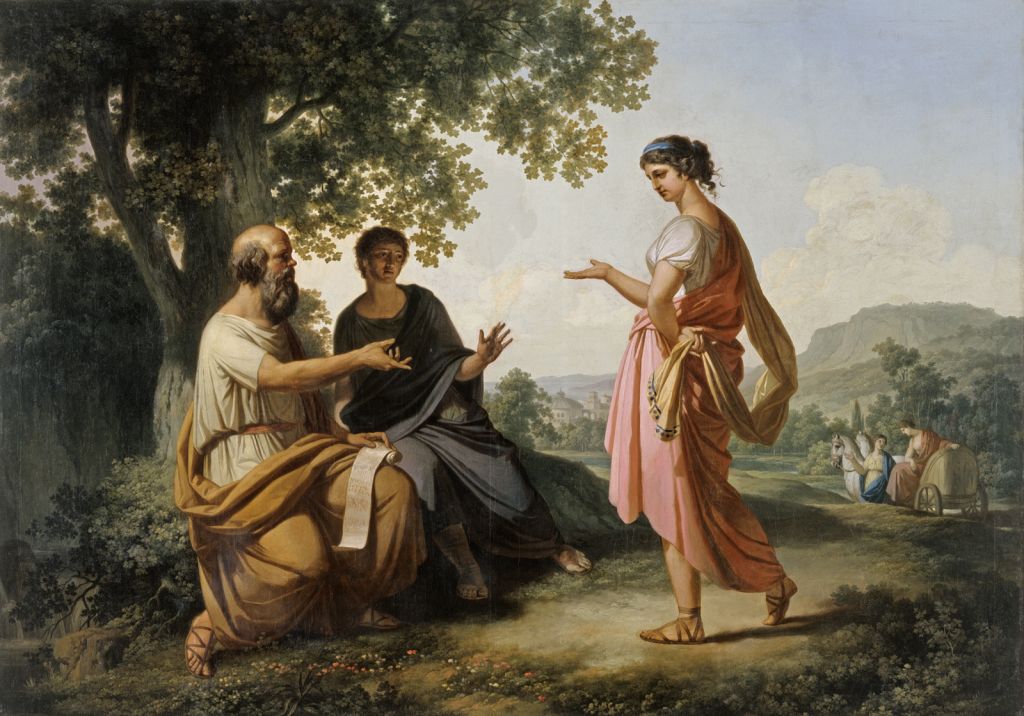
And once a thing is put in writing, the composition, whatever it may be, drifts all over the place, getting into the hands not only of those who understand it, but equally of those who have no business with it; it doesn’t know how to address the right people, and not address the wrong. And when it is ill-treated and unfairly abused it always needs its parent to come to its help, being unable to defend or help itself. —Plato, Phaedrus
In the second half of Plato’s dialogue Phaedrus the venerable ancient Greek philosopher tantalizes readers with questions about the nature of writing and thought in relation to knowledge and wisdom.
The problem, as Plato conceives it, is that writing is inferior to pure thought and knowledge. Plato is instead concerned with lived-knowledge that informs the lived-experience, not a writer’s capacity to transmit knowledge to others through writing that can fall into the wrong hands and become rhetoric that ultimately works against wisdom. This is especially troublesome when rhetoric is recorded as relative truth that taints and conditions vacuous and unfounded opinions, not truth. This contention sets up one of Plato’s many paradoxes: in order to understand the universal impact of this masterful philosopher, one must read him.
The greater concern for Plato is what can be called the irony of writing and reading. Plato argues that writing and ‘manuals of rhetoric’ make people forget the past and the permanent things—the essences that inform existence and human reality. What is the alternative, you may ask? The alternative is the hard road to knowledge, the road less travelled: the oral tradition that helps to strengthen memory.
We cannot read Plato and appropriate the sheer brilliant insights of this ancient Greek philosopher without testing out what he has written by comparing it with our own time, circa 2025.
While remaining outside the purview of this essay, we can say with certainty that Plato’s perspicuity and insight into human nature and reality does not suffer fools. Plato’s understands people, the human condition, the sensual passage of time, and man’s nature as a spiritual being, a soul that is trapped in a physical, sensual reality that blinds people, making them confuse reality with appearance; he paints a picture of wasted time and human life as a tragedy of mostly cave-dwelling sophomoric children.
Plato reserves his strongest and most convincing arguments for self-contradicting, though effective and crafty philosophical materialists—the sophists of his age. These are the same people who call Plato’s perspicuous and ingenious discovery of form (εἶδος) abstract. Today sophists embrace the guise of lazy and contradictory philosophical materialism; positivists who must find it in themselves to criticize Plato’s essentialism and quest to uncover the standards that objective truth provide for a well-grounded human existence. The latter is Plato’s discovery of form.
Plato is a prophetic philosopher on many counts. Proponents of Plato’s thought are discerning and diligent readers who find it necessary—though, difficult at best—to isolate the hard-hitting spectrum of Plato’s thought, and what his thought means for our own culturally illiterate and morally/spiritually gutted age.
In an age of seemingly infinite printing of books and reading material, an abundance of libraries and bookstores, and community ‘bookmobiles,’ we have fewer readers today than in any previous literate age. Why is that? In an age of technological innovation, an age that prides itself in the chic zeal of progress, the purveyors of chic zombification, have delivered man into a technological dark age of the soul.
Irony abounds in late postmodernity, doesn’t it?
We can best characterize late postmodernism, as Ortega y Gasset predicted in his seminal 1930 work The Revolt of the Masses, by what mass man doesn’t know. That is, by mass man’s prideful ignorance, rather than by what they do know. The prophetic Plato tantalizes late postmodern man with time-immemorial questions and human concerns that have proven to have a stranglehold on late postmodernity.
Plato floods us with metaphysical/existential and moral questions—concerns and problems of perennial philosophy. These are concerns worth having.
Disclaimer: A warning to critics of Plato, people who have not bothered to read his works and whose attention span prohibits them from cultivating and engaging in philosophical self-reflection that addresses Plato’s timeless, pressing concerns; the concerns about writing and reading and the acquisition of knowledge that Plato presents readers with in Phaedrus, have all been answered, subsequent to his death in 347 B.C.
J.R.R. Tolkien: The Silmarillion
Tolkien is the rare kind of writer who has a following of loyal readers. Generally, his readers are knowledgeable and pay close attention to detail in his literary work, given that there are vast and challenging details to consider in Tolkien’s complete works. Also true, the people who write about Tolkien’s work are for the most part accurate in their comprehension of his work.
However, one glaring aspect of Tolkien’s thought and fiction that escapes Tolkien’s readers and many of the people who write about him is the profound grounding that Tolkien’s work has, especially in The Silmarillion, which is the intellectual cornerstone of his fiction, in Plato’s discover of form and Milton’s ‘war in heaven’ in Paradise Lost.
Tolkien’s reputation as a writer rests with The Hobbit and The Lord of the Rings. Unlike stand-alone-books that can be read as singular literary works of fiction, Tolkien’s literary oeuvre is a spider web that links all the elements of his fiction together, while expanding the vision and scope of his literary creation.
The Silmarillion is the center of this spider web. The Silmarillion is Tolkien’s beast of burden, the intellectual and creative workhorse that, in retrospect, leaps way beyond The Hobbit and the three books that comprise The Lord of the Rings.
We must keep in mind that while The Silmarillion was published after Tolkien’s other works, the book was conceived by Tolkien dating back to WWI. The Silmarillion is the superstructure and intellectual scaffolding of the legendarium, Tolkien’s mythopoetic body of work that serves as the foundation for the fictional world he created.
Discernible and careful readers of Tolkien will find many parallels between The Silmarillion and Milton’s Paradise Lost, for Tolkien’s fiction, especially his depiction of the First Age of the world, draws from immemorial classical works of literature. No stranger to the complexity and beauty of classical literature, Tolkien’s The Silmarillion is an ambitious book that re-works the Christian creation story for a secular age. That is a masterstroke of genius that caught his secular critics off guard; an aspect of his fiction that is readily understood today by well-informed readers.
The Silmarillion is an exquisite book. Literate and replete with Platonic and Christian allusions. The Silmarillion is a five-part storehouse of wisdom that, in certain respects, pays homage to the greatest wisdom literature of the Western Canon.
Granted, great literature and books of philosophy require care, dedicated and sustained cultivation. The books that comprise the Western Canon require that readers make a concerted effort to comprehend them, to seek nourishment in them. They also necessitate that readers have a strong grasp of the Catholic foundation of Christianity.
Unlike the superficial and formulaic bestsellers of the last fifty years or so, Tolkien’s books offer readers lifelong and life-giving redemptive value.
The Silmarillion and the ‘War in Heaven’
Part one of The Silmarillion, “Ainulindalë: The Music of the Ainur” and part two, “Valaquenta: Account of the Valar and Maiar According to the Lore of the Eldar,” display many parallels to Milton’s Paradise Lost.
Milton’s depiction of the war in heaven and Tolkien’s creation story are evident to careful readers of Tolkien’s works. These two works have much in common: the creation of the world, the initial corruption of beauty and light by an evil force that cannot bear to witness the flourishing of the light and beauty of creation, rebellion against the creator, and the temporal destruction of the creator’s spiritual beings: man. There are several other themes that unite both works.
Plato and Tolkien: Essence, Form (εἶδος) and Memory
The Silmarillion was published in 1977, four years after Tolkien’s death. The work tells the story of the First Age of the world, a primordial time before the age of The Lord of the Rings. The First Age is Tolkien’s depiction of a primordial time before the creation of the world. What would any creation story be without a depiction of a first age when the world was in its infancy?
In part one, “Ainulindalë,” Tolkien introduces Eru, the One (God), who is called Ilúvatar in Arda (Earth). Eru made ‘first the Ainur, the Holy Ones, that were offspring of his thought, and they were with him before aught else was made.” The angelic beings that Tolkien’s calls the ‘Ainur’ were spiritual beings, helpers of Eru (God). Eru is Oneness. We encounter the idea of Oneness (monism) in Pythagoras, Parmenides, Socrates, Plato and Aristotle in ancient Greek philosophy. God as Oneness is the essence of Christianity. Eru is responsible for creating heavenly (angelic) beings. This makes Eru a monistic God.
While the five parts of The Silmarillion are the foundation of Tolkien’s other works of fiction, the first two chapters offer Tolkien’s readers a significant and profound metaphysical foundation for God, the creation of the world, angelic beings, and good and evil. Most importantly, Tolkien shows readers why his metaphysical scaffolding is essential to his fiction.
A significant aspect of Eru, the One, in The Silmarillion is the creation of ‘heavenly music that fills the Void’ and “the Deeps of Time and in the midst of the innumerable stars”: “And a sound arose of endless interchanging melodies woven in harmony that passed beyond hearing into the depths and into the heights, and the places of the dwelling of Ilúvatar were filled to overflowing, and the music and the echo of the music went out into the Void, and it was not void.”
The harmonious and melodious music that Eru creates is equivalent to the Word in the Bible. In Platonic terms, Word λόγος (logos), means the order of things.
The narrator of The Silmarillion goes on to mention the foundation of Being: “Then the themes of Ilúvatar shall be played aright, and take Being in the moment of their utterance…and Ilúvatar shall give to their thoughts the secret fire, being well pleased.”
This brings us to the importance of Tolkien’s music of the Ainur to Plato’s distrust of writing in relation to knowledge. The implication in the early chapters of The Silmarillion is that eventually, in the created world (Arda), the Children of Ilúvatar to come (man), the music of the Ainur will be the source of innate and intuitive understanding. Little would be needed for man to understand the ‘thought’ and role that Eru has devised for man. Man’s implicit and intuitive understanding goes awry when Melkor (evil), Eru’s chief Ainur who is later named Morgoth, and becomes the greatest antagonist to Earth (Arda), undercuts Eru’s plan for the Children of Ilúvatar to have a peaceful and spiritual existence. This brings about the ‘fall’ of the Children of Ilúvatar. Melkor’s plan for man’s downfall entails forgetfulness.
Melkor’s destruction of Eru’s conception and execution of a spiritual realm, where man’s temperament can decipher good from evil and right from wrong, becomes a world where knowledge is only begotten through writing, positive law, and instruction, not intuitive understanding. In effect, through debilitating cyclical history, not through an intuitive grasp of the Good, as Plato contends.
The hierarchy of Being, as Plato argues that form is the manifestation of God’s intelligence, can be apprehended by degrees, depending on the capacity of respective souls for self-knowledge and the order of creation. Plato argues that the human soul comes in many variations. For instance, understanding of truth depends on the type of speech that each kind of soul can decipher.
Socrates tells us that sophists, like Thrasymachus, corrupt the soul by corrupting speech:
–
Since the function of oratory is in fact to influence
men’s souls, the intending orator must know what types
of soul there are. Now these are of a determinate number,
and their variety results in a variety of individuals. To the types
of soul thus discriminated there corresponds a determinate
number of types of discourse. Hence a certain type of hearer
will be easy to persuade by a certain type of speech to take
such and such action for such and such reason, while another
type will be hard to persuade.
–
We must take seriously the implications of Plato’s contention that writing can empower and embolden the rhetoric of sophists. Plato argues that these are people who, knowing the truth, will manipulate it for their own good. This realization is a devastating indictment of human history and the world, for the best intentions, virtue, and goodness of wise, knowledgeable, and virtuous people can and will be manipulated for evil purposes by highly intelligent entities like Lucifer in Milton’s Paradise Lost and Melkor in The Lord of the Rings. Plato is concerned that rhetoric in writing, not wisdom, eventually finds its way into the hands of hapless future generations that cannot decipher good from evil and right from wrong, having been confused by twisted writing.
What is the alternative, some people will ask? The alternative is remembrance (anamnesis). But who will remember anything of substance when man’s soul becomes ruled and corrupted by earthly, sensual forgetfulness?
Table of Contents
Pedro Blas González is Professor of Philosophy in Florida. He earned his doctoral degree in Philosophy at DePaul University in 1995. Dr. González has published extensively on leading Spanish philosophers, such as Ortega y Gasset and Unamuno. His books have included Unamuno: A Lyrical Essay, Ortega’s ‘Revolt of the Masses’ and the Triumph of the New Man, Fragments: Essays in Subjectivity, Individuality and Autonomy and Human Existence as Radical Reality: Ortega’s Philosophy of Subjectivity. He also published a translation and introduction of José Ortega y Gasset’s last work to appear in English, “Medio siglo de Filosofia” (1951) in Philosophy Today Vol. 42 Issue 2 (Summer 1998). His most recent book is Philosophical Perspective on Cinema.
Follow NER on Twitter @NERIconoclast