by Jack Watson (May 2026)
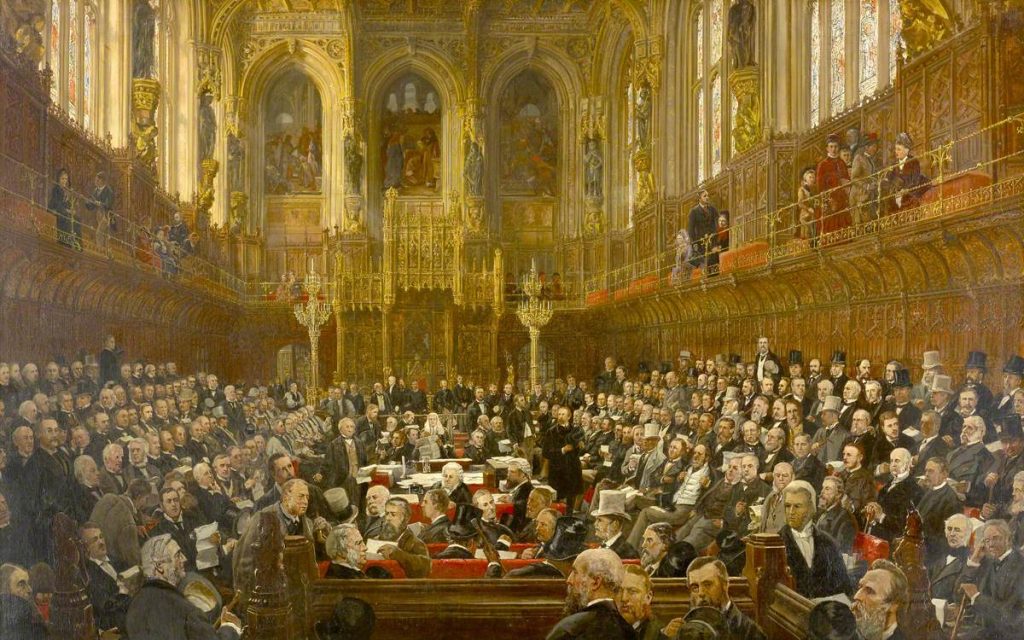
Canadian singer-songwriter Joni Mitchell, in her most famous anthem Big Yellow Taxi, sang that ‘you don’t know what you’ve got ‘til it’s gone.’ These words could soon become poignant for the people of the United Kingdom where a long-established part of our political tradition is on the verge of being rendered unrecognizable.
I am referring to the second chamber of the British Parliament, the House of Lords, which, while it has undergone significant reform over the decades, remains unelected and retains some hereditary peers. Both these principles are under threat, and it is worth considering what the United Kingdom will lose if both the hereditary principle and the unelected nature of our upper house are abolished.
The Long Evolution of the Lords
The United Kingdom, where the first elected chamber is the House of Commons, is not unique in having a second chamber. They exist in the United States, Australia and Malaysia, possibly as a reflection of the British political system. Thailand also has a second political chamber. However, unlike those systems and systems across Europe, the House of Lords is unique among democracies in not being elected.
The House of Lords has a hereditary element. Lesotho permits hereditary tribal chiefs to sit in its second chamber. Until 2013, Belgium had hereditary Senators by Right sitting in its second chamber.
The House of Lords has been a trademark of British politics since the 13th–14th centuries. The Lords began with Anglo-Saxon councils and Norman councils, evolving from sovereign-led meetings of church leaders. The reign of Edward III saw Parliament develop into a bicameral system, with two chambers. The Lords originally consisted mostly of hereditary nobles, bishops and abbots. In the 17th century, during the Civil War, it was abolished by Parliament in 1649 but was restored in 1660 following the return of Charles II.
The Acts of Union in 1707 with Scotland and in 1800 with Ireland introduced appointed representative peers from different parts of the UK, creating a united British Parliament. They focused on creating law from 1876, until major modern modifications significantly reduced their powers. The 1911 Parliament Act removed the Lords’ power to block money bills entirely and reduced their power to delay other bills to two years. This was further limited to 12 months under the 1949 Parliament Act.
Hereditary peers, holding noble titles passed down through generations, constituted the majority of the House of Lords for over 700 years. The peerages emerged, with titles such as Earl and Viscount passing to descendants, to ensure military support for the monarch in the 13th Century. They maintained an automatic right to sit and vote in the chamber.
The Life Peerages Act of 1958 introduced non-hereditary life peers, reducing the reliance on inherited seats. Before the House of Lords Act in 1999, which was introduced under Tony Blair, around 600 hereditary peers were in the House of Lords; there are only 92 left now.
As presently constituted, there are four types of Lords. The Lords Temporal include the remaining hereditary peers, the appointed peers and the Law Lords who sit by virtue of their membership of the Supreme Court. The Lords Spiritual include specific Anglican Bishops and Archbishops whose seats qualify them for membership. Politically, at the time of writing, there are 278 Conservative peers, 225 Labour peers, 76 Liberal Democrat peers, 177 crossbenchers, and 46 non-affiliated peers in the second chamber.
The Assault on the Upper Chamber
The House of Lords now acts as an independent, largely appointed second chamber, acting as an effective revising body. The presence of hereditary peers is a strength here as their experiences and expert knowledge of politics enhances scrutiny.
Hereditary peers are to be removed from the House of Lords after the Conservative group in the Lords agreed not to oppose the House of Lords (Hereditary Peers) Bill in return for the Government granting 15 life peerages to departing hereditaries. This plan by Labour is the first step towards a complete reform of the Lords. Their next plans include introducing a mandatory retirement age of 80, improving regional representation, and potentially replacing the chamber entirely, though the immediate focus is on modernization.
The Labour Party, currently in power, claim they want to improve democracy within the Lords; however, this seems to be the first step towards dismantling the Lords and replacing it with a very different kind of chamber. Ultimately, the House of Lords, known for the respect shown to each other by members and for the polite conduct of debates, risks becoming another House of Commons, a place renowned for robust debate and the regular exchange of insults.
As presently constituted, Conservatives hold the most hereditary peers (44), which is the real reason Labour wants to remove them. It would reduce the number of Conservative peers in the chamber, making it easier for a Labour Government to pass its legislation. Labour argues that a built-in conservative majority is undemocratic. The Labour government also states it is committed to removing the remaining hereditary peerages on principle, as it believes ‘nobody should sit in the House by virtue of an inherited title’. This is the social justice argument for equality and against ‘privilege’. The Government has also pressed the Conservatives to encourage some retirements from among their life peers.
The Politics Behind the Principle
Whilst hereditary peers are criticised for being unelected, elitist and archaic, they play an important role in parliamentary scrutiny. They are experienced and experts in a variety of areas and are valued for bringing historical constitutional knowledge. Hereditary peers have this advantage over life peers because they have inherited knowledge passed down through generations. Hereditary peers have also served an average of 21 years in the chamber, compared with an average of 14 years for appointed life peers. The average age of hereditary peers is approximately 69 to 70 years-old, meaning many have witnessed 16 different Prime Ministers. They provide specialist and specific knowledge, helping the House of Lords fulfil its purpose of being a revising chamber for bills created by the House of Commons. An elected and reformed chamber means that much of this expertise will ultimately be lost to British politics.
Hereditary peers are criticised for being inactive. However, evidence suggests otherwise. There were 632 divisions (votes) in the House of Lords during the 2019–2024 parliament. Of hereditary peers, fifty-one per cent participated in approximately half of the divisions in which they were eligible to vote, whilst 49% of life peers voted. Of hereditary peers, 48% also contribute to speaking in the chamber, which is the second highest out of the four types of peers. In addition, 57 out of the 89 current hereditary peers (64%) were members of at least one committee. Therefore, hereditary peers can be credited for being more active than other peers during a typical parliamentary session. Removing them will be detrimental to the House of Lords and the functions of Parliament.
The Case for the Hereditary Principle
Setting aside the long-term and stated aim of the ruling Labour Party to replace the House of Lords with an elected chamber, what justification could there be for retaining a hereditary element to our second chamber? There are good conservative arguments in favor of what is referred to as the hereditary principle. But we rarely hear these arguments because it is heretical, even to modern conservatives, because it questions the modern orthodoxy that equality, equal opportunities and democracy are unquestionable goods.
For example, T.S Eliot, an American, argued in favor of the hereditary principle on the grounds that culture is transmitted and not constructed and that transmission depends to a considerable extent on inheritance across generations. He referred to an elite, not merely of the wealthy and powerful but one which acted as custodians of education, tradition and a sense of public responsibility. Of course, a meritocratic elite is important but one that is purely meritocratic can lack continuity of outlook and a long-term perspective. Meritocratic elites are more prone to short-term pressures.
In a similar vein, but from a historical perspective, David Starkey makes similar points but based on legitimacy, diversity of outlook and freedom from party political discipline. Conservative philosopher Roger Scruton considered the hereditary principle engendered obligation to future generations, stewardship of the land and a sense of belonging.
The Erosion of Constitutional Balance
Labour’s plans may enhance democracy and legitimacy, but the Lords’ features are unique and important. The House of Lords has no single party in overall control and includes a significant body of independent ‘crossbench’ peers. Supporters of the reform ignore the fear that an elected house would fall under the control of party leadership. The impartiality of many in the House of Lords provides a counterbalance to the adversarial system in the House of Commons. This significantly strengthens parliamentary scrutiny by shifting the focus from party-political conflict to evidence-based revision. Scrutiny can then be freely conducted with a focus on improving the technical quality and fairness of legislation rather than simply supporting or defeating the sitting government.
However, without the House of Lords , there would be no limit on what bills the government could pass. For example, their role in scrutinizing the controversial and current Assisted Dying Bill. Since passing its second reading in the Commons in November 2024, the bill has been subject to extensive scrutiny, with hundreds of amendments being tabled as it moves through its committee stages in the Lords. On such serious and important bills, the House of Lords plays a crucial role.
The Labour Party has been actively pursuing reform of the House of Lords, starting with the removal of the hereditary peers, as confirmed in their manifesto, with the aim of having a second elected chamber. However, removing an impartial, experienced and important scrutinizing second chamber, for an elected chamber risks undermining one of the foundations of our constitution and parliamentary system.
Note: I am indebted to the following: Lord Young of Acton; Alistair Miller, Editor of The Salisbury Review; and Professor Roger Watson for reading multiple drafts and making comments, additions and suggestions for this article.
Table of Contents
Follow NER on Twitter @NERIconoclast