by Esther Cameron (July 2026)
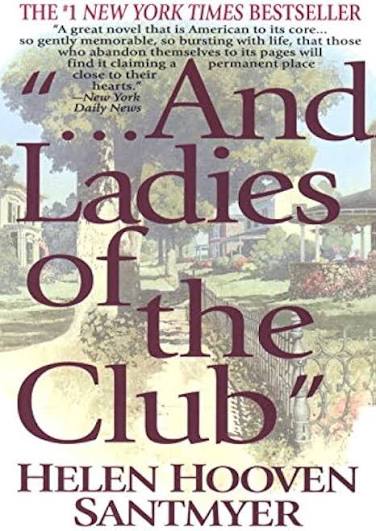
Helen Hooven Santmyer’s massive novel, …And Ladies of the Club, first published in 1982 by Ohio University Press, was rescued from obscurity by two readers who found it “the greatest novel they had ever read” and brought it to the attention of someone who was able to get it republished by Putnam. Then it was widely reviewed and sold 2,000,000 copies. Since then, it seems as if no one mentions it. I checked out the lists of “greatest novels” which have been compiled in recent years, and …And Ladies of the Club doesn’t appear on any of them, not even on the list of the 500 greatest novels.
Curious.
A couple of years ago I picked up a copy in Jerusalem, on one of those stations where people place used books. A few months ago I had the impulse to open it. I have now read it through and started over.
 It is something very big, and not only as to length. Were I on the jury for one of those lists, I’d definitely consider it for the top spot, along with along with War and Peace (I thought everyone thought War and Peace was the greatest novel), Middlemarch (the Guardian’s recent top pick), and Mansfield Park. Mansfield Park I threw in because of its elegant design and the number of characters analyzed in deep and dazzling depth, but perhaps it doesn’t qualify because of its relative brevity. The world’s greatest novel, one feels, should be long enough to get seriously lost in.
Why is …And Ladies of the Club such a dark horse? Perhaps because the title seems almost provocatively to cordon off an area—women’s clubs, now a thing of the past—from which men were excluded and which they often made fun of. And certainly the book describes a society—the small southern Ohio town of Waynesboro between the years 1868 and 1932—whose attitudes are no longer current, to put it mildly. The townspeople speak of the formerly-enslaved in the terms that were then in use (though in a couple of small episodes, the author’s sympathy with the latter is made clear). Most of them vote Republican. There is social stratification and snobbery (of course that no longer exists…). The standards of sexual morality are what they were before the sexual revolution. Finally, “small-town life” in recent literature has had a bad press. Santmyer apparently started writing …And Ladies of the Club as a rebuttal to Sinclair Lewis’ satirical Main Street (which one character mentions with indignation). It often seems that small-town life is acceptable as a subject only if its conventions are shown to be a coverup for various gothic carryings-on. The characters of …And Ladies of the Club live mostly within the conventions and seem content enough.
Among my candidates, …And Ladies of the Club most resembles War and Peace in its almost impersonal flow of events. Mansfield Park is driven by certain personal moral struggles, though these reflect what is happening in the broader society. Middlemarch paints a broad canvas but focuses on two characters who set out with high aspirations and fall short of realizing them. In War and Peace the Napoleonic war provides a central focus; but even the war is only a big wave on the surface of the broader theme, which is the course of human existence and the passage of time.
Santmyer’s book does not have a “plot” in the sense of a central agon. In the three-score-plus years which it covers, the two most prominent characters, Sally and Anne, simply live out their lives—get married, have children and raise them, grow old, and die. Other characters around them are going through the same process in a multitude of variations, while major events are mirrored in the novel’s microcosm: the repercussions of the Civil War, economic vicissitudes, elections, a polio epidemic, a flood, World War I.
Through all this the meetings of the women’s club serve as an organizing device, a kind of refrain. Each chapter contains, among many other events, an account of a club meeting. In connection with each meeting we learn something about the states of the characters at the time. Each chapter is prefaced with a list of the current members, followed by a list “In Memoriam” which gets longer and longer. But new names have also been added to the first list. “A generation comes and a generation goes.”
There are tragedies in the book; and there are episodes which show that Santmyer can, if she chooses, do gothic. On a visit to relatives on a decaying plantation down South, Anne’s husband John begets a child on a cousin whose husband is impotent. Years later, the cousin, widowed, wants to come to Waynesboro with the boy. But the gothic element is brought under control: determined to avoid conflict and scandal, Anne pretends ignorance and makes the cousin welcome. The cousin behaves herself, integrates into Waynesboro society and eventually marries a local widower. On the other hand, there is the aged and ailing teacher who commits suicide despite the community’s botched attempt to help her. A wide spectrum of human flaws is on display, but often the flaws are balanced by admirable qualities. Eliza, for instance, is a gossip and a mischief-maker; but she displays resourcefulness when her father has a stroke in her presence, and she is capable of love for a troubled child.
Though the majority of the characters are female, there are also clearly-delineated male characters—Anne’s doctor husband, a judge, a lawyer, a mousy music teacher, an old general, a former captain, an elderly theologian, a hideously obtuse minister, and above all Sally’s husband Ludwig, whose rope factory and other enterprises constitute, alongside the women’s club, a kind of second epicenter of the novel. Santmyer has a lot of fun with Ludwig: his entrepreneurial creativity forms a counterpart to the novelist’s world-building.
Moreover, the child characters are vividly portrayed both as individuals and in their group activities. They provide some of the novel’s humor (a snowball fight, a prank with a bucket of water in a tree…) But they also have their tragedies: a young girl runs away from home and comes back to die of tuberculosis, another risks her already-precarious health to gather violets for a girl she has a crush on, a boy grows up maladjusted from being both coddled and repressed by his overly-religious mother. The children are not only individualized characters; they also are convincingly the children of their respective parents. I cannot recall another fiction in which the children come in for this kind of attention.
The novel not only chronicles the lives of a large number of vividly-individualized characters, but constructs a minutely-detailed setting: nature, the layout of the town, architecture, interior decoration, fashions, the processes of rope manufacture. The amount of detail gives the novel a stereoscopic quality, somewhat like that of Middlemarch.
As said, the underlying theme of the book is time— “the relentlessness of time,” as one character puts it on the last page. Time does not only pass; there are moments when it seems, briefly, to stand still, and an impression crystallizes whose very vividness makes one realize that it will pass, that everything will pass. Beneath all the episodes of life, its business, its crises, its fun, runs the sense of mortality. A book of the sayings of Marcus Aurelius, the Stoic emperor, passes from one character to the other, seeming to provide a kind of anchor for souls facing the end. Concerning the afterlife, Santmyer probably subscribed to Robert Frost’s dictum “the strong are saying nothing until they see,” though Anne at the end sees her dead son and thinks that “after all there was something.”
The last word in the novel is given to the secretary of the club, who, after the death of its last charter member, notes that “An era has ended. Another begins, which we hope will be as fruitful…” These words comfort only those readers who refrain from remembering what came after the last date of the novel—1932. The world depicted in this novel is, like each of its members, mortal. But there is a sort of mercy in the novel’s ending where it does.
For all its stereoscopic realism, the world of …And Ladies of the Club is somewhat idealized. It is not that Santmyer did not know better, or rather worse. She had published a book on her home town of Xenia (Ohio Town), which paints a darker picture. A shorter novel, Farewell Summer, shows us a world in which the powerful are ruthless and the sensitive are crushed. No one in …And Ladies of the Club is actually ruthless, except for two spinsters who don’t have much power to harm, and perhaps the second husband of Anne’s son’s ex-wife, though he is only glimpsed briefly. Ludwig, the most powerful man in the town, is also the most generous. Moreover, through good management and good luck, he manages to outlast the machinations of the national corporations trying to force him out, thus preserving Waynesboro from the beginnings of the national corporate takeover. Like Austen’s Darcy, Ludwig is a character who comes alive even though one is not sure of meeting with his like in reality.
After all, Jane Austen’s novels are not exactly realistic, either. Her biographer, Claire Tomalin, points out that the world in which Austen lived was more chaotic than that of her books. Even in Mansfield Park, the slave trade and the ruthless Admiral are only mentioned, not seen. Austen was out to create a vision of order as a counterpoise to the real world, not a replication of it. I read once that after World War I her books were given to traumatized veterans. And in Joyce Carol Oates’ Them, the character Maureen, who is allegedly based on an actual person, feels that Jane Austen’s world is “real,” unlike the violent milieu in which she is growing up. Santmyer’s masterpiece gives us that kind of reality.
I suppose it is no coincidence that I tuned into …And Ladies of the Club in this time and place. It has become the book for my sleepless nights. But perhaps it do would many of us good to sojourn for a while in a world that appears, though far from flawless, not yet altogether insane.
–
–
Table of Contents
Esther Cameron is a dual citizen of Israel and the US, now living in Jerusalem. She is the founding editor of The Deronda Review. Her poems and essays have appeared here and there; she has published her Collected Works on Amazon and has had one book published by an academic press—Western Art and Jewish Presence in the Work of Paul Celan (Lexington Books, 2014).
Follow NER on Twitter @NERIconoclast