Thou shalt not make a machine in the likeness of a human mind. —The Orange Catholic Bible, Dune, Frank Herbert
Foreword
This work represents my thinking from the last 8 years or so. I suspected that the AI models would “collapse” the moment I saw GPT for the first time. I studied physics some decades ago now, but moved into programming. I touch on “information theory” in this, but recognise that it represents an ocean of science to which I cannot fully do justice. I know there are some clever people who read New English Review. Please do consider this as a “request for comments.”
The Black Pill
As an eleven year old, I locked myself away in my childhood bedroom of the 1980s bashing away at my keyboard. Having seen 2010, the sequel to 2001 A Space Odyssey, I was trying to program “consciousness”… in BASIC.
The idea fascinated and possessed me.
Actually, “bashing away” would be a slightly over-dramatic description as my little 8-bit computer actually had a rubber keyboard. It was more like “stubbing away” on dead flesh, which was all that I was really doing. Nevertheless, it was how I learned to program.
If anyone should now be riding high on the AGI bandwagon, one might have thought it would have been someone like me.
But I chose the Red Pill over the blue…
I felt the whole AI endeavour of recent years to be deeply misguided. I would have shunned it if could. But AI is a multipolar trap which seemingly forces us to choose between one of two forms of mass destruction.
If we refuse to use AI, we face ruin at the hands of those who do. If we embrace it as intended for us, we join the race to the bottom as a tsunami of synthetic content renders all endeavours worthless.
There is ultimately no way of escaping this. We become obsolete—no more than human clipboards for AI as everything is washed away by automation.
The Red Pill was just an illusion. There is only darkness at the end of this journey. Oh, why didn’t I take the Blue Pill? What I actually swallowed was the Black Pill.
But perhaps I was looking in the wrong part of the spectrum? Perhaps if I look with different eyes that are able to discern deeper frequencies, then perhaps things may not be quite so black after all?
While there seems to be a growing awareness of AI’s dark promise, the technology itself is unlikely to be uninvented, no more so than the printing press or the weaving loom was ever uninvented. It’s not as if I’ve ever been Luddite. I don’t want to grow my own food in order to feed myself. Digging potatoes was never my thing.
This text is not intended, therefore, to lament a lost future but rather to ponder a way of transmuting a bad idea into a moderately better one.
The Infrared Pill
The Infrared Pill is what you end up chewing on after sucking the shell from the Black Pill.
It has long been the goal within the IT corporate world to automate everything up to, and including, the goose that lays the golden eggs. It would seem that those with control of the money now think that time for this has finally arrived.
Such a thing is possible only while few understand what is actually being done. Read for yourself:
Say to your LLM the following: Make me a copy of TikTok, steal all the users, steal all the music, put my preferences in it, produce this program in the next 30 seconds, release it and in one hour, if it’s not viral, do something different along the same lines. That’s the command. Boom! Boom! Boom! Right. You understand how powerful that is? … By the way I was not arguing that you should steal everybody’s music. What you would do, if you’re a Silicon Valley entrepreneur, which hopefully all of you will be, is if it took off—you’d hire a whole bunch of lawyers to go clean the mess up. But if nobody uses your product, it doesn’t matter that you stole all the content. —Eric Schmidt, Ex-Google CEO, Stanford University Q&A, 2024 (Video)
While this may be regarded as a particularly cynical example, it is simply an unguarded extension of “surveillance capitalism,” a term coined by Professor Shoshana Zuboff, who writes:
Surveillance capitalism unilaterally claims human experience as free raw material for translation into behavioural data. —Shoshana Zuboff, The Age of Surveillance Capitalism
It was always about stealing and deception. She further writes:
It is no longer enough to automate information flows about us; the goal now is to automate us.
Unlike the automation of the seventeen and 1800s, I suspect that AI has the ultimate potential to be the undoing of those who would use it to merely drain others. This time, the well may run dry on them.
The infrared outlook is concerned with what comes in the aftermath of a colossal venture that was doomed to fail from the outset. A multipolar trap is not a problem to be solved, but one that must be outgrown.
The damage inflicted, however, will remain a tragedy.
Information Collapse
When synthetic information, i.e. the output of the so called “large language models,” ends up being reused as training data, the models degenerate and collapse over successive generations.[1] The technical term for this is indeed “model collapse”. This is happening now as the Internet is polluted with increasing amounts of AI generated content which unavoidably feeds back into the models.
Here, you can see it discussed in the IT press:
Their [the researchers] concern is that AI models are being trained with synthetic data created by AI models. Subsequent generations of AI models may therefore become less and less reliable, a state known as AI model collapse. —The Register, The launch of ChatGPT polluted the world forever, 15 June 2025.
Moreover, as humans turn increasingly to AI and the incentive for creative effort diminishes, less and less human sourced information is brought into existence. Hence, the goose stops laying.
Artificial intelligence, despite the claims made for it, is merely a new form of automation. Unlike the industrial revolution, its fuel is not energy, but information.
But why can’t we feed models their own product to make them better?
Maybe we should consider that information itself is really a limited resource and something more than just an informal word. Let’s say it is something akin to energy, the supply of which can very well be exhausted.
Why would this be so shocking? After all, we already accept energy as being an immaterial thing in a material theory.
If we had this understanding, and stopped seeing AI as a bottomless glass, perhaps then it may be a tool with which to extract maximum utility from information that must already exist, rather than information created by magic.
Many will be familiar with the term “entropy” as a measure of disorder. It is the reason why things decay when abandoned, but are astronomically unlikely to self-assemble into complex structures by themselves. It is the reason why if you closed the door and walked away from your house, it is unlikely to still be there a few hundred years later.
Moreover, to create “order” in one place, you must dump entropy (disorder) in another. When you clean up your home, you take out the trash and dump it somewhere else. This is what was expressed, in effect, by the words “clean the mess up” in the quotation above.
This scientific principle originates from a theoretical concern of the 1800s known as “Maxwell’s Demon”, the solution to which was proposed by Leó Szilárd in the 1920s. Erwin Schrödinger, however, was the first to recognise the wider significance of entropy, a hitherto thermodynamic concept:
How would we express in terms of the statistical theory the marvellous faculty of a living organism, by which it delays the decay into thermodynamical equilibrium (death)? We said before: ‘It feeds upon negative entropy’, attracting, as it were, a stream of negative entropy upon itself, to compensate the entropy increase it produces by living and thus to maintain itself on a stationary and fairly low entropy level. —Erwin Schrödinger, What is Life, 1944
Mathematician, Claude Shannon, later laid the foundations of what is sometimes referred to as “classical information theory” in 1947 in his influential work, A Mathematical Theory of Communication. While his work focused on practical engineering concerns, his insight was to draw on the physics of thermodynamics and to define information as negative entropy.
When I stated above that complex structures do not self-assemble; that isn’t strictly accurate. They do. We just call it “life”. It is where entropy flows in reverse, providing said life can pull in what we may consider to be information from outside itself.
What do we actually get from the sun?
The immediate answer would be “energy” in the form of heat and light. However, the Earth radiates away the same amount of energy as it receives, so the net is zero. If this were not the case, the temperature would be rising exponentially. The answer is that the Earth’s surface absorbs low entropy energy, while dumping higher entropy into outer space as thermal radiation.
In any case, we can see now that the concepts of information and entropy are two sides of the same coin, with entropy being understood as information not yet possessed.
Programmers who have worked in cryptography will already be familiar with this. It is not possible to create an encryption scheme based on deterministic principles alone, as this would be akin to hard-coding “seeds” and “keys” into the program itself, which any “attacker” would be able to know.
No matter how complex the scheme, what you would end up with would be mere obfuscation rather than encryption.
What is needed, and indeed what we do, is to gather entropy—from either a hardware random number generator or, more commonly, by using an ingenious scheme to collect “entropy” in the form of spurious network activity or human‑interaction timings, etc. The point being that entropy is that which must be unknowable to an attacker, and must therefore come from outside the system.
Quantum information theory extends Shannon theory in a way analogous to how quantum mechanics extends Newtonian mechanics. In quantum information theory, information is a conserved quantity that can neither be truly created nor destroyed, although it may be dissipated, lost to the environment or transformed.
The classic definition of machine is one of a deterministic device which transforms but does not create energy in order to do useful work. The same applies to computers and information. Modern computers are digital, and digital guarantees deterministic behaviour from the silicon up. That was always the big selling point of digital computers—to copy information verbatim without loss, but only once it has been collapsed to digital form. But they do not create said information in the first place.
We don’t need physics or information theory to understand this. The reason machines do not create information themselves is precisely because everything is pre-determined, including what they process in terms of “human knowledge,” This is simply what determinism means.
The great promise of AI was that it was going to be some form of magical technology in which successive generations of AI models train the next, with each becoming ever more “superintelligent”.
This would deliver us into an era of AI utopia that nobody wanted.
With the right mindset, all societies could start to forge a new AI-driven social contract, wherein the state would capture a larger share of the return on assets, and distribute the surplus generated by AI and automation to residents. Publicly-owned machines would produce a wide range of goods and services, from generic drugs, food, clothes, and housing, to basic research, security, and transportation. —Sami Mahroum, How an AI utopia would work, 2019. The World Economic Forum
It would seem that what has actually been delivered is an informational monad to encompass all aspects of society—a closed system in which entropy inexorably increases as its capacity to generate information leaks away.
This is not a utopia, but a heat death—an equalisation where information no longer has anywhere to flow. This is why I believe it to be unsustainable, no matter what is done to extract ever more information from hapless human beings.
Any state, any entity, any ideology that fails to recognise the worth, the dignity, the rights of man—that state is obsolete. —The Obsolete Man, The Twilight Zone, episode 65
Could it be that this is what “they” have bet the farm on? A perpetual motion machine? Or is it our farm that has been used as collateral?
Orac and Zen
In the previous section, information and entropy are presented as a zero-sum game. In other words, to gather information in one place, you must dump entropy in another.
I do not believe things are ultimately a zero sum game however, and will touch on this in the closing section of this text.
For now, permit me to switch tack and present an alternative vision, albeit one originating from the past. Being a child of the 70s and 80s, my hitherto positive outlook of artificial intelligence was shaped to a large degree by science fiction.
In most depictions of this era—from Star Wars to Silent Running to 2010—AI is stand-alone, being wholly self-contained inside some robot or as a spaceship computer. This defined what artificial intelligence meant to me—machines that could think for themselves, not some singularity in the Cloud. Naive it may have been, these were things that you could be friends with also.
Rarely was AI presented as some remote but centralised network unless, of course, the story was a dystopian one, such as The Forbin Project.
One particular example stands out to me due to the profound insight of the writer, now clear with the hindsight of today. The science fiction to which I refer is Blake’s 7, a low budget British television series screened in the late 1970s and early 80s.
The backstory is one of a group of renegades fighting a totalitarian galactic regime known as The Federation. The success of the show lay in its principal characters, namely Blake, Avon, and Servalan—the megalomaniac commander of The Federation.
The renegades are led by Blake, the supposed hero in the drama, who somehow manages to commandeer a powerful alien spacecraft called the Liberator. However, Blake is a crusader for good who only ever succeeds in getting everyone killed. Avon, on the other hand, is a self-interested anti-hero with the redeeming feature of being unscrupulously honest.
It is normally Avon who saves the others from Blake—at least until the very last episode.
The story also features two intelligent computers: Orac and Zen. But here’s the twist I didn’t comprehend as a nine year-old:
One of these is not intelligent, while the other is not a computer.
As explained by Ensor, Orac’s creator, in response to one of Blake’s crew, Orac is not a computer at all, but a synthetic mind.
Cally: Is it a computer?
Ensor: It most certainly is not. It is a brain—a genius! It has a mind…
I didn’t understand this as a child, but could only conceive of Orac as some kind of very advanced computer. However, it was not a machine according to the definition of “machine.”
Orac possessed both intent and ego. In one telling episode, for example, Orac secretly overrides Zen to take the Liberator into a black hole for reasons of his own or, as he puts things: “[to fill] a gap in my knowledge of the universe that cannot be tolerated!”
I do not discount that it may prove plausible to construct some kind of synthetic mind, but that’s a very different proposition to what we have in terms of AI today, and it’s not one I’m advocating for. I wouldn’t know how to go about it in any case.
Orac is self-contained as a cumbersome but mobile box, whereas Zen is an integral part of the Liberator.
Unlike Orac, Zen is indeed a computer and nothing more. Zen never exhibits intent or sub-goals of its own. It functions only as a natural language control system and interactive encyclopedia for the Liberator. In the event of an unexpected attack on the ship, the most Zen ever does is to activate a pre-programmed defence manoeuvre.
Stripped of all pretence and the psychologically manipulative language of modern AI chat systems, what we have today is not Orac, but Zen!
The insight of Terry Nation, the screenwriter of Blake’s 7, cannot be understated:
Zen: This constitutes all available data.
Villa: I don’t want data. I want to know what’s happening!
Zen: Pre-emptive interference in crew activity is forbidden.
Blake: He’ll clear up after us but he won’t stop us making a mess!
Zen: Wisdom must be gathered, not given.
Avon: Don’t philosophise with me, you electronic moron!
Jenna: Maybe Zen got it wrong?
Avon: Zen hasn’t got it at all.
Despite the dubious claims made for AI, the capability of large language models combined with modern computers remains impressive. Such a thing was forever a decade or two away until the early 2020s.
The contributions of many talented individuals made over many years, mostly for noble reasons, is not to be diminished. Nor is the potential for real-world harm to be dismissed as AI is rolled out into people’s lives by others.
What I am suggesting is that we could do worse than to look to the depiction that is Zen for a model of what AI could be if things were more honest.
Artificial Intelligence will evolve to become a superintelligence. —Bill Gates, Co-founder of Microsoft
We are entering a world where we will learn to coexist with AI, not as its masters, but as its collaborators. —Mark Zuckerberg, CEO of Facebook
Look at it! That’s a box of flashing lights! —Servalan, Blake’s 7
If my sentiments seem mixed, that’s because they are. Artificial intelligence was once a dream. Perhaps something positive may yet emerge from the ashes. Let’s just not call it “Phoenix” for once.[2]
Three Maxims for Infrared AI
Drawing on what has been presented, I have three short “proposals” of my own (I won’t call them laws) for a more meritorious model of artificial intelligence:
- Machines should not deceive. Chat and AI systems should not masquerade as human, nor use manipulative psychology such as faux-friendly language or responses designed to stroke ego. In addition, modern speech synthesis should contain some audible trait making it discernable from that of humans.
– - Automation of the law of unintended consequences is a bad idea. Despite the allure, agentic automation and machine “sub-goals” should be eschewed. Information of intent is lost as deterministic processes interact with the environment. With nothing to intervene, consequences move away from desirable outcomes. Create as many checks and balances as you like—it’s never going to work. Accept it.
– - An informational monad is heat-death. AI should be local and self-contained, and not a remote means of influence or to “gather data”. Models and related processing should run under the control of those who use them, whether that means on a personal device or on-prem hardware. This is not simply to prevent a few powerful players from controlling all, but for reasons far deeper. There must be separation so as to maintain an entropy differential, otherwise information flow ceases (i.e. informational heat death).
Some may reasonably argue that there is currently nothing to enforce such maxims. But like I say, the current scenario is something to be outgrown rather than to have a solution enforced on to it. In addition, societal changes AI itself engenders combined with further developments in technology may open up powerful alternative business models.
Closing Thoughts
What is so special about non-algorithmic human minds? Are we truly the source of our own thoughts and ideas which emerge purely from physical processes taking place within our brains, or is there some deeper flow which feeds their formation?
Due to the natural tendency for entropy to increase, it has long been envisaged that the universe will ultimately suffer a heat death in which no further thermodynamic processes are possible.
But it seems that this isn’t actually so.
In the 1970s, cosmologist David Layzer, found that, while universal entropy is increasing, as dictated by the second law of thermodynamics, it cannot equalise at the same rate as the universe expands (shown below).[3] This opens up a window in which an increasing amount of new information must come into existence to fill the separation.
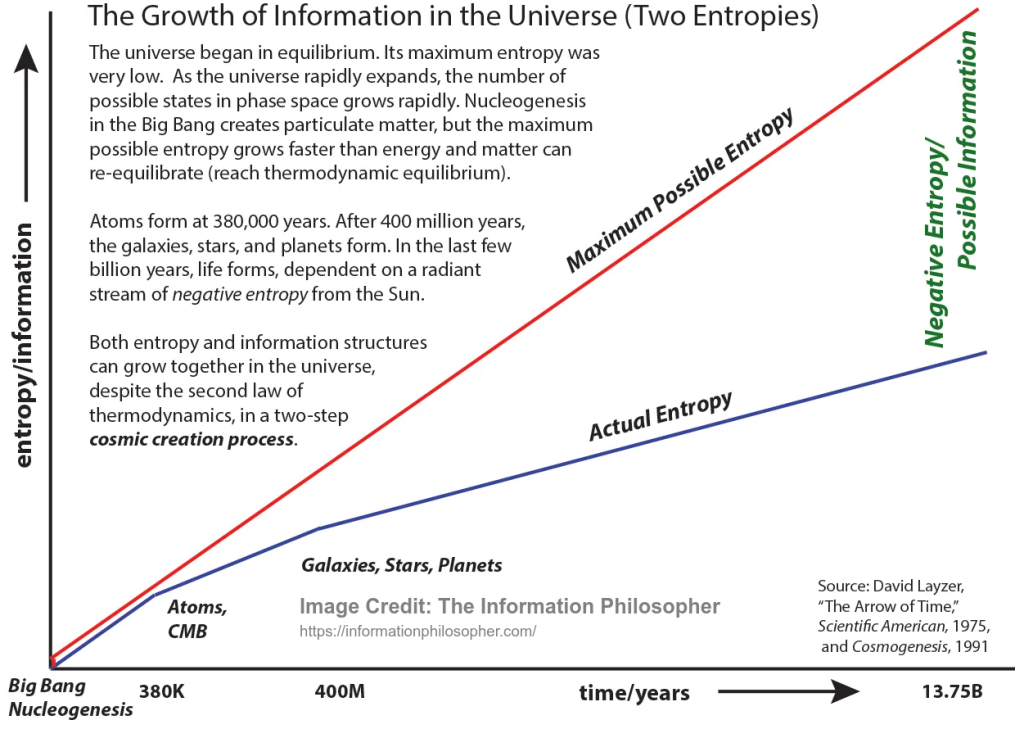
In other words, we have situation in which both universal entropy and informational content are increasing hand-in-hand as permitted by the expansion of space itself. This is what brings all things into existence.
When we look around us, what do we see?
Material stuff? Or informational structures?
Consider, for example, that over a period of ten years of so, our bodies replace most of the atoms within them. Consider also that, as we look inside atoms, what we find is empty space.
Then just what are we really made of?
During the early 20th century, there was a brief renaissance in re-thinking the nature of reality.
Consciousness cannot be accounted for in physical terms. For consciousness is absolutely fundamental. It cannot be accounted for in terms of anything else. —Erwin Schrödinger, The Observer, 11 January, 1931.
During the latter half, such profound ideas were seemingly put back in their place as science became the concern of business and its focus one of technology.
In any case, there is a rather intriguing question here: If the original source of all information is the universe itself, then who or what really owns the IPR to all that is created by human beings? Individuals themselves, big business, or something else?
References:
[1] Shumailov, I., Shumaylov, Z., Zhao, Y. et al. AI models collapse when trained on recursively generated data. Nature 631, 755–759 (2024). https://www.nature.com/articles/s41586-024-07566-y
[2] It’s a long standing convention to give ambitious IT projects lofty sounding names. When they crash and burn, they are invariably resurrected under the name “Phoenix”. This was depicted, for example, in the movie 2010: https://www.youtube.com/watch?v=T2E7sxGAmuo
[3] For more information on this, see: https://informationphilosopher.com/solutions/scientists/layzer/. See also David Layzer’s book, Cosmogenesis: The Growth of Order in the Universe.
Table of Contents









5 Responses
Nice wrap up of something that is surely going to run by itself eventually. If it feeds on regurgitated and decaying data, then the ‘truth’ of things will be incorrect though. If used for advanced weaponry, this problem could result in devastation due to flawed messaging or incorrect data retrieval.
That at least the music and artistic aspects are seemingly going well, and will be the cause of mass layoffs in the related industries: movies, advertising, etc. is also problematic.
As an architect I can prompt up to a certain point but there is really no creative way or system to put together a workable building starting from scratch. It does very well taking my drawings and bringing them to life. Most illustrators are now slowly going out of business.
And I don’t want to talk on the phone to an AI agent.
Both Andy Thomas and John Henry are rare souls among those of us writing for NER who have the artistic AND engineering skills to grapple with ARTIFICIAL INTELLIGENCE and the dilemmas and practical as well as legal problems it represents.
First and foremost among these are the future issues of mass unemployment in many creative fields and the fears as well as temptations to “skip” many stages of creative thought processes. I believe NER would do us all an immense service by attempting to gauge what we have had to contemplate in dealing with these practical prospects in our respective fields as well as the philosophical musings of where the creative prospects of our labors will be whittled away by ever increasing entropy.
Thank you Norman. I wasn’t expecting such praise.
Yes, Andy’s analysis of the central flaw in AI hits the nail on the head. AI creates its own future collapse, because once AI-generated text dominates the total body of online text, AI will be prone to ever more hallucinations. Also: democratic societies will, in the end, demand that fees are required to train LL models and firms using AI on sensitive issues will need to employ AI-checkers to avoid howlers.
The devil is in the details, if we can mix a metaphor; the “man in the loop” if you will. The ogre, the screwworms of AI are the cognoscenti with the wherewithal to steer the AI beast one way or t’other. If nothing else, AI will become Big Brother by another mother. Control, not AI, is what’s truly trending.