by Juliana Geran Pilon (March 2026)

Why place an ad during the Super Bowl? Right: 100 million viewers. But an ad opposing antisemitism? Never mind the optics of sharing the electronic stage with other visual material of seriously questionable taste. The Executive Director of the nonprofit American-Israeli Cooperative Enterprise (AICE) Michael Bard asks the obvious questions: How many will watch it, understand it, care about, let alone change their behavior afterwards? The ad’s sponsor, however, was betting on scale—and on urgency. The Blue Square Alliance (BSA), founded by Robert K. Kraft, the philanthropist owner of the Patriots, was alarmed by its own December 2025 report, which showed that antisemitism has rapidly “metastasized and taken firm root in American life.” Yet nearly two thirds of adults in this country think antisemitism is merely a minor problem or not a problem at all, with more than a third believing antisemitism is blown out of proportion.
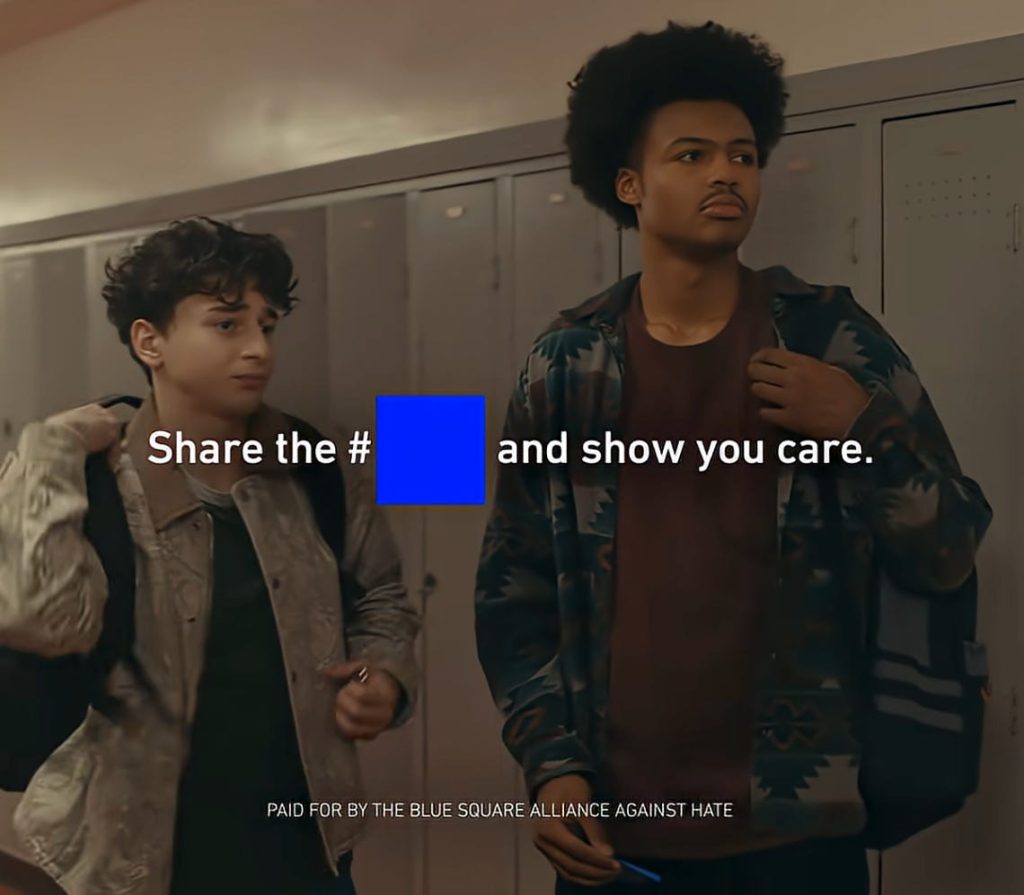
It isn’t only the size of the Super Bowl audience that mattered but its composition: most viewers could be counted upon to feel pride at hearing their national anthem. Their minds less corrupted by fashionable isms, they won’t be donning keffiyehs, burning Israeli alongside American flags, or shooting people who look guilty of Mosaic extraction. The fans might be sympathetic to a minute’s video about a Jewish high school kid being taunted with a sticky note placed on his backpack by stupid colleagues whom he obviously hadn’t done anything to offend, being comforted by a black friend with the words: “I know how you feel.” The note reads: Dirty Jew. The ad closes with these words: “2 in 3 Jewish teens have experienced antisemitism. Share the #🟦 and show you care.” It’s a nice break from the “Hitler should have finished the job” and “Globalize the intifada.”
Jewish groups mostly hated the ad, “a range of commentators panning it as ‘disconnected’ from the real experiences of contemporary Jewish teens, who more frequently encounter antisemitism online and in the context of anti-Israel activism; a ‘waste of money’; and a cliched portrayal of Jewish weakness.” And they have a point. The victim of this lame prank looks merely dejected as he walks past snickering teenagers. The note elicits no response. Couldn’t he have scoffed maybe, or at least laughed? His being called David sounds like a bad joke: it seems to signal to any wannabe Goliath that he has nothing to fear from this nice kid. It feels like the wrong punchline.
Isn’t that just what one would expect of the approval-seeking, spineless Jewish establishment, fumes Tablet magazine’s Leil Leibowitz. Learning from the executive of one of the country’s largest and most well-endowed Jewish organizations that they believed, “based on their expert data, that no message resonated more loudly than victimhood,” Leibowitz explodes: “Respectfully, f-[…] that. You would think that nearly three years of ramped-up antisemitism surging in from all corners would make these so-called communal leaders.”
Whether the modern-day equivalent of the sycophantic court Jew justifies stooping to obscenity is a question for his rabbi, but the expletive is singularly unambiguous. If he had the money, he would produce an ad featuring a group of hot IDF soldiers cleaning their weapons, getting ready for action. The caption: ‘Don’t Like Jews? Fuck Around, Find Out.’” Our tribe is nothing to mess with. Teach Jews to stand up. Michael Bard agrees: “avoid Madison Avenue’s soft-focus sermons in favor of messages that strengthen resolve and self-confidence.” They are both absolutely right.
Bret Stephens, the editor of Sapir magazine, agrees as well. His solution is for Jews to strengthen their own community rather than spend money seeking goodwill from the goyim. In a February 1, 2026, lecture on the State of World Jewry, he scoffs at “what we call the fight against antisemitism, which consumes tens of millions of dollars every year in Jewish philanthropy and has become an organizing principle across Jewish organizations.” Bard’s solution echoes Stephens’: “wealthy Jews should devote their philanthropy to Jewish causes and Israel.”
But Stephens’ assessment of Jewish philanthropy as “a well-meaning but mostly wasted effort,” is far too generous for Leibowitz. “You would think that scores of milquetoast rallies—always featuring progressive clergy delivering some soapy universalist message but rarely a bearded rabbi delivering a genuine Dvar Torah—would’ve proven by now that appealing to the kindness of strangers, and focusing on liberal strangers exclusively at that, was a recipe for annihilation.” Jews should stop courting strangers whose kindness and approval is demeaning.
Former CEO of the Jewish Council for Foreign Affairs (JCFA) David L. Bernstein similarly opposes the Jewish establishment’s obsequious alliance with progressive establishment elites. In his excellent book Woke Antisemitism: How a Progressive Ideology Harms Jews, he accuses Jewish leaders of having consistently placed their bets on left-liberalism, “a philosophy that leads inevitably to more antisemitism and undermines liberal principles” they otherwise pretend to advocate.
But he differs in one crucial respect: he avoids the predilection of too many Jews to think in terms of us vs. them. The enemy isn’t “the stranger,” since after all, without allies the Jews could not have survived all these centuries in exile. Not to mention that some of the worst antisemites have been Jews. Karl Marx, for starters, thundered: “The God of the Jew is money!” His unholy brood, the intifada-intoxicated “as a Jews‘ on American campuses, are even worse: at least the descendant of distinguished rabbis didn’t know about the Holocaust, Soviet pogroms, and Islamist terrorism.
This is why, after leaving the JCFA in 2021, he founded the Jewish Institute for Liberal Values (JILV) to advance “liberal principles in an age when both left and right demand ideological submission.” It proposed to “counter social justice extremism inside and outside the Jewish community,” thereby setting Judaism in the right broader context.
Unfortunately, though understandably, in 2025, JILV became the North American Values Institute (NAVI). The new name, explained National Program Coordinator Rabbi Mark Cohn, was meant to avoid “the widespread misunderstanding of what ‘Liberal’ means.” What about “Jewish”? He might have explained but he didn’t, perhaps because it is obvious: it too is a concept widely misunderstood, specifically within the Jewish community itself. Its extraordinary ambiguity has constituted its strength and weakness in equal measure. Switching to the far less contentious “North American” because of its geographical objectivity, however, unwittingly exposes its utter uselessness when applied to “values.”
Now there’s a word we cannot quite do without: values. They define what we seek, as individuals and as a nation. For America’s purpose, captured in the document whose 250th anniversary we celebrate this year, the Declaration of Independence, is at once Jewish and liberal. The premise that man was created in God’s image, the rock of the Hebrew bible, is the self-evident basis of liberty. But how can we still understand what we stand for, if we can’t agree on the words to describe it?
After decades of semantic sabotage that brought us to this moment, where even to begin? The global escalation of violence against Jews, especially after October 7, 2023, has an exceptionally complicated and sinister history. Millennia-old superstitions were grafted onto whoppers found in a tsarist-era forgery, Protocols of the Elders of Zion, that Soviet leaders repurposed and deftly disseminated through a global disinformation network. This witches’ brew, subsequently orchestrated by the KGB and aided, sad to say, by Henry Ford, was then brilliantly adapted to Islamist extremism and Nazi racism. It succeeded, with considerable Western help, to turn anti-Judaic, anti-Israeli and anti-American sentiment into a formidable weapon of mass distortion.
The ensuing coalition of anti-liberal forces, an axis of terror, could not have found a better scapegoat than the Jews to target what dictators fear most. It is no accident that Israel is called by Jihadists “Little Satan” and America “Big Satan.” So of course we need education, a great deal of it, to appreciate the silent bomb ticking at our doorsteps.
Seen in this light, Robert Kraft’s ad is almost pathetic. And yet, he is not wrong to appeal to the good sense of ordinary Americans. As Tablet Magazine’s uncommonly perceptive Lee Smith wrote on February 9, the Sticky Note may resonate with Super Bowl fans who notice that “[c]onspicuously absent [from the ad] are teachers in the hallway, coaches, administrators, security—that is, all authority figures.” For people of all political persuasions recognize the profound lack of leadership throughout our institutions, especially in schools.
This is especially true of people leaning conservative, who are a critical political sector, when an increasing number claiming to not be antisemitic nonetheless make common cause with faux-patriotic headline-hunters like Tucker Carlson, Candace Owens, and Nick Fuentes, whose vicious remarks about Jews mirror those of woke flag-burning radicals and the lemmings they mesmerize. It is to this misguided cohort’s conscience the ad is meant to appeal.
The ad’s ending, writes Lee, is particularly poignant: “That the lone figure to step in is a Black teenager named Bilal only highlights how thoroughly the adults entrusted with shaping American mores and guiding the next generation have abandoned the task.” Most culpable are the idea-mongers who orchestrated the semantic disarray that sabotaged our self-confidence as Americans. This is not only about the Jews but about all of us. Let’s do something about it, and make it stick.
Table of Contents
Juliana Geran Pilon is Senior Fellow at the Alexander Hamilton Institute for the Study of Western Civilization. Her eight books include The Utopian Conceit and the War on Freedom and The Art of Peace: Engaging a Complex World; her latest book is An Idea Betrayed: Jews, Liberalism, and the American Left. The author of over two hundred fifty articles and reviews on international affairs, human rights, literature, and philosophy, she has made frequent appearances on radio and television, and is a lecturer for the Common Sense Society. Pilon has taught at the National Defense University, George Washington University, American University, and the Institute of World Politics. She served also in several nongovernmental organizations, notably the International Foundation for Electoral Systems (IFES), where as Vice President for Programs she designed, conducted, and managed programs related to democratization.
Follow NER on Twitter @NERIconoclast









2 Responses
Out, damned blue square! Out, I say!
Photo Caption Sparks Outrage: AFP Photographer Labels IED-Throwing Suspect an “Activist”
A controversy erupted online after a widely circulated news photo caption described a man holding a homemade explosive device during a protest in New York as an “activist,” despite authorities later determining the device was a functioning improvised explosive device (IED).
The image, taken by AFP photojournalist Charly Triballeau and distributed through international media outlets, appeared in coverage by ABC News of a March 7, 2026 demonstration outside Gracie Mansion, the official residence of the New York City mayor.
The caption accompanying the photo read:
Critics quickly seized on the wording, arguing that describing an individual preparing to throw an explosive device as an “activist” minimized the seriousness of the incident.
What Happened at the Protest
The demonstration had been organized by conservative influencer Jake Lang, who staged a protest opposing what he called “Islamification” and public Muslim prayer in New York. According to police, roughly 20 people attended Lang’s rally while about 125 counter-protesters gathered nearby.
Authorities say the incident escalated when a man identified as Emir Balat allegedly threw two devices near the protest and a line of police officers. Another man, Ibrahim Kayumi, was accused of handing one of the devices to Balat.
The New York City Police Department later confirmed that the object shown in the photo was not merely a firework or smoke device but a real explosive.
Investigators said the device consisted of jars wrapped in tape and filled with nuts, bolts and screws—components commonly associated with improvised explosive weapons.
Witnesses reported seeing flames and smoke as the device flew through the air before striking a barrier near officers.
Police also said Balat shouted “Allahu akbar” during the incident, according to an AFP correspondent at the scene.
Online Backlash Over Media Language
The phrasing used in the caption quickly became the focus of criticism on social media, where commentators argued the description reflected a double standard in how political violence is framed.
The account Libs of TikTok wrote on March 9 that the same media ecosystem that labels right-wing figures as extremists appeared to describe a suspected bomb thrower as merely an activist.
The criticism gained wider attention after investor Bill Ackman reposted commentary by Jaimee Michell mocking the caption and highlighting the wording from the ABC News photo description.
The post circulated widely on X (formerly Twitter), where users debated whether the terminology reflected editorial bias or simply a descriptive caption written before the full details of the device were confirmed.
Who Took the Photo
The photograph was credited to Triballeau, a New York–based photojournalist working for Agence France-Presse (AFP). According to his professional profile, Triballeau has previously worked in Tokyo and has had his images distributed across global outlets including Newsweek, Le Figaro, Yahoo News and other international publications.
Wire-service photographers typically supply images and captions that are then distributed to media organizations worldwide. Those captions sometimes rely on the information available at the time the image is transmitted.
Ongoing Investigation
The NYPD said the case is being investigated jointly with the FBI through the Joint Terrorism Task Force. Both suspects were arrested at the scene and remain in custody as authorities determine potential federal charges.
Police said the explosive device “could have caused serious injury or death.”
Notes / Sources
Libs of TikTok (@libsoftiktok), X post, Mar. 9, 2026.
https://x.com/libsoftiktok/status/2031010759509991744
Jaimee Michell (@JaimeeUSA), reposted by Bill Ackman, X post, Mar. 10, 2026.
https://x.com/BillAckman/status/2031566901315351013
ABC News photo caption referencing AFP/Getty image.
https://www.aol.com/articles/4-arrested-suspicious-device-thrown-210246748.html
Archive:
https://archive.is/Lm5hP
Gregory Walton, AFP — “NY police say device thrown near anti-Islam protest was IED.”
https://www.starcitytv.com/news/national/ny-police-say-device-thrown-near-anti-islam-protest-was-ied/article_0b867d32-a5a7-5fae-bc3a-a1a36c8a50ae.html
Archive:
https://archive.is/xsd8g
Charly Triballeau profile.
https://muckrack.com/charly-triballeau