by Robert Boucheron (May 2026)
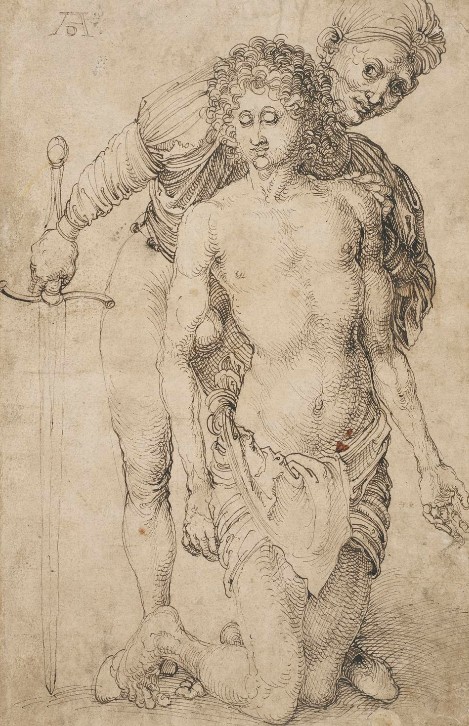
Long ago, in the ancient city of Babylon, a soldier killed his comrade in a drunken brawl. The soldier woke the next day in jail, bruised and bloody, his tunic torn. He had a vile headache, a sick stomach, and no recollection of the night before.
“Rise and shine,” the jailer said. A veteran himself, he was sympathetic but impartial.
“Where am I? What happened? Why do I feel like crap? Dadgummit sat up, hung his head, and noticed the shackles on his wrists.
“You’re in jail, because you killed a man last night.”
“I did what?”
“You and your soldier buddies were drinking beer, and the party got loud. Lots of shouting, throwing punches, and rolling on the ground. You walloped your friend so hard, he departed this life.”
“I don’t remember anything except going to a tavern.”
“The tavern keeper says it was a stupid argument. An unwise word that led to the use of excessive force. There were plenty of witnesses.”
“Oh, my head! And my stomach! I think I’m going to— ”
The jailer shoved a pail toward Dadgummit, who leaned forward and retched into it noisily, then wiped his mouth on the back of his hand.
“Feel better now?”
“If anything, worse. Who did I … you know … wallop.”
“A soldier named Goshgali.”
“No way! Goshgali is my best friend!”
“Maybe he was.”
“We marched to battle side by side, fought shoulder to shoulder, and sipped beer through straws from the same keg. We were inseparable!”
“You always hurt the one you love.”
“But it was an accident!”
“The law takes no notice of accident, insanity, or extenuating circumstances. Goshgali’s widow and infant son will appear in mourning to demand justice, and the court will hear their plea. You will be condemned to death for murder.”
“Goshgali! I sent you to the underworld, that dark and dusty place where the sun never shines. I will never forgive myself!”
A messenger arrived and spoke to the jailer.
“The king heard that you have one of his soldiers in jail. This one, I assume. He orders you to bring the man into his royal presence forthwith.”
“You heard him, Dadgummit. On your feet, forthwith.”
Dadgummit moaned in pain as he stood. The three marched to the royal palace, where they were admitted to the royal presence. Surrounded by officials and functionaries, the king sat on a throne flanked by carved cherubim, or winged bulls. The messenger spoke.
“Your royal highness! As per your order, the city jailer and the prisoner accused of murder!”
The men bowed deeply. Dadgummit winced and stared at the floor.
“Look up when I speak to you, Dadgummit. The evidence shows you are guilty of a brutal and senseless murder. This is your last day to enjoy sweet sunlight and gentle rain, to walk the earth and taste its fruits. I am reluctant to lose such a mighty warrior. But the legal case will not go to trial.”
All present expressed surprise. The king continued.
“As commander-in-chief of the army, head of state, and chief justice all rolled into one, I have an idea. The army needs men, and you are a proven killer. As it happens, the post of executioner is vacant. The job comes with a house in the city, a salary, and benefits, but no one ever applies for it. Babylonian society detests and shuns the executioner. But I, King Humdinger, offer you a choice. Accept the post of executioner and live, or pay the penalty of murder and die.”
“Your highness is too kind,” Dadgummit thought quickly and spoke smoothly. “In such matters, no discussion is expected, yet a simple yes or no is unworthy of your generous offer. As the executioner, I will be reviled and spat on, a universal object of disgust. No woman of Babylon will marry me. I will live alone to the end my days and go my grave unloved, without a lawful son and heir.”
“All you say is true but beside the point. You will wield great power in my name. You will rank after the sons of my loins and the palace steward. For intimacy, the prostitutes of the temple of Ishtar may refuse no man. And the household slaves, as property of the city, will be at your command.”
“In that case, I accept.”
The king nodded to the jailer, who removed the shackles.
“You are free, Dadgummit, but as a convicted criminal, you are henceforth deprived of full rights as a citizen. As a soldier in reserve, you can be recalled to active duty. Renewed hostilities in Mesopotamia are possible, even likely.”
Escorted to the official residence, Dadgummit made the best of the situation. In the courtyard, he summoned the household slaves. Among them was a young woman.
“Lovely young slave girl, what is your name?”
“Hunnibun, sir. If I may ask, what is your name?”
“Dadgummit. Did the previous executioner retire?”
“He wasn’t that old, but he lost his grip.”
“Do you mean he lost his grip on the axe?”
“Exactly. The last execution was botched, and he was forced to resign.”
“How did you come here?”
“I was taken captive as a child in the war with Uruk. “
“That was before I joined the army.”
“I hardly remember. I grew up in Babylon.”
“Do you harbor resentment at your fate?”
“For a girl like me the cultural change was slight.”
“I feel that we will hit it off and become a couple.”
“The opportunity is nothing to sneeze at.”
“The relationship will have no legal status.”
“Our children will not be citizens?”
“No more than you and I, Hunnibun.”
“Dadgummit, so what? Babylon recognizes merit.”
“They will work their way up to respectability!”
“If the gods allow. Would you like to freshen up?”
Dadgummit bathed, changed into a new tunic, and combed his hair and beard. Hunnibun showed him around the place, and they rearranged the furniture. He hefted the big bronze axe, the tool of his new occupation.
In the days following, he chopped wood for practice and pruned trees in the garden. He dug ditches for irrigation, a common pastime in Babylon. To be ready for active duty, he marched around with a soldier’s pack on his back, heaved boulders, and practiced on a dummy with sword and javelin. He kept his armor clean and polished.
For official business, the executioner wore the traditional black hood. Dadgummit showed off his magnificent body. His skin was browned by the sun and oiled. His thick black beard glistened. As he strutted into the public square in front of the Ziggurat, he twirled the axe like a baton. The curved bronze blade reflected sunlight like the tips of waves in the Euphrates River.
The crowd appreciated the show, but tradition required expressions of loathing. People shouted insults and rude remarks, louder as the executioner reached the block and thumped the butt of his axe on the ground. When the criminal arrived, the noise died down. Dadgummit then sang a little song he devised for the occasion.
Step up, my friend, and kneel,
And hang your head for sin.
The axe will fall before you feel
A tickle on your chin.
–
A blow clean as a kiss,
Much closer than a shave,
I promise, and I never miss,
So one last time be brave.
Despite the lack of a department of social services, adequate street lighting, and education other than the school for scribes, who spent years learning to write in cuneiform, crime was low in Babylon. To preserve family honor, parents nipped bad behavior in the bud. From envy and a passion for fairness, citizens kept a close watch on their neighbors. Mutual deterrence did the trick, and public executions were rare.
More often, Dadgummit was obliged to punish minor offenses for which the criminal could not pay a fine. These were spelled out in the Code of Hammurabi. In a case of personal injury, the rule was, “An eye for an eye, a tooth for a tooth.” For petty theft, the executioner cut off a finger, for grand larceny a hand, for trespass a toe, and so on. He flogged slaves, since masters were legally restrained from inflicting bodily harm. Slavery in Babylon was often a result of unpaid debt, nothing to do with ethnic origin.
Dadgummit carried out his duties with impartiality. He tried to make each victim feel they received the proper amount of spectacle. He always wore the black hood, even for floggings and small amputations. Twenty years passed.
The position of King Humdinger was precarious. For all the pomp, the royal bodyguard, and the swarm of court officials, assassination was a constant threat. The king had a council of city leaders, wealthy merchants and landowners. They competed and coveted the throne. One day the jailer brought a young man in shackles to Dadgummit to be executed.
“Who is this stalwart and fearless young man?”
“A prisoner convicted of muttering against the king. Under our system, which lacks freedom of speech, independent newspapers, and political parties to channel dissent, muttering is high treason.”
“No one claims the system is perfect. The prisoner looks familiar, like someone I once knew.” He addressed the young man. “What is your name?”
“Upanattem, son of Goshgali.”
“Goshgali! He was a friend of mine.”
“He died when I was still in the cradle.”
“Your father was a good soldier. Yet I was the cause of his death.”
“You were? But he was no criminal.”
“An unfortunate accident. Beer was involved.”
“When beer is involved, things happen.”
“Are you guilty of high treason?”
“Certainly not. My accuser bore false witness, and the judge refused to hear my defense.”
“Whether your tale is true or false is outside my scope. Mercy is not my trade. What I can say is this. To kill both father and son is a monstrous crime I refuse to commit.”
This statement shocked the crowd of curious onlookers. In Babylon, there was always a crowd. Dadgummit dispatched a runner to King Humdinger to inform him and ask how to proceed. The royal messenger returned with an armed escort. They marched to the palace and into the royal presence. The king sat as rigid as the cherubim to each side. A throne is not made for comfort. Nor is it made for an ordinary man. Humdinger was shrewd and vigorous, a fighter with quick moves, which may explain why he lasted so long. The jailer spoke.
“Your highness, we have a problem. This young man is convicted of high treason and sentenced to death, and the executioner refuses to carry out the sentence. In this unprecedented situation, what should we do?”
“Law and order bring peace, and the peace of Babylon is paramount. My will is to execute this prisoner. Dadgummit, do you obey?”
“Your highness, with all due respect, I cannot.”
“Are you aware of the consequence?”
“I have served you faithfully, sire, in peace and war for twenty years. Except for one mistake. This man is the son of my comrade, slain by my hand. To kill both father and son would bring damnation on me and shame on you.”
The king turned to the prisoner.
“Upanattem, I make you the same offer I made to this wretch twenty years ago. Accept a reprieve and the post of executioner. Your first act will be to execute the man who killed your father and now defies me.”
“Your highness is consistent,” Upanattem said. “Allow me to point out, however, that my conviction is invalid, since I committed no crime. To accept your reprieve would amount to a confession of guilt. Rather than bring shame on the name of Goshgali, a good soldier and a father I never knew, I prefer an honorable death. My blood be upon the judge who failed to administer your justice.”
“Who is this judge? Summon him to appear before me. Meanwhile, what is your defense?”
“Behind my trial lies a shady backstory. My accuser was a government supply contractor who indulged in fraud and over-charging. Bigdil’s business practices are notorious. I dared to criticize Bigdil in public, and he retaliated with a smear campaign to silence me. Most likely, he bribed the judge to obtain a false judgment.”
“I will summon Bigdil and demand to see his business accounts. Also, the judge’s bank statement. See that these things are done.”
The clay tablets were brought in carts. The business accounts did not add up. The judge had a higher bank balance than his salary could account for. A large deposit hinted at a bribe. The inquiry lasted all morning. By noon, the judge and Bigdil were under arrest, the court was on edge, and the king was tired and angry.
“We have gone from an impasse to a fetid swamp,” he said. “Babylon is all about business, business relies on fair dealing, and fair dealing relies on truth. The trial of those two despicable characters will follow in due course. Let them be an example.”
The jailer led Bigdil and the judge away in chains. The king continued.
“Upanattem, I release you on parole, pending the reversal of your wrongful conviction of treason. You are a credit to your father. You performed a public service in bringing corruption to light. Going forward, I advise you to watch your mouth.”
The King turned to Dadgummit.
“As for you, by defying me you undermine royal authority, mine and that of future kings. Death is the only conceivable penalty. Still, your record of public service weighs in your favor. This is a case for the gods to decide. We will consult the priest of Marduk.”
The court adjourned for lunch. They reconvened, and the priest of Marduk spoke.
“Your highness, on behalf of Dadgummit and pursuant to your order, I sacrificed a bull in the temple of Marduk. Skilled in divination, I examined the entrails. The god Marduk declares the supplicant to be cleansed of bloodshed.”
“My royal wrath is appeased. Dadgummit, I hereby restore your rights as a citizen.”
“Your justice and mercy are great, sire. May Marduk bless you forever!”
The executioner returned to his residence, where Hunnibun greeted him.
“You’re home at last! I was worried, Dadgummit.”
“It was a long day, Hunnibun.”
“Tell me about it in a few choice words.”
“The king restored order, and Babylon is back in business. So am I, with rights as a citizen.”
“Let us rejoice in our good fortune!” She handed him the axe.
“The blade is dull. It needs to be sharpened.”
“Can it wait?”
“Of course. What now?”
“Over the past twenty years, I managed the household efficiently, and I bore you several children.”
“You are a treasure, Hunnibun.”
“Now that you are a citizen, with the money I saved from your salary, you can buy our freedom.”
“It will be done tomorrow.”
“And we will be legally married. Better late than never.”
“Let us rejoice!”
Table of Contents
Robert Boucheron worked as an architect, editor, journalist, and musician in New York City and Charlottesville, Virginia. His stories, essays, book reviews, and translations appear in Alabama Literary Review, Bellingham Review, Fiction International, Literary Heist, and Saturday Evening Post. His one-act plays have been staged in Concord, North Carolina and Detroit, Michigan.
Follow NER on Twitter @NERIconoclast