by Christopher Carson (June 2026)
The Western as a Carrier of Redemption
Even the more severe American westerns retain a buried structure of moral possibility. They depict violence, exhaustion, and accumulated wrongdoing, and yet they continue to assume that something within the human person may still be reclaimed. What is striking is not that they say so, but that they say so under the harshest conditions the genre can devise, as though to prove the framework precisely where it should fail. Three films, taken together, map the range of what that framework promises.
Consider first the oldest and the most uncompromising. In The Searchers, Ethan Edwards spends years in obsessive pursuit of a niece taken by the Comanche, and his purpose, as everyone around him slowly grasps, is not to rescue her but to kill her, the captivity having rendered her in his eyes no longer white and no longer kin. His hatred is the most intractable thing in the film, racial to its marrow, hardened by grief into something close to a vocation. And yet at the last, sweeping her up where he had meant to murder her, he says only, Let’s go home, Debbie, and the whole gravitational pull of the picture resolves into that line. Even a hatred of that depth can be absorbed back across the domestic threshold. The door that closes on Ethan at the end, leaving him outside in the wind, is the price of his redemption rather than its refusal: the home endures because such men have carried their violence away from it.
If The Searchers shows hatred redeemed, 3:10 to Yuma shows virtue rewarded, which is the harder and rarer claim. Dan Evans is a diminished man, lame, indebted, overlooked even by his own wife, with nothing of the gunfighter’s glamour about him. He undertakes to deliver the charming outlaw Ben Wade to the train against every practical calculation, and his persistence makes no worldly sense; it will not save his ranch, and it costs him his life. Yet the film insists that the sacrifice restores to him a moral weight the world had stripped away. Even bad men love their mamas, Wade observes, conceding a floor of humanity beneath all wrongdoing, and it is finally Wade himself, moved by a courage he cannot account for, who completes what Evans began. Courage and fidelity and sacrifice are shown to purchase something real, even when they purchase nothing practical.

And in Hostiles, the most penitential of the three, redemption takes the form of the slow remaking of a self. Captain Joseph Blocker begins as a man defined by a sanctioned, professional hatred, ordered against his will to escort a dying Cheyenne chief he regards as a butcher across a country saturated with reciprocal slaughter. The journey erodes him. Proximity, shared danger, and grief do their patient work, until the enemy has become a man and then a kind of brother, and the title’s accusation comes to rest on everyone alive: we are all hostiles, a recognition rather than a collapse. At the close, Blocker, who has every reason to ride back into the only life he knows, boards instead a train east with the widow Rosalie and the orphaned boy, choosing to begin again. The reconfiguration is uncertain and dearly bought, but it holds.
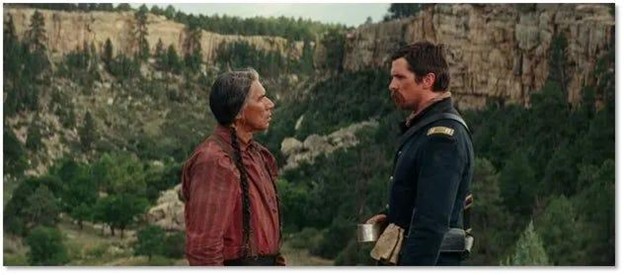
Hatred redeemed, sacrifice rewarded, the self remade: these films acknowledge suffering in full while maintaining a hidden, Christianized framework in which it can still be interpreted. The order they depict has not ceased to honor courage and fidelity and sacrifice; it merely demands a fearful price for them. It is this framework, established here as a rising stair, that The Homesman will set its protagonist upon and then kick away beneath her.
The Homesman: The Withdrawal of the Horizon
The Homesman operates on a different premise, and its severity lies precisely in what it refuses to supply. Mary Bee Cuddy (Hilary Swank) stands at the center, capable and disciplined and devout, morally serious, the very embodiment of those frontier virtues upon which the earlier narratives silently drew to keep their world from coming apart. She farms competently, she prays without irony, and she alone among the upright citizens of her territory will assume the burden that the men, the gutless spouses and the reluctant parish, have all declined. When no husband will transport the three women whom that pitiless winter has driven mad, it is Mary Bee who takes up the reins: Gro, who could no longer share a house with her mother’s stinking corpse; Arabella, whose three infants died of diphtheria within a week; Theoline, gone somewhere past speech. She recruits George Briggs (Tommy Lee Jones), a claim-jumper she has cut down from his own hanging, and the two begin the long passage east toward Iowa, toward what the film with quiet cruelty permits its characters to call salvation.

The film frames her, with a candor that is easy to miss, between two refusals. It opens upon Mary Bee proposing marriage to a neighbor over a dinner she has cooked, and being told that she is plain, and bossy, and that he is leaving to find a wife elsewhere. It returns, two-thirds of the way along the journey, to the same scene in another key: exhausted, having ridden a night in a circle through the desert and come back to the very grave she had stopped to restore, she proposes to Briggs, and Briggs, who is no farmer and means to stay no man’s husband, refuses her as the others have refused her. That night she lies with him regardless. The next morning she hangs herself.
The arrangement of these events is the whole argument. Her despair is not the abstract erosion of frontier conditions, nor a generalized loss of hope; it is something far more specific, and far more damning to the consolation the genre exists to provide. Mary Bee possesses every natural virtue the West is supposed to reward, and the West rewards her with nothing: not survival, not meaning, not even the bare human companionship that the least of her virtues ought to have earned. Strength and prudence and fidelity and piety do not merely fail to save her; they fail to purchase her so much as a husband. The film advances, through her body on the rope, the very claim the Western has spent a century constructed to deny, that there are forms of affliction the human virtues cannot contain, however genuine those virtues are, because the order that was supposed to vindicate them is no longer there.
Moments of Grace, Sealed Off
The film does not eliminate goodness; it allows brief manifestations of it and then seals them off. During a river crossing, one of the afflicted women, long silent and withdrawn, helps another across the current. The moment reveals that something human persists beneath the damage, that moral awareness has not been wholly extinguished. It alters nothing. The act stays isolated, gathering into no larger meaning and redirecting nothing, an instance of goodness that finds no continuation. In a world still possessed of its gospel, such a gesture would be a seed. Here it is a spark struck in a vacuum, bright for an instant and gone, chiefly serving to magnify its own absence in the larger narrative.

The Grotesque Echo of Bingham
The closing movement completes the inversion. Briggs continues the journey after Mary Bee’s death without assuming her moral posture; he admires but does not become a vessel of her goodness. He steals food to feed his hungry charges, and in a fit of rage he burns down the home of a wealthy man who has offended and threatened them. Having delivered the forsaken women into proper care, he has a fine stone cut for his dead heroine and plans a proper burial, an act of conscience purchased, one suspects, to ease his guilt at having refused her. But on discovering that his coveted three hundred dollars is worthless paper from a defunct wildcat bank, Briggs despairs of a settled life. Penniless, he gets drunk and boards a keelboat heading west again, an atomized loner severed from society. A passenger kicks the gravestone into the river, unnoticed and unwanted.

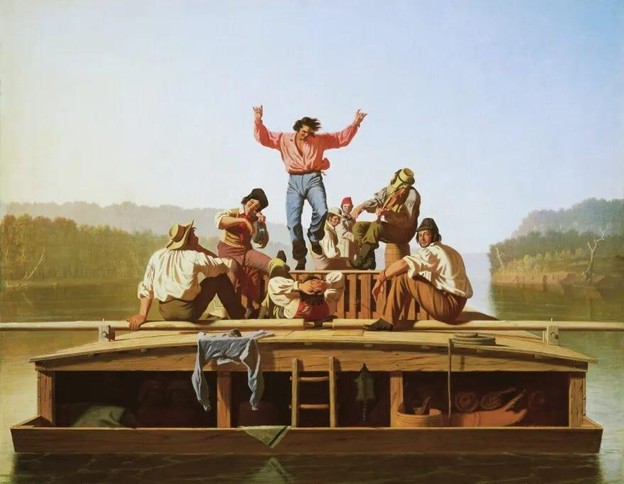
Briggs drifts into hysterical performance, into spectacle, into behavior bordering on derangement. His final display, the wild firing of his pistols from the departing keelboat, recalls in grotesquely inverted form the joyful communal energy of Bingham’s river scene. The visual elements remain recognizable: movement, music, human proximity are all still present. Only their significance has changed, curdling from fellowship into chaos. It is the Jolly Flatboatmen run backward, the same dance performed over a void, the inversion of Grace itself.
The West Without a Gospel
One might say that The Homesman presents a world from which meaning has simply been removed, an indifferent landscape, a neutral cosmos that neither punishes nor rewards. This is the gentler reading, and it is false to the film. Indifference would be a mercy. What Jones gives us is a devouring god, not an absent one, which is the thing the title rightly calls sinister. Briggs names it himself, cursing from the ferry that the West is a goddamn devil, and the film has spent two hours proving him right. This frontier is not neutral toward virtue. It is appetitive, it selects against the good, and it consumes Mary Bee precisely because she offered it the most to consume.
Here the distinction that governs everything is the one between a world that is pre-Christian and a world that is post-Christian, and it is the second that the film inhabits. The classical tragic hero suffers within an ordered cosmos; his ruin is terrible, but it is intelligible, woven into a fabric of necessity and divine attention that grants even catastrophe a kind of dignity. Oedipus is destroyed by gods who are at least looking at him. Mary Bee is destroyed by a silence. Her world has known the Gospel and lost it: the church still stands in her territory, the Reverend still presides, she herself still prays, and yet grace has withdrawn from the machinery while the forms remain, like a watch that keeps perfect time over a dead spring. This is why the film approaches the severity of Antigone without ever attaining its grandeur. This is not tragedy. Tragedy requires an order to be violated, and what remains here is something later and colder, an exposure without inevitability, a suffering that does not even rise to the dignity of being meant. This is pathos alone.
The Thomist will recognize the precise nature of the wound. Mary Bee’s virtues are real acquired virtues, her fortitude and her prudence and her justice no illusions, and the film never mocks them. But the natural virtues are ordered, in their very structure, toward an end they cannot themselves secure; their completion lies in a beatitude that only grace can supply, and absent the theological virtues that orient them beyond the visible world, they are left to bear a weight for which they were never engineered. Caritas is the form of the virtues; strip it away, and what remains is a magnificent scaffolding around an empty center. Mary Bee is a pagan stoic stranded in a country that used to be Christian, exercising heroic natural virtue in a cosmos that has quietly ceased to honor the contract. That she names one of her horses Redemption is the film’s bitterest stroke: the word survives as a noise an animal answers to, a thing one drives before a wagon, while the reality it once named has gone out of the world like heat from a corpse.
This, too, is the film’s honest half. The West has long been idealized as a place where hardship yields character and suffering produces clarity, and that idealization, for all its truth, excludes a vast portion of what was actually lived. The frontier generated psychological collapse as readily as resilience; it produced an isolation that exceeded human tolerance; it created conditions under which the bravest endurance simply failed. The Homesman restores these to the picture, and functions, at this level, as a correction of selective memory, Bingham’s dancer answered at last by the woman on the rope he never painted.
The Dancer and the Rope
To depict the West without a Gospel is not to depict a West that never heard the good news, for that West would be merely pagan and might still be tragic in the high and ordered sense. The film depicts something worse: a West that heard the news and from which it has receded, leaving the vocabulary intact and the substance gone. The familiar consolations are still on the shelf and they simply no longer work. Human effort continues, Briggs delivering the women and buying the stone and meaning well by his lights, yet the effort no longer gathers into a pattern, and the river carries Mary Bee’s marker away unnoticed, as if to insist that even memorial, even the small human refusal to let a good life pass for nothing, will not be permitted to hold.
Return, then, to Bingham’s dancer, that figure whose exuberance expresses a confidence about the very structure of the world, a confidence that the river will carry him, that labor will be absorbed, that the human form will hold under pressure because Someone has guaranteed the terms. That confidence does not appear in this film, and its disappearance is the whole of what Jones has to tell us. Briggs fires his pistols from the same river, performs the same dance, and means nothing by it but noise. A world without salvific grace is, in the end, impossible for any human being to absorb. The film’s achievement, and its cruelty, is to make us sit inside that possibility for two hours, and to deny us the exit the genre has always, until now, left quietly open.
What could Tommy Lee Jones have meant by staging so sinister a spectacle of despair? One admires the nerve of it, the willingness to inhabit an emptiness most filmmakers would flinch from and furnish with some consoling gesture at the end. And yet it is hard to escape the suspicion that Jones has shown us not a truer West but an impossible one, an alternate universe none of us has ever actually lived in and none of us could, because the thing he has withdrawn from it is the thing without which no human world has ever in fact subsisted. The film’s silence is not a discovery about reality; it is a hypothesis about it, and a false one. Christ could save such a place, and in His infinite mercy would want to. The horror Jones has built is that He is simply, and without explanation, not permitted to enter it—and that Mary Bee, praying to the last, never learns it was the world that failed her, and not her God.
Table of Contents
Christopher S. Carson, J.D., M.A., formerly of the American Enterprise Institute, is a criminal defense attorney in private practice in Milwaukee.
Follow NER on Twitter @NERIconoclast