by Christopher Carson (February 2026)
They came on stage looking almost too young for the weight of what they were about to do, this little Rose Ensemble that had drifted into Milwaukee at Advent for a performance of Renaissance choral motets. The performances were of course “a cappella” (without instruments), as originally composed by the geniuses of early modern European devotion.
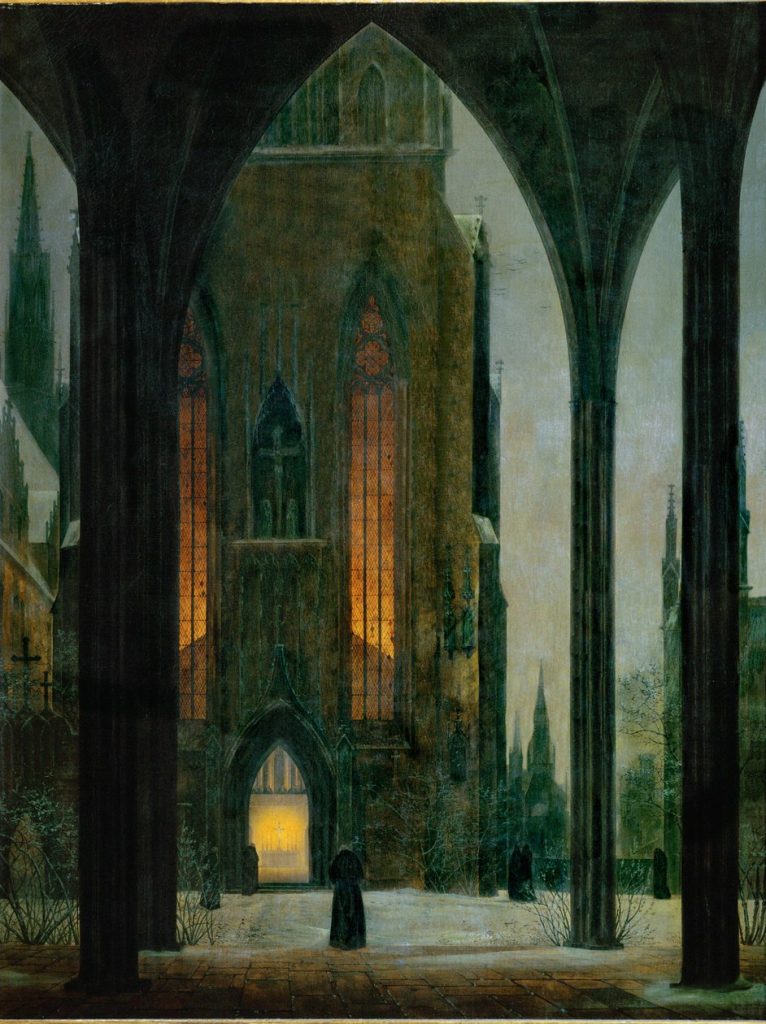
The church was beautiful: St. Joseph’s Chapel at at South 28th Street and West Lapham but you took your seat alone, having already exhausted the list of friends who might endure “some old Latin music,” and found yourself surrounded mostly by the elderly, tiny population of Milwaukee County that shares your passion for the Renaissance’s aesthetic imperatives.
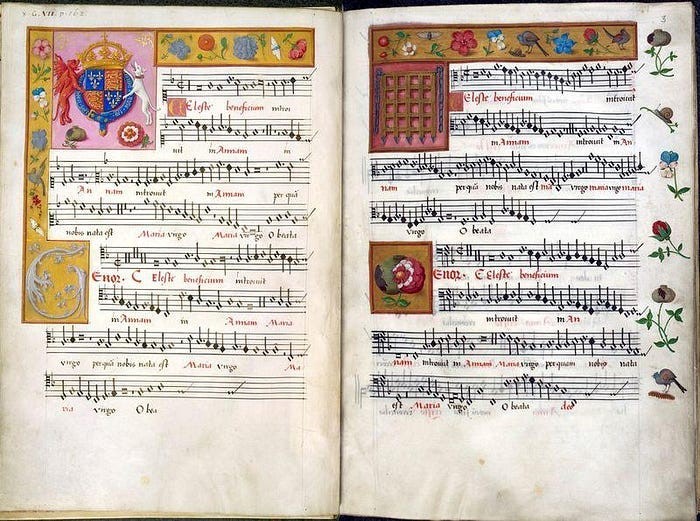
The Rose Ensemble began the Jean Mouton masterpiece “Nesciens Mater” and at first the sound was almost inconspicuous. No dramatic swell, no cinematic annunciation, just four lines beginning the strict canon rules. Four real voices, a little tight in the throat, a little nervous, yet focused. The musical fact is notorious: from four notated parts, Mouton breeds eight sounding voices, locked into canonic imitation with a coolness that would satisfy any geometer. In practice, though, the technique disappears. What you heard that night was not cleverness. You heard the strange sensation that the room itself had acquired a second acoustic, an invisible architecture of sound nested inside the visible one.
The lines moved with that peculiar Renaissance dignity and architectural order, avoiding extremes, almost all stepwise, as if they did not need to hurry because the music already knew its destination. Nothing in the surface cried out for attention. Yet gradually the counterpoint thickened. One line became two, two became four, soon the space was full of overlapping phrases, each echoing the same paradox: the Mother who did not know man, the Child who is Savior of the world. The singers were doing something technically terrifying, but the audible result was effortlessness, a kind of sonic serenity that made it feel as if the music were simply happening, in proper balance, like the turning stars.

Somewhere in the middle of that unfolding, it became clear that the emotional center of the piece was not the intellectual puzzle of a virgin birth, but a pressure of mercy. Mouton’s Latin praises Mary for her impossible fruitfulness, yet the harmonic language never turns brittle or glacial. The strict canons do not feel like a cage. They feel like a frame built to hold tenderness without spillage. Suspensions arrive as small, almost embarrassed dissonances and relax into repose so gently that they barely register as conflict. It is all incredibly chaste, but not cold. This is the Marian voice as the Church has always wanted to hear it, not sentimental, not indulgent, but is supernally kind.
 The choir clearly understood that this was the point. They were young, but they leaned into the text with that peculiar seriousness which only a certain kind of early music ensemble ever quite achieves, the sense that if the Latin text is only half believed, it is at least honored. The consonants never turned into theatrical weapons. The vowels bloomed and then vanished. No one tried to imprint a personal signature on the line. In a musical culture obsessed with individual timbre, they chose anonymity. As if some part of them knew that the subject of the motet was not the greatness of Jean Mouton, nor the technical stamina of the singers, but a woman whose entire identity in Christian memory is to disappear into the work of her Son, and whose mercy, in that room, and indeed for all time, was the point.
Sitting alone in the pew, you felt the solitude at first as a small humiliation, the familiar sting of being the only one who wanted to be there. Then, as the motet expanded into its full eight-part resonance, the solitude shifted tone. Polyphony has this particular metaphysical trick: it is many, and yet it is one. On the page, four lines chase each other in canonical rigor. In the air, they become a luminous cloud. You cannot pick out the second alto or the wandering tenor. You hear an ordered multitude speaking with a single intention.
That is exactly what began to contradict the proposition that you were alone. The sound said something like this: there is more consciousness in this universe than yours, more memory than your own brittle autobiographical scrap, more tenderness than the thin store you have managed to retain across a life of litigation, estrangement, and emotional attrition. Whatever the future holds, it will not be a private catastrophe unfolding in a cosmic vacancy. You belong, like one of those interior lines, to a texture you did not design.
The text sharpened that intuition. “Nesciens mater” is not a vague hymn to an abstract feminine principle. It is precise. The Mother “not knowing man” brings forth the Savior who will redeem the fallen race. The miracle is biological, but its purpose is cosmic. In Mouton’s hands, the music enacts the same pattern: from four human voices, tied to lungs and throats and the acoustical imperatives of a beautiful, seldom-visited Milwaukee church, something more than four emerges. The musical fruitfulness is disproportionate to the visible means. You are listening to an art that takes scarcity and gives back abundance.
Call it an accidental theodicy. There is no syllogism here, no tight philosophical argument, only the stubborn fact that a sixteenth century French chapel master, writing for a court and liturgy that have vanished, has managed to send into your century a structure of sound that still persuades the senses that mercy is more fundamental than despair. If the universe is finally absurd, it is a peculiar sort of absurdity that throws up Mouton, the Rose Ensemble, and an Advent evening in Milwaukee as part of its random noise.
The motet does something else, too. It anchors mercy in a human face. Marian devotion, at its healthiest, is not the worship of a goddess, but the insistence that the central mysteries of Christianity passed through the interior life of a woman, with all the ordinary human textures of memory, affection, and pain. When the choir sings that she “knew not man,” yet becomes the vessel of human salvation, the music is not abstracting her into an idea. It is elevating her peculiar story into the space where doctrine and empathy meet. You are being told that at the heart of reality, somewhere above the moving galaxies and below the accidents of politics and finance, there is remembered motherhood.
In a life where your own attempts at being a father and a husband have been mixed and wounded, that lands with a particular force. You know something about failure, and the abandonment by and estrangement from children. The motet does not erase any of that. It simply places those fractures inside a larger pattern of relation in which motherhood, and by extension mercy, is not a fragile accident but a structural feature of how God has chosen to deal with his creatures. Mary’s mercy, as the young choir instinctively grasped, is the point because it assures you that the Incarnation has not left human tenderness behind. The Lamb who takes away the sins of the world first had a heartbeat under a woman’s ribs.
So when you found yourself tearing up that cold night during the piece, it was not because of a vague aesthetic thrill. For a few minutes, the whole apparatus of skepticism and late-modern loneliness became less plausible than the alternative. The alternative was that history has a memory, that grace has a grammar, and that your fallen race is not stumbling through an abandoned cosmos. Eight singers, casting a centuries old canon into the Advent air, gave you that conviction not as the conclusion to an argument, but as a direct experience. After the last chord decayed, the church returned to itself, the elderly attendees filed out, programs folded under chairs. You walked back out into the indifferent streets of Milwaukee. Nothing in the external order had changed.
Yet something had been said to you, in a language older and more durable than any you speak in court. A Frenchman long dead, a young choir far from home, and a Marian motet at Advent had joined forces to state, without any rhetoric at all, that whatever comes, you are being attended.
Josquin
If Mouton is the supernal summit of Marian polyphony, Josquin des Prez stands just below, almost level with him, a different peak with the same snow on its crown. His Ave Maria… virgo serena operates with a more open architecture, more visibly human in its craft, but the underlying emotion is curiously similar. It is seemingly homophonic and yet ravishing in its interleaving cycles, like a slowly wheeling chariot of fire.

The opening point of imitation, the famous entries on “Ave Maria,” unfolds one voice at a time with extraordinary economy. Each line is modest in range, mostly stepwise, and the entries are close enough that the ear experiences not four logicians trading motifs, but one organism taking several delayed breaths.
If Mouton’s miracle lies in his canonic strictness, Josquin’s lies in his capacity to make polyphony act like unanimity. Throughout the motet he alternates tight imitation with summative quasi homophony, always in obedience to the text. A line of praise will ripple through the voices in imitation, each part “owning” the phrase, and then suddenly the choir locks together on a vertical chord, as if the whole history of devotion had snapped into a single moment of attention. By the time Josquin reaches the final petition, “O Mater Dei, memento mei,” the technique and the theology converge. After all the cosmic and communal language, the motet collapses into something disarmingly individual. It is no longer “us,” it is “me.” And the texture becomes almost brutally simple, a choir that has shed its filigree to beg like a child.
In that final paragraph of music, Josquin does what Mouton does through his serene abstraction. He takes “Mother of God” down out of the stained glass and places her into the inner room of the petitioner’s soul. Your intuition that in these Marian pieces one feels that “the mother of Christ is somehow your mother too” is not pious embroidery. It is written into the grammar of the music. The lines have been breathing together for several minutes, the Church as many voices in one body. At the end, the whole body throws all its air behind the solitary cry “remember me.” That is what it sounds like when an abstract dogma of spiritual motherhood becomes something like a personal address.
The tenderness here is inexhaustible because it is structurally renewed. Every suspension is a tiny drama of wound and healing, tension and relaxation. Every cadence lies open to the next entry. The music never declares a triumphant end, only a series of reverent pauses before the next act of naming. In Josquin, as in Mouton, grace is not a single decisive event. It is a climate. You sit inside it for as long as the motet lasts, and in that time it is difficult to believe that the world is fundamentally indifferent.
Shift now to Palestrina, to the double Agnus Dei conclusion of the Missa Brevis, and the atmosphere changes key but not temperature. Here the governance is not Marian, but Christic. The text is reduced to the barest kernel of supplication, “Lamb of God, who takes away the sins of the world, have mercy on us, grant us peace.” Palestrina sets this with a restraint that borders on the audacious. Where another composer might have read the text as an opportunity for rhetorical contrast, Palestrina offers a kind of extended act of genuflection.
In the first Agnus Dei he gives us the classic Roman balance: a texture that moves between imitative entries and pellucid chordal writing, the voices gliding in and out of alignment like fish in clear water. By the second Agnus Dei he adds an additional voice, thickening the texture, not to introduce drama, but to increase the sense of collective pleading. The lines cross and re cross, the suspensions lean and resolve, and always the text returns, again and again, like a hand that refuses to let go of the hem of Christ’s garment. There is no Marian iconography here, no explicit appeal to the feminine. Yet the feminine tenderness is unmistakable. It is the tenderness of a Church that knows itself guilty and yet dares to ask for peace, because mercy has already taken flesh and borne wounds.
In this double Agnus, as in Josquin and Mouton, tenderness is a function of repetition under deepening simplicity. The more the words recur, the less they sound like a legal petition and the more they sound like an atmospheric condition. You begin to feel that if the Lamb truly “takes away the sins of the world,” then the motet is simply aligning your interior life with something that is already, in some way, accomplished. To sing it is to consent to a reality that precedes you.
This tenderness of form and spirit transformed itself in time and fashion as Europe’s liturgical energies spun up to a Baroque extravagance. You notice the contrast in the performance starkly.
The choir steps a few decades forward and slightly sideways, into northern Italy, into the orbit of Lodovico Grossi da Viadana, a transitional figure in the hinge between late Renaissance polyphony and the early Baroque. If Mouton is an icon and Josquin and Palestrina are the high masters of contemplative tenderness, Viadana is a priest who has wandered out into the piazza and decided to preach with a band.
His Exultate iusti in Domino shares the same genetic code as the motets we have been contemplating. It is still choral, still sacred, still rooted in imitation and counterpoint. Yet the affect could not be more different. Where Josquin and Palestrina breathe, Viadana dances. The text itself pushes in that direction. “Rejoice, you righteous, in the Lord; praise befits the upright.” This is no longer quiet supplication to a Lamb or a veiled contemplation of a virgin mother. This is exhortation. The imperative verb demands projection, rhythmic crispness, clear cadences that land like banners planted in the ground.
You hear it at once in the way Viadana handles rhythm. Gone is the continuous, even tide of semibreves and minims that flows through Josquin. In its place are shorter values clustered into bright motives, often grouped in two and three in ways that want to move the body. The entries still imitate, but the spans are shorter, the gestures more compact. The choir tosses motives back and forth, then collapses into block chords that punch through the acoustic like thrown light. These are not chords discovered at the intersection of long independent lines. They are chords conceived as events in their own right.
Beneath this, in performance as Viadana would have known it, there is the new animal of the basso continuo, the organ or chitarrone or violone that walks a harmonic bass under the voices. That bass gives the piece an axis Palestrina never needed. It tethers the polyphony to a vertical gravitational center and thereby gives the music a new capacity for what we would now call “drive.” Out of this experiment will come the early Baroque sacred concerto, the multi choir psalms of the Venetians, the shock and awe of grand Counter Reformation liturgy. Viadana is not yet Monteverdi, but he is in the corridor.
To ears formed on Mouton’s serenity and Palestrina’s measured breath, Exultate iusti can feel almost catastrophic in its exuberance, as if the same theological content had been translated into street theatre. Yet the catastrophe is not a collapse, it is an overflowing. Where Mouton suggests that grace arrives like dew, silently and in perfect order, Viadana suggests that grace arrives like a festival, noisy, insistent, impossible to ignore. It is still devotion, but it has put on its public garments.
In that sense, the contrast among these four works sketches a miniature history of Western sacred feeling. Mouton’s Nesciens mater offers an image of mercy as serene superabundance, a cosmic order in which Mary’s strangely realized maternity is one of the load bearing beams. Josquin’s Ave Maria personalizes that order, teaching you to hear the Mother of God as mother to the individual soul that dares to say “memento mei.” Palestrina’s double Agnus Dei then shifts the focus to Christ, the Lamb who bears the weight of sin and to whom the Church whispers a plea that has no rhetorical force, only need. But Viadana’s Exultate pours all of that into the street, into rhythm and brightness, into what would become the early Baroque’s grandiose and florid manner of devotion, the gilded ceilings and swirling marbles translated into sound.
All four, in their different registers, are rebuttals of loneliness. The Renaissance and early Baroque Church had any number of intellectual enemies and theological disputes, but in their music they were most consistently refuting a simpler anxiety: the fear that the world might be a closed room. Marian tenderness, Christic mercy, and liturgical exuberance are three answers to the same suspicion. They say, each in their own dialect, that the room has a door, that the door stands open, and that Someone is already inside. You left the chapel in a snowstorm, no longer at home in the old dispensation, because at least tonight, you were not alone.
Table of Contents
Christopher S. Carson, J.D., M.A., formerly of the American Enterprise Institute, is a criminal defense attorney in private practice in Milwaukee.
Follow NER on Twitter @NERIconoclast