by Christopher Carson (September 2025)
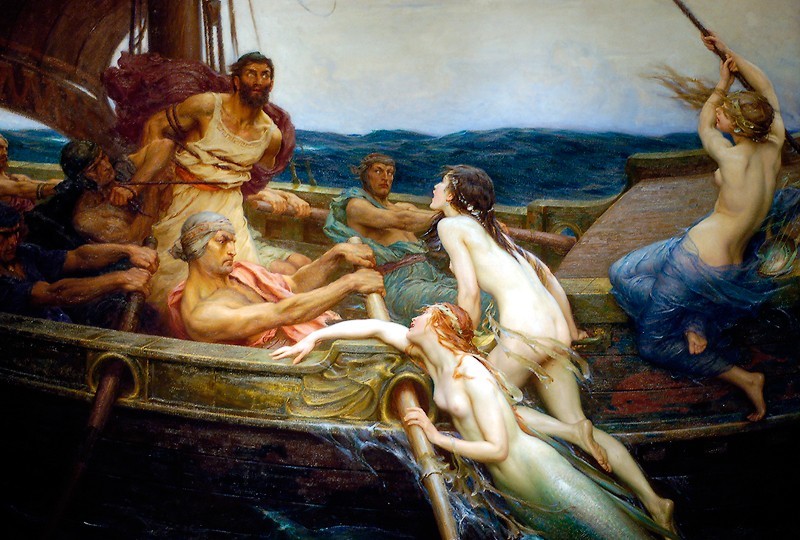
Among the many masks worn by the Western hero, none is more enduring or malleable than Ulysses. From the Homeric sea-captain to the symbolist, the skeptic, and finally the shattered ego of the modernist imagination, he embodies not one ideal but a series of competing postures toward knowledge, experience, death, and the divine. In his ancient form, Odysseus was clever, long-suffering, and reluctant to abandon hearth and home. Yet in his later avatars, he becomes something else entirely, and a figure through which Western writers stage the drama of spiritual striving: is man saved through obedience or ruined by his own ambition? Does beauty elevate or seduce? Is experience inherently redemptive, or must it be subjected to something greater than itself?
In the millennia that followed, three more renderings in particular capture the essential tension. Dante’s Ulysses, in Inferno XXVI, is a man of insatiable curiosity who transgresses divine limits and is damned. Daniel Mark Epstein’s Odysseus, in his poem “Eurylochus recalls the Sirens,” published in the New Criterion in December 2005, is a hero of restraint and submission who is saved by obedience and grace. And Tennyson’s Ulysses, in his dramatic monologue of the same name, is a Promethean figure who asserts that experience, even unto death, is its own justification. These three Ulysses offer not a linear development but a triangulation of Western anthropology. They represent the seeker without God, the sinner saved by God, and the defier who resists God yet hungers for meaning all the same.
Dante’s Ulysses is the most severe of the trio and (as is everything in Dante) the most metaphysically instructive. Not for him is the company of warriors or lovers, but among the damned in the Eighth Circle of Hell, reserved for those guilty of fraudulent counsel. He is enveloped in a tongue of flame, speaking through fire, like a perverse Pentecost. He recounts to Dante and Virgil his final voyage: not to home or glory, but to forbidden knowledge. It is a confession of intellectual hubris:
Neither fondness for my son nor reverence
for my aged father nor Penelope’s claim
to the joys of love could drive out of my mind
the lust to experience the far-flung world
and the failings and felicities of mankind
(Inferno 26.94–99, trans. Mandelbaum)
What’s so wrong about being anthropologically curious, you might ask? This is not the Odysseus of Homer but a new Ulysses: proto-modern, self-justifying, contemptuous of limit. His damnation stems not from wanderlust but the ancient sin of Pride. He trusts in human will and reason, in his own virtù e conoscenza, to carry him past the boundaries set by heaven and nature. He sails beyond the Pillars of Hercules, the classical world’s marker of the end of lawful exploration. And he is drowned for it:
Until the sea again closed over us
(Inferno 26.142)
Ulysses here represents what Aquinas would term curiositas: not the noble pursuit of truth, but the grasping after knowledge unmoored from its proper end. It is the disordered appetite for divine things on merely human terms. He does not fall like Adam but plunges forward like Icarus. Dante condemns him not because he seeks knowledge, but because he seeks it without grace. In this rendering, the very impulse of the Enlightenment is prefigured and damned in advance. Ulysses is the man of intellect without obedience; not exactly a Promethean figure, but a Luciferian one.
In our own time, the American poet Daniel Mark Epstein, by contrast, gives us an Odysseus who survives precisely by not trusting in his own strength. His poem, “Eurylochus recalls the Sirens,” is a retelling of the Sirens episode, but with theological gravity. The Sirens are not mere creatures of sensual seduction; they embody a beauty so profound, so laced with tragic knowledge, that it wounds even through wax-stopped ears:
If the stars could sing in their heavenly courses;
If the wind could intone the harp of branches;
If nightingales had accompanied Orpheus,
After the Sirens, they would seem like noise.
The Sirens promise forbidden insight:
Come, come, famous Odysseus…
By Zeus, you shall know the past and future.
What they offer is not pleasure, but gnosis: precisely the kind that destroyed Dante’s Ulysses. Yet Epstein’s Odysseus does not succumb. He is bound to the mast by his crew and saved by obedience to a higher instruction:
But a voice inside us or above,
Made us true to more than the moment;
And so we tied him faster to the mast.
That phrase “a voice inside us or above” distills an Augustinian insight: the distinction between the inner voice of conscience and the transcendent Word of God is not always clear, but its origin is higher than the self. Epstein’s Odysseus is not a master of his own destiny. He is spared not by cunning but by submission. He endures temptation because others are faithful on his behalf. This is not the Pelagian hero who earns salvation by effort. This is a man preserved by gratia praeveniens—prevenient grace that prepares and protects.
In the end, he remembers the Sirens’ song not as glory or trauma, but as a fading echo:
Sometimes I hear the exquisite refrain,
Though kindly it grows fainter every day.
Memory here is not condemnation but purification. The soul remembers the temptation, but its sting has been drawn. Augustine, in Confessions, speaks similarly of how sin lingers in memory even after conversion, but as a wound healing, not festering. The final line of Epstein’s poem is quiet and absolute:
I welcome our voyage into the dark silence.
This is not nihilism. It is a relinquishing of disordered desire. Epstein’s Odysseus accepts finitude. He does not rail against the divine. He rests in it.
Tennyson’s “Ulysses,” composed in the aftermath of personal grief and national uncertainty, rejects both Dante’s judgment and Epstein’s submission. He will not be punished, and he will not obey. He will persist. Tennyson’s Ulysses is aging, tired, but unyielding:
I cannot rest from travel; I will drink
Life to the lees.
He refuses domestic comfort, handing off kingship to his son Telemachus and calling his mariners to one last voyage:
Come, my friends,
’Tis not too late to seek a newer world.
He does not mention heaven. He does not mention grace. He worships motion itself:
To strive, to seek, to find, and not to yield.
This is not the curiosity of Dante’s Ulysses nor the obedience of Epstein’s. It is heroic fatalism, a defiance that is itself the point. Experience is his salvation. One recalls Nietzsche’s Zarathustra, who teaches that one must love the eternal recurrence of things. Tennyson’s Ulysses accepts no redemption beyond what the soul makes for itself in motion. The western stars are not the gate to heaven, but simply the last horizon before the dark.
And yet, Tennyson’s final word on the matter is not found in “Ulysses,” but in In Memoriam A.H.H., the massive elegy to his friend Arthur Hallam. There, the poet undergoes a profound theological journey. At first, he is tempted by materialism and despair. Nature appears callous:
So careful of the type she seems,
So careless of the single life.
Yet he cannot remain there. The elegy bends toward faith, not easily, not triumphantly, but steadily. He begins to see that all our systems are broken reflections of something greater:
Our little systems have their day;
They have their day and cease to be:
They are but broken lights of thee,
And thou, O Lord, art more than they.
The final canto is a quiet apocalypse. The poet sees not merely the dead restored but the cosmos transfigured:
That God, which ever lives and loves,
One God, one law, one element,
And one far-off divine event
To which the whole creation moves.
Here at last is the peace Epstein’s sailor welcomes and Dante’s poet intuits. Even Tennyson, whose Ulysses strode into death for experience’s sake, at last yields—not to despair but to the Christ.
The final stanza reaches a crescendo of eschatological hope:
That God, which ever lives and loves,
One God, one law, one element,
And one far-off divine event
To which the whole creation moves.
If Dante’s Ulysses is the man who refuses God and is punished, and Epstein’s is the man who submits and is saved, then Tennyson gives us a third type: the one who defies, but in the end, mourns the silence of God and strains to hear it again. His faith is not obedience but longing. His salvation is not assured, but desperately desired.
And what of our own time? James Joyce’s Ulysses gives us a final mutation—Leopold Bloom, the modern everyman wandering not across oceans but across Dublin. He is not seeking knowledge or glory. He is seeking lunch. He is not tempted by Sirens but by loneliness. His journey has no clear end because the structure of purpose has collapsed. The epic becomes interior. The myth becomes parody. The sacred becomes opaque. Bloom does not ask what lies beyond the Pillars of Hercules. He asks what kind of kidney to eat for breakfast. And yet, in his small gestures of kindness and endurance, something of the old hero remains, not as a figure of grandeur, but of endurance.
In this disintegration, one sees both the cost and the residue of the Western imagination. The hero has been punished, has been saved, has been defiant, and has been dissolved. What remains is the question each Ulysses posed in his own way—what is man’s journey for? Toward what does he sail? The Sirens still sing, but their music no longer promises knowledge. It promises distraction. And the mast to which we might be bound is no longer sacred wood, but the lonely iron of the self.
In the end, only one Ulysses hears the song and does not perish. Only one is saved. He is not the strongest. He is not the bravest. He is the most obedient. And that is perhaps the final scandal of the Western canon—that the one who conquers temptation is the one who is willing to be bound.
Works Cited
Aquinas, Thomas. Summa Theologiae. Translated by the Fathers of the English Dominican Province, Benziger Bros., 1947. Referenced in the discussion of curiositas (II-II, q. 167) and gratia non tollit naturam, sed perficit (I, q. 1, a. 8).
Augustine. Confessions. Translated by Henry Chadwick, Oxford University Press, 1991. (Especially Book X, on memory and the lingering wound of temptation, and Book I, on grace and divine love.)
Dante Alighieri. Inferno. Translated by Allen Mandelbaum, Bantam Books, 1982. Canto XXVI, the episode of Ulysses, lines 94–142.
Epstein, Daniel Mark. “A New Poem.” Unpublished manuscript, 2025. Full poem used by permission. Provided by author and analyzed in thematic and theological detail.
Joyce, James. Ulysses. Edited by Hans Walter Gabler, Vintage Books, 1986. Referenced for postmodern fragmentation and the secularized descent of the Ulysses archetype into quotidian parody.
Plato. Symposium. Translated by Alexander Nehamas and Paul Woodruff, Hackett Publishing, 1989. Diotima’s speech on the ladder of love (210a–212b), referenced as a classical analog to the theological ascent.
Tennyson, Alfred Lord. “In Memoriam.” A.H.H. Edited by Erik Gray, Norton Critical Edition, W. W. Norton & Company, 2004. Sections LV, CXXVIII, and others cited for theological meditation on nature, grief, and eschatology.
Tennyson, Alfred Lord. “Ulysses.” In The Major Works, edited by Adam Roberts, Oxford University Press, 2009, pp. 155–156. Full text analyzed as the Promethean rendering of the Ulysses archetype.
Table of Contents
Christopher S. Carson, formerly of the American Enterprise Institute, is a criminal defense attorney in private practice in Milwaukee.
Follow NER on Twitter @NERIconoclast









One Response
This is a very good read with fine, relevant verse. Of all the views, I prefer James Joyce’s as the final epiphany. “He is not seeking knowledge or glory. He is seeking lunch.” The idea that the spiritual journey consists of many small things, including the small ego.