by Albert Norton, Jr. (November 2025)

I’ve long had a concern about rising totalitarianism, and the ways it now looks different from its communist and fascist precedents. In various essays and book reviews of late, I’ve seen Fyodor Dostoevsky’s book Demons (a/k/a The Possessed) repeatedly mentioned, as an illustration of how totalitarianism gets its footing. So I read the 700+ pages for myself, and can happily report what I found to you. This is not a book review, exactly, but rather a summary of elements to incipient totalitarianism that Dostoevsky presciently wrote about in the 1860’s. My translation was that of Richard Pevear and Larissa Volokhonsky (Vintage Books 1995), and so page number references are to that volume.
I’ll say what I didn’t like about the book before getting to the more important stuff. As much as I admire Dostoevsky, I think he’s got some structural issues, starting with the fact that there’s a first person narrator who regularly slips into omniscience. Omniscience means the author is all-knowing and can just tell the reader anything he wants at any time. That sounds easy, but it’s not, in fact it’s limited in that the author can’t routinely break the fourth wall, so to speak, by directly lecturing the reader. On the other hand it’s perfectly fine to talk about eternal verities without placing oneself in the story. My favorite example of this is from a contemporary of Dostoevsky’s, George Eliot, in her 1863 Romola:
Our deeds are like children that are born to us; they live and act apart from our own will. Nay, children may be strangled, but deeds never: they have an indestructible life both in and out of our consciousness.
Dostoevsky in Demons has his first-person narrator drift off into omniscience by saying things he could not possibly know within the context of the story, for example by describing for us events for which he was not present and which he did not hear from some other character.
Another point of critique—since I’m so qualified to point out the flaws of one of the greatest writers who ever lived—is possibly an issue of translation from the original Russian. “Fear” is often used when the author meant the character was startled, as by some abrupt intrusion or sudden realization. There are a few other malapropisms, again possibly because Russian and English do not share equivalents. Differing languages are not just word substitutions, but reflect differences also in culture. It could be, for example, that English has lots of words to shade the distinctions among forms of wild surmise, whereas Russian has just one, perhaps reflecting a cultural difference in which the precise nature of the agitation is unimportant in Russia.
Those little cavils aside, Dostoevsky is showing us psychologically how radicalism grows and flourishes in the pungent soil of nihilism. The radicalism involved here—1860’s Russia—is what we would later simply call Bolshevism, but in the run-up to the 1914 Russian revolution there was first the freeing of the serfs in the 1860’s and the slow tumultuous deconstruction of the nobility and related social hierarchy. The Russian experience was a special case of what was called elsewhere in Europe at the time “anarchism.” We take that to mean simply lawlessness, but back then it was used to mean something like ill-defined deconstruction for the sake of deconstruction, the liberationist impulse run amok, kind of like with Antifa today.
It is essentially nihilism, as Seraphim Rose explained it, in his book actually titled Nihilism. It is the necessary descent that begins once we put on blinders so as to box-in our imaginations against God. We then imagine there is somehow ultimate truth and good and justice without Divine authority. But then we see that’s stupid so we imagine truth and morality (and beauty!) is something we just kind of feel, changeable with time and circumstances, and then we start to realize that the only reason to say x is true and y false, or x good and y evil, is social consensus, and if that’s the case then truth and morality can be moved and shifted over time through “activism.”
This is moral relativism and subjective, individualized “truth.” All-against-all conflict is inevitable. This is a triumph of the transgressive spirit of negation, the spirit of the French Revolution and nihilism and anarchism and antifa and self-justification of any moral question, to the point it seems justified to just go shoot someone who starkly disagrees with the devolution, like Charlie Kirk. I can almost imagine the hatred someone in the deconstruction camp must feel for someone so strongly in the building, reconciling, and achieving camp, as was Kirk.
There are those who oppose moral structure, whatever form that structure might take. There are those in the middle, who don’t really know what to think until the social wind blows to inform them. And then there are those who don’t fight eternal moral structure, seeing it etched in the stars, so to speak, the logos of the natural order which quietly but unambiguously testifies that there is an Author who holds up the implicit rationality of the cosmos and the unchanging architecture of moral good and evil.
Dostoevsky does show the ease with which an individual is driven to strive for the breaking down of society, with no coherent plan for what should take its place. Deconstruction is his purpose, including, ultimately, self-destruction. Only the “how” is answered: blood and death. A violent dismantling from below. Dostoevsky’s characters personify such tendencies, in this case in the character is Pyotr Stepanovich. He is a master at stirring society up against itself, chiefly by making the old guard look like the self-satisfied superficial dupes they are, like many conservatives in the pre-Trump era.
There is another driving force behind it, which Dostoevsky also personifies: the character Nikolai Stavrogin. Pyotr Stepanovich looks up to Nikolai Stavrogin precisely because Nikolai Stavrogin is the demonic force behind the revolutionary spirit. And yet Nikolai Stavrogin is not one of the revolutionaries himself because he doesn’t serve a cause, he serves only himself. Serving oneself (Nikolai Stavrogin) is the spirit behind serving revolution (Pyotr Stepanovich).
The reference to actual demons, in Demons, is sotto voce, I thought, all through the book. But there was an originally-censored sub-chapter that for some reason was included in my volume at the end, I suppose because the editors/translators wanted to present the book as originally published but then also provide this. Too bad, really, because this previously-censored add-on is significant.
It centers on Nikolai Stavrogin. In the anti-hierarchy of villains, Nikolai Stavrogin was at the top (or bottom, should I say?) even though he wasn’t one of the revolutionaries himself, because he lived so completely for himself and his momentary pleasures no matter who it hurt. But in this last chapter it’s clear that he’s morally tortured by his own misdeeds to the point of wanting to make a full written confession of the most horrible misdeeds you can imagine. Despite the depth of his regret, he doesn’t want the confession known until his death by suicide, as if to put an exclamation point on his ultimate nihilism.
Except it’s not ultimate nihilism really, is it, if he feels guilt? This all comes out in Nikolai Stavrogin’s interaction with a monk to whom he has gone for confession, though he scoffs at religion. (I’ve read elsewhere about the role of Orthodox ascetics in the resolution of conflicts, for example it’s brilliantly shown in The Brothers Karamazov, so this exchange is not at all implausible). Nikolai Stavrogin believes in actual demons, especially his own, though he doesn’t believe in God.
I realize the chapter was originally censored because of the nature of Nikolai Stavrogin’s depravities, but it certainly wouldn’t be now, we read news headlines every day that are worse. No one asked me, but I’d have plunked that censored section right where it really goes in the novel, and leave it in, because it is the best explication of moral philosophy in the book.
Back to the main influence of demons, or “demons”—take your pick. One of the co-conspiring anarchists made a full confession after a crime of murder, and explained the rationale. Dostoevsky would say the murder was the product of demonic influence. This is from pre-Bolshevik literature concerning nihilism, remember. As to why the crimes had been committed, it was all:
For the systematic shaking of the foundations, for the systematic corrupting of society and all principles; in order to dishearten everyone and make a hash of everything, and with society thus loosened, ailing and limp, cynical and unbelieving, but with an infinite yearning for some guiding idea and for self-preservation—to take it suddenly into their hands, raising the banner of rebellion, and supported by the whole network of fivesomes [think Antifa cells] which would have been active all the while, recruiting and searching for practically all the means and all the weak spots that could be seized upon. (p. 670)
Sound familiar? This book is an excellent explainer of how a spirit of negation works in us to motivate us to do evil because we believe it will somehow bring about good; about how the sundering of all social forms and all ties including family ties—but not those of one’s co-ideologues—is imagined necessary to bring about some golden age. There is no utopian vision here, really. It’s just a conviction that whatever we end up with will be better than what we have, because the negators fail to understand the problem is right there in their own hearts, not in a contrived social system weighing us down. This book published in 1871 is about 2025.
A few more notes on Demons. The long lead-up to Pyotr Stepanovich Verkovhensky and Nikolai Vsevolodovich Stavrogin has to do with their parents directly and as representatives of the often frivolous bourgeois of the upper-middle class. The environment created by Stepan Trofimovich Verkhovensky (Pyotr Stepanovich’s father) and Varvara Petrovna Stavrogina (Nikolai Stavrogin’s mother) helps us see how the contempt of the next privileged generation grows. The forbears are tightly interconnected socially (unlike the atomistic revolutionaries) but in many ways are frivolously over-concerned with honor, dignity, and social standing. 80, 86, 89 provide some examples. They are rightly concerned with the negative character traits of the rising socialist-leaning generation, e.g. 77, but don’t see how their own wavering convictions contribute to it.
Why don’t people just kill themselves, wonders silly Stepan Trofimovich, as he stumbles toward understanding the outlook of the generation following. He dimly perceives this is the ultimate conclusion of anarchism (or nihilism) as he sees it (94ff, 113, esp. 114-17). Fear of God and eternity makes man weak; the Nietzschean New Man will overcome and no longer fear the pain God induces, in the nihilist vision (115).
“Tendency” as used by the characters means, I think, the historicism of Hegel, the new zeitgeist, whereby history itself replaces God, generating meaning in social process (129). They have this word for it, “tendency,” because the idea then was relatively new, unlike now, when historicism is the water we swim in. Without God, geist becomes dialectical materialism, and in fact the revolutionaries in Demons are explicitly Marxist, and in its rather more pure classical form, given the times, rather than the cultural forms it takes today. Even the old guard, in the novel, is slowly waking up to the fact that history itself replaces God, for the next generation, and this marks an epochal shift. It’s a new, third era: cave man to God-fearer to New Man.
Shatov, who will be one of the victims of the plotters, despairs of life but pulls out of the secret activities because he sees its vacuousness. The revolutionaries won’t let him go and contrive to kill him. Shatov’s tenuous nihilism is shattered by new life, when his wife returns to him and is pregnant with Stavrogin’s child, incidentally (593). This assures his murder because he’s more dangerous than ever. In his more revolution-oriented days he said “to start a rebellion in Russia one must inevitably begin with atheism.” (226.) This is true everywhere, however, not just Russia.
Kirillov is in the same position as Shatov, but he resolves to kill himself, with the perverted urgings of Pyotr Stepanovich, who, with demonic facility, appeals to Kirillov’s morally confused vanity, saying to Kirillov “it’s loathsome for a decent man to be in the world.” (614-18.) “Life is, and death is not at all,” says Kirillov in his moral confusion, adopting yet another ideological twist which is, in the end, just another form of nihilism (236). His ideological capture is complete, when he says “thinking makes it so,” as when he imagines a bright-green leaf in winter. 237. “Everything is good.” Just deny evil, or the evilness of evil acts. This refers to the supposed amorality of nihilism. When they discover their innate goodness, evil will cease (238).. The “man-god” will then replace the “God-man.” (238.)
Shatov and Kirillov, who had earlier travelled together in America, wanted to leave the “society” of revolutionaries, but they know too much. Hence Shatov will be murdered, and Kirillov will kill himself.
“Every man is worth an umbrella,” says Nikolai Stavrogin at 270. This statement cuts both ways. Every man has worth, yes, but that worth is no greater than that of an umbrella. This is the effect of the nihilist revolution. The idea is to develop New Man as an ineluctable cell of society, not to acquire individual dignity in the face of evil. In the new dispensation of nihilism/antinomianism/anarchism/communism, man is worth an umbrella but no more. We’re to acquire utopia at the cost of our individual souls.
Rebellion necessarily requires a thinning of filial respect (e.g., 306). The rebelling generation doesn’t just trash the values of the preceding generation, but the people of that generation as well, including mothers and fathers and all the old-world ideas they represent. Family connection must take a back seat to ideology. One of the revolutionaries referred to as “girl student” explicitly repudiates the commandment to honor one’s father and mother. The commandment is found in religious text, and anyway parents represent tradition, which is to say moral standards codified in traditional norms, and all of that is supposed to be swept away by the new system (397).
Elitism is an inevitable result of ideological revolution (308). The evidence for this is throughout Demons, but I point to another example, in the 1981 movie Reds, with Warren Beatty, set in the years of the Russian Revolution. There’s a scene on a train car in which the revolutionaries, in their ratty proletarian clothes, cluster around a rickety table in a shabby train car to talk about the great revolution to come. And then a later scene, when the revolution is well on its way. The Whites have been defeated and the Reds are ascendant, and especially these young radicals, now a little less-young, and the camera pans them from exactly the same angle on the same kind of train car, but this car is not shabby, the table is not wobbly, the drinks on the table are not weak tea, there is a fine tablecloth and the same revolutionaries sitting around it are attired in fine clothes, speaking in low bureaucratic tones instead of their former fiery rhetoric. What happened? An inevitable rise of the elite. Experts must govern society, which is now run by human-made rules, a system to run on its own, though the system is still being refined, by these very people, the new managers of the engine of state socialism.
There were excesses of artificial aristocratic hierarchy in the old Tsarist regime, no doubt. But this is qualitatively different. Society is going to be run on “scientific” principles, in the new dispensation. Not by knucklehead elites of the quasi-nobility, like the character von Lembke in Demons, but by a vast cadre of specialists who together will run society like a vast machine.
Technocrats don’t rule the day, however. After the Revolution it will be the foremost Bolshevik ideological agitators. The technocrats are to be below the ruling elite. This feature of the progress of nefarious ideology is matched in Western “democracies” now, in the uncomfortable half-realization that self-appointed elites call the shots and not those ostensibly accountable to the vote. A difference is that instead of a dictatorship of the proletariat to install the technocrats, we have Narrative, a story shaped by the elites to which we must adhere, on pain of being cast out from polite society. It is the story that contains the new operative fluid values and regnant “truths” about human nature and our place in the machine.
All this is enabled by the feeble lack of self-confidence of the old guard, in their own institutions. The same von Lembke (back to Demons, now) says at one point to the chief revolutionary Pyotr Stepanovich: “We merely hold together that which you are shaking apart.” (314.) But the governor is a weak man who quails before the imagined strength of the rebellion. Von Lembke personifies the vacuous self-satisfied pomposity of the old guard.
Vague utopian vision: “In the new order there will be no poor at all.” (339.) This from one of the compromised bourgeois, Varvara Petrovna, which makes it doubly silly. The first silliness is that there is no specific vision for the revolution, ultimately, especially not as early as the 1860’s. For decades into the communist revolution in Russia (and in other places it has erupted, for that matter) the urgent need is theory-theory-theory, precisely because the communists had no clear vision of where they were headed, other than an imagined withering away of the state, but how that was supposed to happen was entirely unexplained. So, the proposition that poverty would dissipate, after the revolution, was completely unsupported.
The second silliness is that this comes from the mouth of one of the old guard, a rich aristocrat with no ideas of her own aside from retaining her social status, but with a desire to be hip to the new ideas rather than be seen as a relic of old Russia now rendered irrelevant. And so it is now, when cultural elites glom onto the stupidest ideas imaginable—like the proposition that one can change one’s sex—because not doing so puts them on the outs with the new wave. Like Varvara Petrovna, they don’t want to be “on the wrong side of history,” and that’s more important than being factually correct, because time itself is the agentic truth- and meaning-making vehicle. They may sense, but not understand, that their obsequious acquiescence to the revolution’s shibboleths marks a larger sea-change in understanding reality than they overtly realize: there is no objective nor absolute truth, in the revolutionaries’ paradigm, but all truth and all morals and all of reality, for that matter, is now socially constructed. The likes of Varvara Petrovna cravenly repeat revolutionary talking points even as they’re being led to the tumbrils.
This book is as much about the pusillanimous old guard, who don’t understand their own foundations for legitimacy (e.g. the Orthodox Church) as it is about the new nihilists. E.g. Yulis Mikhailovna von Lembke, the governor’s wife, is a silly cypher for both directions, able to speak out of both sides of her mouth, often nearly simultaneously. Like with Varvara Petrovna and the governor von Lembke, it is useless to maintain the old moral order because they don’t understand it, only the trappings of it beneficial to them (344).
“[T]he whole essence of the Russian revolutionary idea consists in a denial of honor.” (371.) True, and this follows from the denial of God, because how does one measure such a thing as “honor” if there is no fixed understanding of right and wrong, so that we can observe one acting to standards of unchanging virtue even when there is a cost.
There is a hint of instability in the revolutionary attitude. The revolutionaries are constantly denouncing each other to other revolutionaries, as a mark of their revolutionary bona-fides; that is, their fidelity to abstract transgression for its own sake and to ill-defined utopian goals, rather than to actual people (396). It’s a matter of virtue-signaling, just like putting a BLM sign in your yard. Or one of those signs that says “In this house,” followed by vapid principles like “we believe in science.” Virtue-signalling with a literal sign.
Shigalyov was a sort of goof among the amateur revolutionaries, but he took the trouble to write out his system, which he proposed to impart over the course of ten meetings (402). The significance is that it’s all a system, and so operative unto itself, perhaps, but unconnected to the reality of rational order, of mankind’s nature and the logos. Accordingly, he had to admit that the result of all his systematic social formulations end the same way: “starting from unlimited freedom, I conclude with unlimited despotism.” He was treated by his comrades as a fool, but he was right. Pyotr Stepanovich had no illusions about this, in a later exchange with Nikolai Stavrogin: “We’ll extinguish desires: we’ll get drinking, gossip, denunciation going, we’ll get unheard-of depravity going; we’ll stifle every genius in infancy. Everything reduced to a common denominator, complete equality.” (418.)
The “woman question,” female “liberation,” is central to the revolutionary quest precisely because, aside from stirring dissension within households for purposes of general “shaking” of status quo, it makes the personal political (462). We are all the state; the state is all we are—the essence of both communism and fascism. Note feminists are described here as “women who embodied in themselves the woman question.” As with all dehumanizing ideologies, the ideologues don’t merely adopt a set of beliefs about how things might be better, but they “embody” those beliefs. Sane people hate woke principles. The woke don’t hate sane principles, they hate the sane. They inhabit the ideology; it fully defines them; they are nothing without it. That’s precisely how the bungling revolutionaries in this book behave, and how actual revolutionaries behave in all movements of nihilism, anarchism, and antifa-led madness.
As now, there is a sudden rush to capitalize on signs of instability. This is “accelerationism” (473), and signs of it are everywhere now, just as they were in Dostoevsky’s Russia. It is the deliberate seizing upon events of disruption to make them even worse, to hasten disorder and so to magnify the sense of urgency for revolution. When the public mood seems to favor disintegration, add fuel to the fire. There may be a pull-back, but each such event ratchets us up a notch to more chaos. Each such opportunity hastens the ultimate disorder.
And yet, all is not chaotic all the time. The revolution is a staged and controlled process, and the existing bourgeois are unwittingly complicit in it because they run around giving assurances instead of warnings. It’s much like the “moderate” conservatives of today responding to leftist agitation excess by urging a return to “conversation” and political normalcy, but their normalcy is only a slow and measured capitulation rather than a sudden one. It preserves their standing but gives away civilization to the barbarians. This is the National Review wing of the conservative party, the Mitt Romneys and Bush’s, hapless von Lembke’s who urge “lowered temperatures” so we can get back to giving away the inheritance of Western civilization piecemeal rather than all at once (486).
“Peace, peace,” they seem to say, when there is no peace. (Cf. Jeremiah 6:14 and 8:11.) The false peace is a dangerous deception that provides false comfort and prevents us, like the proverbial frog, noticing the heat being turned up incrementally. The pitiful response to revolution is to pretend we can compromise or come to accommodation, but it’s equivalent to making a deal with the devil, who bargains much more aggressively than “moderate” stooges on the right who serve as unwitting collaborators. We make this mistake when we think we see some glimpse of humanity in the negators and so we’re tempted to give a little to evil, thus ratchetting down another step (584).
As in Dostoevsky’s day, so in ours.
Table of Contents
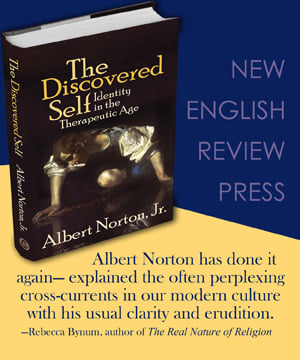
Albert Norton, Jr is a practicing attorney and the author of several books on the intersection of religious faith and postmodernism, including most recently The Discovered Self: Identity in the Therapeutic Age and The Mountain and the River/Genesis, Postmodernism, and the Machine. You can follow him at albertnorton.com and albertnorton.substack.com. .
NER on Twitter @NERIconoclast








4 Responses
Very good. Thank you.
Thanks for reading. Pretty cheeky of me to insert a bit of critique at the beginning.
Well expressed. This is the downward part of the trajectory. So, what do we do as the water warms toward the boiling point? Cavil and go along until we float belly up? Or fight back, not with useless words but with useful weapons? I know what my choice is, i hope others choose it as well.
Thank you for your elucidative article.
Fight, I say. The difficulty is figuring out with what, and against whom. I think our fight is with the principalities and powers, and so our best weapon is intellectual clarity. I am ever more convinced that evil creeps upon us because we let the devil tell us what words mean.