by Ryan Larson (February 2026)
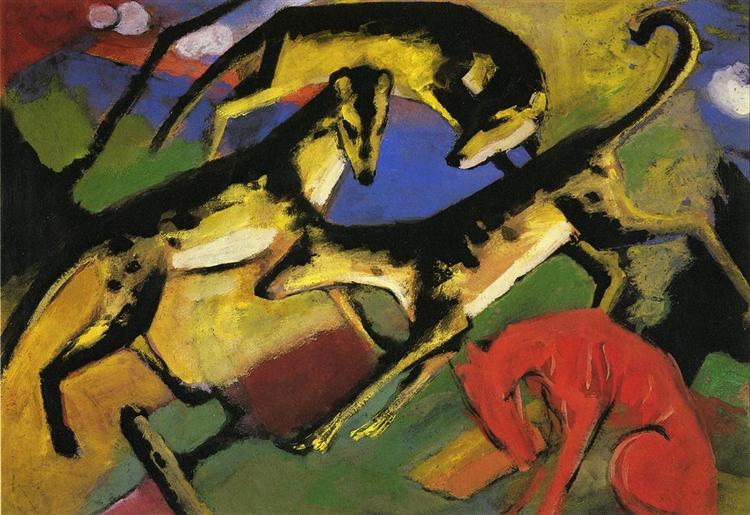
Isaiah halted. The dogs scattered and regrouped, raising their stony-faced heads in curious deliberation, pacing in and out of the harsh beam that split the morning mists. Some loitered warily in the undergrowth beside the highway; some sat statuesque in patient examination, the glinting half-moons of their eyes shining cooly and without emotion. He counted five, but they shifted in and out of shadow so easily that there could have been more; at any rate, Wooley was absent. Isaiah had not seen Wooley for over two months now.
It was the time of the day when the sun first began to make its presence known, though the trees still slumbered in silent darkness. A note of blue daubed against the sky to the east; the stars were dimming. Creation was cool and wet. Crickets and cicadas sang, unobservable in the woods, trilling to the promise of morning warmth. The artificial white sweep of the flashlight was the only potent source of light, as the road had no streetlamps. The house the Abneys lived in, a quaint rotting skeleton of a mobile home, sat moldering twenty feet from the shoulder of the mountain curve, and its side was pebbled black from the asphalt pebbles thrown by passing cars. It was the kind of road that was designed to be taken at 25 but just safe enough to be taken at a gentle 65; at night they would scream by: teenagers on joyrides, druggies on to dropoffs, cops after the druggies. To the Abneys, they were just cars. They did not mind the noise so much—it was either the cars in the mountains or the train in the town, and the train was much more persistent and much louder. It was not the whistle of it, for that was punctually rare; it was the infinite screech of iron on rusted iron as car upon car limped on to unknown depots. From the Abneys’ house it was a mere whimper in the night, only audible if they listened closely and turned their ears to it. At the moment, as Isaiah’s mind was occupied, it never occurred to him that the train was passing through town on its way up to Chicago. The patch of infertile land between the road and the trees was dappled with grass poking up between stones of all sizes, crushed concrete, bits of rebar, beer cans, glass shards. The dogs pawed it restlessly, treading lightly and carelessly over the beaten terrain.
Isaiah counted again though he knew he did not need to: five; and he could not tell any one from any other. He did not feel disappointment—he was past that: he felt the hope that had been waxing in the three days of their absence crumble, disintegrate, go to nothing. He knew that the specter floating in his periphery was not immortal; twelve years was a long time for a dog to live anyway, or one of Wooley’s size.
It was a silly name, he knew, but he was only four when he chose it. It had been a long, tiresome Christmas. There was too many consolatory presents to be opened and too few people in the house. In those days the house was a trim, tidy little cabin, with a fresh-painted interior warmly lit by many-colored strands of cheap lights in the corners of the ceiling. The tree was plastic; the week-old sweet potato dish sat molding on the counter. The living room, neatly shoved between the bedroom and kitchen area, was comfortably close but not claustrophobically so; in those days the walls had rough textures that Isaiah liked to run his fingers across. It had rained all night, not cold enough even for sleet; the lace shade was pulled across the living room window but the grey tones of the rainy morning seeped in and dampened the little house. Isaiah woke up and came into the room trying to form inadequate questions in his clumsy tongue, which were not questions but the shapes of questions, the outlines. His father did everything he could have done; it was a peaceful, bountiful Christmas and no convenience was forgotten.
They ate their scones in thoughtful silence, surveying the clumps of crumpled wrapping paper strewn across the carpet with mock contentment. Then, just as Isaiah was beginning to gather the refuse and prepare his mind for another bleak year, Jeremiah Abney suddenly stood and announced with a gleaming air that there was one more gift. Suddenly it occurred to his son that he had been hiding something all morning: those secretive smiles were more than those of a proud parent but rather those of a secret-keeper, a self-confidant. Isaiah realized that he had known this unconsciously and had been in a state of anticipation all morning. The image of his father stooping across the room in swift strides, casting a mischievous look back at his beneficiary, embedded itself in Isaiah’s memory and, in subsequent years, brought itself forth unannounced and uncalled for quite often.
Jeremiah Abney’s back was bent thoroughly as a result of his many long years at the coal mine, hauling boxes of equipment here and there, unloading, reloading, going this way and that wherever directed. On the somewhat rare occasion that his occupation called him into the depth of the black beast itself, he came home stained black by fine coal dust that gave him the look of a burnished bronze statue. Isaiah would use the black chalk dust that was left in a residue on everything his father touched to draw pictures on the walls, and the pictures would remain undisturbed before the slow erosion of the ceiling fan faded them into dusky shadows. Jeremiah liked his job very much, or at least he took much pride in it. He had a thin, long face with protruding eyes and a continuous layer of two-week stubble across the lower half of his face, thick and bristly. His hands were large and calloused, with thick muscly fingers and years of near-invisible scars. He was the sort of man who deserved to be the head of a large prosperous family but got on with his lot the best he could. His eyes continually crinkled with smile lines, laughing at his own secret jokes; that was the way Isaiah usually tried to remember him.
As his father stole away into the cramped pantry that served as the laundry room, he placed himself on the couch and folded his jittering hands in mock poise. When he saw the first corner of the dark blue plastic crate scrape into the living room, Isaiah lost all restraint and rushed over to it with wild uncontrollable excitement, pressing his face eagerly into the metal grate.
Until he was twelve or so years old, Isaiah’s eyes always drifted slightly apart. This gave him a slightly confused look most of the time, and his father endearingly said he looked like a billy goat. He habitually stared off into the distance when not engaged in anything, which was often. Most summer days found him wandering and wending his portion of the woods, a scrap of land that wrapped over the top of an ancient nameless hill; undevelopable land. The road bordered it on one side, with the one-story house right in the fringes of it, and it gradually bled down into a decrepit neighborhood a quarter mile to the south. The mobile home shared the lot with two others, both abandoned. One had been slowly imploding with time, inch by creaking inch, since anyone could remember; the other had been left to rot after its ninety-year-old tenant, called Mrs. Paige, was found by a bill collector in a state of half-disintegration three months after her death. Both houses had been picked over so thoroughly by hobos and wandering druggies that nothing remained of their interiors save rags of dirt-stained wallpaper and the pipes too large to rip from the walls. Isaiah claimed them as his territory, and used them as clubhouses and vacation homes.
Isaiah Abney was a short child for his age, with the same thin, bulging face as his father and two deep, perplexing eyes that wandered wherever they pleased. He was of a solemn and solitary countenance, confined as he was for most of his home life to the piece of rough land he was more familiar with than his bedroom. He rarely spoke to those he did not know, and when he did it was with a sort of soft childish lilt that turned every statement into a question. He flicked the flashlight experimentally; the dogs did not stir. He was not afraid of them as he was of the bear that occasionally wandered into his territory: they knew him, and after the years respected him as another wild inhabitant of the wood. But still he did not dare step closer; there was a natural separation that could not be broken.
He often wondered if Wooley’s departure was the result of the terrible event or if it had built up slowly. Perhaps there had always been a lurking question; perhaps it had been inevitable. It was true that Wooley was no more socialized than the boy: having essentially no human contact outside of the two Abneys, the dog was always anxious and nervous around newcomers, moaning with veiled fury and crouching low beneath Jeremiah’s chair. Not that newcomers came too often anyway; until the mine closed down the only visitors were occasional co-workers in for a quick meal or a drink. In these instances Wooley was tied to a tree out back or shut in the bedroom where the frantic screaming was a little more muffled. “He’s a great judge of personality,” Jeremiah would joke whenever a guest inevitably set off the dog’s hair trigger. But when the mine closed down, as everyone had known it would for a long time, those visitations ended and were replaced with new ones: dark, ragged men with twisting eyes that stopped in uninvited at random points during the day, men who Jeremiah forbade his son from speaking to by a look. Whenever one of these unannounced arrivals turned up Isaiah and Wooley were both unceremoniously herded into the bedroom and shut in while whatever strange negotiations took place. As if by instinct, Isaiah never asked his father who these men were or why he would sometimes leave suddenly and not come back until two or three in the morning. Isaiah could never rest when his father was gone; he laid in the dark open-eyed, wanting to sleep, feeling the dull ache of weariness behind the eyes, wanting to sleep but kept awake by a million subtle noises (the scratching of insects, the wind in the boughs, the creak of the roof, and a million glinting fingers, insects crawling on the roof, and, and the terrible creatures stalking in the dark, and, and, and), until the soft thud of the door in the frame startled him out of his spiraling reverie and he sat up in bed, blinking at his father in the light of the flashlight.
“Sorry to wake you, bud,” his father always whispered, laying a rough palm on his forehead. “Go back to sleep.”
And then, finally, sleep came, warm and simple.
Even then Isaiah sometimes felt that the house was on fire in another room and he was only smelling the smoke. But the real trouble did not start until Miss Sally stepped through the screen door. She was a counselor from his middle school, a sweet, short little lady who always carried a miniature can of diet Mtn. Dew in her purse. She came by the house after Isaiah accidentally let slip that he spent all his free time alone, few friends; it was an off-the-books visit, she said, she only had wanted to make sure that everything was all right. Jeremiah was polite and smiling; he was confident in his parental abilities. He gently steered her through the house, modestly showing off all of the ways in which he enriched his son’s well-being; the only disruption was Wooley’s savage screaming from the yard, only partly muffled by the peeling walls. After about half an hour Miss Sally was convinced that Isaiah was in a good home and had a good father, albeit a ferocious dog. Isaiah was sent off to the yard to play and he watched his father talk with Miss Sally for another half an hour over coffee. He put his arms around Wooley’s neck to soothe the frightened creature and the vicious baying subsided to only a low growl. Isaiah laid his head on the Wooley’s neck and felt the vibrations run through the trembling animal. The adults talked for a long while and they were laughing; he began to wish that she would leave. She smelled unfamiliar but nice, and she kept looking over at him with a strange smile.
Miss Sally came back the following week, and it soon became a regular thing. Isaiah grew to like her very much: she was kind and gentle, yet in a way unlike his father’s, with a wholly pure kindness without any machinations or hidden meanings. She sat him down at the kitchen table at the onset of each visitation and asked him simple, earnest questions about his day, his feelings, his father.
“Lucky charms,” Isaiah responded to her asking what he had eaten for breakfast; “only we didn’t got no milk and I put water in them and they turned into oatmeal.”
“I’ll get some soon,” interjected his father from the kitchen area as he made two cups of coffee.
“I drunk it all,” explained Isaiah proudly. “I drink so much I’ll turn into a cow.”
Miss Sally laughed and looked over at the kitchen. “Would you like to be a cow? Would you enjoy it?” She had a pleasant shrill laugh.
Isaiah shrugged. “I dunno.” His eyes drifted divergently, signaling that he had lost focus. He was in thought.
No, he would probably not like to be a cow, he decided. But then he would probably never know for sure.
Over the course of four months, the visits became more regular and more lengthy. Isaiah was glad that Miss Sally liked to talk to him so often. After she was finished talking with him he would go out and walk around the wood with Wooley while the adults, presumably, talked about him.
Despite the repeated exposure to her presence, Wooley was never completely comfortable when Miss Sally was in the house. But the dog was getting better: now, instead of letting out a wild uproar upon her arrival, Wooley would stand legs-apart in the corner of the room or in a doorway, pulsating with growls and occasionally letting out a mean bark. They supposed that things would settle out over time.
Then one day, the adults surprised Isaiah by deciding that Miss Sally would live together with them. They set him down at the table to tell him, after a long and particularly good meal. They explained that they had grown quite fond of each other (how strangely they smiled!) and that from now on Miss Sally would be sharing the bedroom with Jeremiah. Isaiah nodded along complacently, perfectly understanding nothing.
“But where will she sleep?” He asked. After all, there were only two beds.
And so she moved in. Miss Sally brought nothing but a large plastic suitcase and a bedside table that was her inheritance. It was a fine old table, and it went straight into the living room next to the TV. As the new lady of the house, she took it upon herself to freshen up the ‘cozy, but unstimulating’ environment of the place. It was true, Jeremiah sheepishly admitted, that since the mine closed the house had gotten shabbier: the walls were creeping with some sort of black mold, the paper tearing off in the corners; the furniture smelled strongly of chemicals and cigarettes; empty cans and bottles nested in the darkest corners of the house; a small weedy tree had even started growing up through the bathroom’s veneer tiling. Isaiah was a little sad when she pulled the tree out by the roots, but he understood that its necessity for removal overshadowed its sentimental value.
Despite this new development, day-to-day life continued to amble on in much the same manner. In the summers Isaiah tramped through the wood with Wooley and in the winters he rode the schoolbus through mazes of dead, brambly trees. Things were better than perhaps they had ever been. His father was steadfastly unchanged, still as rough and kind and mean as he had ever been. Miss Sally was always gentle, always ready to listen and offer good advice, making up games to play and telling roundabout stories. Isaiah kicked a rock around contentedly.
Then, one August morning, Isaiah kicked his rock across the path of a man he did not recognize. The man was not very tall, though he was quite thick, and his face bore a gloomy, determined expression. He was dressed all in dark clothes that were rumpled enough that he might have been wearing them for several days straight. He hardly glanced at the boy as he crossed the patch of land over to the mobile home in swift, short strides. On the shoulder of the road a blue Chevrolet pickup sat waiting.
It was a hot, humid morning; the forest that swelled over the house was green and bristling with life. A bead of sweat dripped down Isaiah’s forehead and he did not brush it off, letting it roll down the line of his nose and drop off the tip, absorbing into the dirt. He saw the man go up to the screen door and knock politely, he put his hands behind his back and looked around idly while he waited. He did not look back at Isaiah, even as he stepped up close behind the dark, strange-smelling man.
The inner door behind the screen door opened; it was Miss Sally. She held the door open only enough to see out of.
“Hello,” she said, looking him up and down several times. “Can I help you?”
“Good mawnin’,” said the man politely. He did not seem fazed by her appearance. “If you don’t mind, miss, I’d like to speak with— with your—with Jerry. With Jeremiah, I mean.”
Miss Sally did not move an inch.
“If you don’t mind, I mean,” the man blustered on, “or if maybe now ain’t a good time—“
“Jeremiah.” Miss Sally did not have to raise her voice, small as the house was. “Some man here for you.” Her voice contained a note that Isaiah did not recognize. He wondered if he should attack the man.
Isaiah heard his father’s footsteps across the veneer floor: they were slow and deliberate, almost hesitant. His face appeared in the crevice of shadow behind Miss Sally’s, hard-lined and emotionless. He registered no surprise or confusion whatsoever.
“Come in,” he said simply. Miss Sally did not yield the door.
“Who is this?” She asked, not removing her gaze from the stranger’s face.
“Come in,” Isaiah’s father said again, and he pulled the door open with one hand. Miss Sally did not move or offer resistance.
“Damn, I’m sorry, I never introduced myself,” said the stranger awkwardly, not stepping inside. His neck muscles contracted and Isaiah supposed that he was smiling. “I’m Lou Digby, I’m your—I’m Jerry’s hunting partner. I wanted to plan a hunt with him today. We haven’t in a while, and we wanna get back into it, you know. I hunt with him,” he summarized lamely.
Miss Sally’s face flushed suddenly, then broke into an embarrassed smile. “I’m so sorry,” she said. “I thought—I don’t know. I’ve been so rude. Please come in.”
The stranger nodded and stepped into the house. The door shut, sealing the adults off out of Isaiah’s view. For a moment he listened intently to the voices inside, then he resumed kicking his rock. A terrific racket suddenly started up in the mobile home—Wooley must have woken up—and the dog was promptly ejected into the yard before the door slammed shut once more. Allowing one more cautionary ruff to slip out, Wooley trotted over to Isaiah and walked alongside.
However slowly, Wooley’s outbursts had been getting better. Several months ago, the stranger’s sudden arrival would have sent the creature into throes of anguish; now it was only a habitual screaming. The dog had gotten better with Miss Sally, too: touch was not permitted but she was now able to inhabit the same room as Wooley with little complaint. Whenever Miss Sally tried to reach down to pet the dog, though, Wooley would quickly slide out of arm’s reach, leaving a warning growl lingering in the air.
“Someday,” she would sigh sweetly to the fleeing dog, “you’ll learn to love me.”
Isaiah, with Wooley faithfully by his side, floated around the fallen leaves of the forest, breathing in the golden air lit by midday sunshine. He tried to imitate bird calls to see if they would land on his arm; the effort was without success. When he got back to the mobile home the strange man was gone; his father was in the bedroom looking through drawers, Miss Sally was sitting at the kitchen table flipping through a cookbook. Neither greeted Isaiah.
Jeremiah left around 5 in the afternoon, right after a hasty supper of beans n’ franks. He dressed in long, dark clothing as to not be spotted by the deer and the whole house reverberated with the screen-door slam of his exit. Miss Sally sat down on the left side of the shabby couch, having finished cleaning up from supper, and Isaiah sat on the far end facing the black TV screen. It faintly occurred to him that he had never been alone with Miss Sally at home before; usually, it was she who went out while his father stayed put. The situation felt strangely alien, so Isaiah sat on the couch and looked at the black TV screen. He wanted to turn it on and watch something but he didn’t want to seem too rude; There was a guest present, after all.
Miss Sally looked down and focused on her crocheting, and Isaiah watched the lively needle-tip weave smartly through the colorful threads. But here and there the point stuttered, and the thread had to be carefully rewoven. As a result of these accidents a broken line of color ran throughout most of the scarf. It was only about two feet long so far.
“I’m sorry,” Miss Sally said suddenly after three or four minutes, “I had forgotten—I didn’t mean to ignore you. Would you like to play a game? We can play garbage if you want.” She set aside her quarter-scarf and looked around at nothing.
“Are you scared?” Asked Isaiah.
“No.” The response was curt. She stood up. “Do you want to play garbage?”
“Are you nervous?”
“I’m not nervous,” she said nervously.
“Why are you scared?”
“I’m not scared. Why do you think I’m scared?”
Isaiah shrugged, and his eyes drifted apart for a moment. Then he looked back at her. “Are you scared that Daddy’s gonna get eaten by a bear?”
“I’m not scared,” she repeated. “Why on earth would I be?” She squatted to pluck a ratty deck of rubberbanded cards from a lower cabinet, then suddenly shook her head a little and straightened. She turned with a peculiar look and sat back down on the couch, next to Isaiah.
“Tell me,” she said, then hesitated.
Isaiah obediently waited. He was about to ask her what he was to tell her when she completed her thought: “has your Daddy ever gone hunting before?”
Isaiah shrugged. He looked at the TV.
“I don’t know,” he said finally.
“But has the man from earlier come to the house before?”
“Maybe,” said Isaiah. “I don’t remember his face.”
“But do men often come by the house?”
“Sometimes.”
“What do they say?”
“I don’t know.”
“Has Daddy ever brought home meat? Deer or Turkey? I mean from hunting.”
Isaiah thought about it. “No,” he decided, “but sometimes he gets the nice bacon because I don’t like the cheap kind very much and when I’ve been good he gets the good bacon—“
“Okay, yes,” Miss Sally cut in.
“—And the bad kind doesn’t ever get crispy like I like it, it only gets soggy and greasy and when you try to wipe the grease off it just gets on your hands.”
Isaiah looked back at the TV. It was still black. “Why?” He asked summarily.
Miss Sally looked at him. “Why what?”
“Do you ask?”
“I don’t know.” She looked earnestly into his eyes. “I just wanted to make sure—I don’t want—“ she broke off. “I don’t know.” She suddenly looked weary.
This puzzled Isaiah, but he would have rather been watching TV. They played two rounds of garbage and Isaiah won both times. When he laid down an ace of clubs to claim his second victory, Miss Sally was still on level four.
“Don’t feel bad,” he comforted her to her bemusement. “I have lots of experience with garbage.”
They went to bed but Isaiah could not sleep. The clock on the mantle suddenly became harsh, inescapable; the wind rattled the shutters and unspeakable vermin prowled outside. Isaiah lay in his bed (it was too short; the frame touched his feet) and felt the familiar sensation of a red tiredness building up behind his eyelids. He heard Miss Sally turn over, creaking the bedsprings noisily, and he knew she was asleep.
The wind scraped against the windowscreens, and he knew that there were bears outside; bears prowling circles around the mobile home, bears peering through the cracks in the walls, bears—
The screen door opened with a noisy wooden squeak. Jeremiah stepped in; catching sight of the two sitting up to look at him, he smiled and sheepishly whispered: “sorry it’s so late.” He set an envelope on the bedside table and lay in the bed fully dressed.
“You’re still wearing your clothes,” laughed Miss Sally sleepily.
But he had already fallen asleep. Soon, so had his son.
When Isaiah awoke late the next morning, his father slept facedown in the bed alone and Miss Sally stood in the living room holding the envelope. The air was still and cold; bright shafts of light filtered in through the windowshades. A car loudly rattled by outside, and Jeremiah awoke, blearily looking around before settling his vision out the bedroom door.
“Oh,” he mumbled upon seeing the crumpled stack of bills that Miss Sally produced from the envelope, “I forgot to say. Killed a buck, sold it. Some money.” And he fell back asleep.
Jeremiah went out hunting from time to time from then on, and he never failed to kill a buck. Isaiah was sad whenever his father left, but he was glad that his father was such a successful hunter. For some reason, however, Miss Sally did not seem to like those hunting trips at all.
“Tell me what it is,” she instructed Jeremiah one morning when she disc another envelope on the counter. “I only want to know.”
Jeremiah smiled warmly over his coffee. “There’s nothing to know.”
Isaiah spilled his lucky charms and went to find paper towels. He was not quite sure that the adults knew what they were talking about, for they kept using mysterious phrases such as “enterprise.”
“This enterprise,” said Miss Sally one afternoon as she made hot dogs on the stovetop, “is it risky? How risky is it? I only want to know.”
“There’s no enterprise,” explained Isaiah’s father calmly. “I just go hunting from time to time.”
Miss Sally seemed to be getting notions of strange delusions; she began to treat Jeremiah with slight distrust, even distaste. Wooley growled at her, mimicking her temperament.
“I only want to know,” she said incessantly. “Just for my sake.”
“Fine,” shot back Jeremiah one night. “If you wanna know so goddamn badly you’ll know.”
Isaiah was dismissed to the backyard. He sat and watched the headlights of approaching cars round the mountain curve as he listened to the distant muffled voices that seeped through the screen door. Jeremiah heard eerie things moving in the underbrush and he very much wanted to be back inside. He was alone; Wooley must have been asleep inside, most likely curled up on the couch. It was a hot night; the moon was near full and the dark stillness did little to dispel the sleepy sweetness that had lingered in the air all day. A car, headlights flashing, rounded the curve and sped on past the house; Isaiah caught a glimpse in the yellow-lighted interior of an old woman, staring intently out the windshield, cigarette hanging loosely from her lower lip. A smatter of music followed in the car’s wake and he watch the taillights wink behind the trees.
The door slammed open; Jeremiah called Isaiah back in. His look was glaring and ill-tempered. Isaiah became wary. What had she done, what had she said to him?
“I don’t want you do it,” continued Miss Sally. She stood by the couch where Wooley slept, hands on her hips, drawn up to her full height, which was still not so tall.
“I told you,” said Jeremiah angrily, “are you happy? I knew you wouldn’t want to hear it but I told you and now you’re making a big goddamn deal about it just like I knew you would.”
“I want you to stop it,” insisted Miss Sally. “ It isn’t safe. Think of Isaiah.”
“It isn’t any of your goddamn business,” countered Jeremiah. “You don’t get any say. I know the risks, I’ve taken them into account. Just leave me alone about it.”
“You’re selfish,” cried Miss Sally with tears suddenly appearing in her eyes. “You’re a goddamn selfish—“ she began to sob in loud, prolonged bursts and turned away, ashamed.
Jeremiah hesitated, stepped toward her, stopped, then all of a sudden swept over to where she stood. He embraced her and she leaned into his body, sobbing.
“I love you. Don’t you know that? I love you and it’s nothing. Don’t even worry about it. I’ve got you. I’ve got you.” He ended in a whisper.
Isaiah stood on the doorstep, watching the bizarre scene. He was quite sure by now that he was the only sane one in the house. Yet these were adult things that he would surely come to understand some day.
“You’re selfish,” whispered Miss Sally, “you’re selfish.”
Jeremiah did not respond. The two of them stood embracing, swaying slightly on the hardwood floor; it was almost as if they were slow dancing to soft, silent music.
“I love you,” repeated Jeremiah softly.
“I know,” said Miss Sally, her sobs slowly breaking off. “I love you too.”
Isaiah watched her fall towards the couch and he knew what was going to happen; he watched helplessly as Miss Sally landed softly on the cushions, and for a moment she was at rest. Then her left arm, carelessly splayed in her swoon, struck the sleeping Wooley right in the side. Isaiah watched the dog snap awake, wild-eyed, and he heard the terrific scream and Wooley crouched in a corner, bewildered and growling, and Miss Sally screamed again and he saw the deep red gash that ran all along her left arm, the blood soaking into the cushions.
Jeremiah stood in the spot where a moment before been in a tight embrace with Miss Sally, dumbstruck; everything had happened too fast. The air was murky; things were moving. Another beleaguered scream brought him out if his reverie.
“Goddamn animal!” He was truly yelling for the first time Isaiah could remember. “Goddamnit!” Moving automatically, he stepped toward the snarling dog and lifted a booted foot.
Isaiah, realizing too late what his father was about to do, opened his mouth in vain.
The boot swung down hard, catching the dog right in the ribcage, and Wooley let out a howl more anguished than ever before and became a writhing, scrambling ball of fur and limbs. The dog scrambled for the still-open door, zipped right past the shocked boy and disappeared into the night.
“Goddamn dog,” whispered Jeremiah to himself. He stood by the couch where Miss Sally was convulsing, getting blood all over the floor and drawing deep, gasping breaths; Isaiah’s mouth was still open and he let out a cry if pure confusion and shatteredness. He started outside, hesitated, took a step toward his father, and then fell heavily on his backside, sobbing uncontrollably.
It was a long night. Jeremiah drove them all to the emergency room and he and Isaiah waited in a bright, busy place while the doctors stitched Miss Sally up. Isaiah could not stop crying; he could not look up at his father without the feelings of confusion and brokenness flooding back in; he felt as if he were drowning and clutching a waterlogged buoy and he kept getting water in his mouth and when he tried to lift his head out of the water more only poured in down his throat. He could not make sense of anything; a doctor came by and tried to get him to stop hyperventilating. Through a blur of thick tears everything was white, glaring lights, strange shapes, all nonsense. He fell asleep on the trip home and woke up the next morning in his bed. Miss Sally was packing what little she had and she would not speak no matter how Jeremiah implored her. When Isaiah stood watching on the doorstep, long after Miss Sally’s taillights had rounded the curve of the mountain, he perceived movement in his periphery. He turned and Wooley was there. Isaiah started toward the dog but Wooley suddenly panicked, growling, and slipped crashingly back through the underbrush. That night a pack of wild dogs came and sniffed around their windows; Jeremiah went out with his flashlight to scare them off. He and Isaiah talked of simple things, of the weather and the impending approach of school. Sometimes Isaiah would catch a glimpse of his dog, loitering in some vacant lot, having assimilated into the others in the pack. After several months Isaiah could not tell Wooley apart from the others except through careful study. The dog’s fur became matted and grimy; the eyes developed a sharp, instinctual look; the mouth adopted a natural snarl.
Peering into the morning mist, Isaiah once again studied the dogs to make sure that he did not recognize one. He knew that it was of no use but he did it anyway. Then a car loudly rounded the curve, drifting near the shoulder and scattering bits of gravel into the air. As one, the dogs turned and slipped away into the undergrowth. Isaiah studied their departure and listened until he could no longer hear the pattering feet trampling the dried leaves. Then he became aware of a bird call, and followed the sound with both eyes until he came across the source: a lone whip-poor-will, straddling a thin branch thirty feet overhead. The branch swayed under the bird’s weight, and the plain little creature surveyed its domains with easygoing carelessness. The sun was now risen; the dew was already drying up in the heat of it. It would be a hot day. Isaiah became aware of a line of tickling sweat on his forehead, and he sopped it away with one arm.
Turning, Isaiah saw his father standing on the doorstep, watching him. Their eyes met; neither wavered, and some signal almost passed between them. Jeremiah did not smile, but his expression was of soft expectance. Isaiah studied his eyes from afar and concluded nothing. He nodded slightly, almost imperceptibly, and several seconds later the nod was returned. As if on cue Jeremiah turned and let the screen door fall shut behind him. Isaiah watched his father’s gaunt back as he retreated into the kitchen, and when his father was out of view he turned and walked alongside the road, following the curve of the shoulder.
The trees stuck out over the road, throwing monstrous blobs of shade here and there; sunlight slipped through the holes and created a patchwork of light and dark on the asphalt. Isaiah walked along, perhaps thinking, stepping in patches of shade. The road winded on and on, twisting through the wooded hills, bristling with energy, and he doubted he would ever find the end of it.
Table of Contents
John RC Potter is an international educator from Canada, living in Istanbul. He has experienced a revolution (Indonesia), air strikes (Israel), earthquakes (Turkey), boredom (UAE), and blinding snow blizzards (Canada), the last being the subject of his story, “Snowbound in the House of God” (Memoirist). Recent prose publications include “Letter from Istanbul” (The Montreal Review) & “A Day in May 1965” (Erato Magazine); recent poetry publications include “From Vaisler Brothers to Tel Aviv” (New English Review) & “Chiaroscuro” (Strangers and Karma Magazine). The author’s story, “Ruth’s World” (Fiction on the Web) was a Pushcart Prize nominee. His children’s book, The First Adventures of Walli and Magoo, is scheduled for publication.