By Alicia Colson (March 2026)

–
After I arrived, by plane, I learned that Winnipeg “serves” as a jump-off point to the mining districts in the North—i.e. the Arctic or the Northern part of the Province labelled “up North.” It was summer and cheery tourist posters greeted me as I walked into the airport, advertising it’s possible to ‘see’ polar bears or go beluga snorkelling in Manitoba. But they failed to reveal that Churchill is 1,740.82 miles, or 2,801.58 km north of Winnipeg in Northern Manitoba or a car or truck journey lasting at least 32 hours. The train appeared as a viable option. Winnipeg, from one perspective, is a node on a transportation road line both east-west (TransCanada or Highway 1) and north to Churchill and beyond as people either travel through it towards somewhere else by buses (‘The Greyhound’), personal vehicles, minivans or even trucks. Trains stop in Winnipeg, arriving from the West, the East and tracks exist to the north, to Churchill, but not to the South (to the US). In essence, the border is closed to you if you lack a car or can’t afford the bus. In the airport, I learned that Manitoba has seventy-five provincial parks with extensive trail networks but, without a car, it’s impossible to visit them.
I soon discovered that its summer days are long, filled with sunshine and average temperatures of +26°C (78.8F). These temperatures are crucial as the Prairies generate approximately 80% of Canada’s agricultural production. But no-one mentioned that my clothes would stick to my skin. It’s hot and sticky, with little respite in the shade, that can be found. Locals seldom mention the continuous vast clouds of biting mosquitoes which arrive in summer, making one consider wearing mesh a viable clothing option. Summer days in ‘the city’ entail hearing the fog horns of the city trucks prior to spewing insecticide everywhere. The aim is to ‘fog’ the city’s air with the intention to kill the swarms. The ‘fog’ is a haze of chemicals, begging the question: what about the general health of these people?
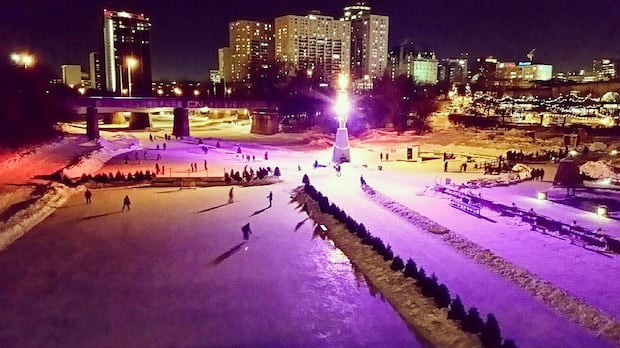
The city’s taste for concrete in its urban areas only accentuates the “frying effect”of the summer’s heat. I considered frying an egg on the ‘pavement,’ i.e. the sidewalks, several times. Climate change appeared not to be an issue, as those energy hungry air conditioning provided respite; relief from the heat. Suddenly freezing cold buildings, due to the “a/c” —a new term—were heaven sent. But respite from this heat eventually comes in late October. For this is the start of winter with its average temperature of −12°C with snowstorms, biting swirling winds and frostbite. Manitoba’s bitterly cold and unpredictable winters are long lasting from October to May. Overnight lows can be −40°C (−40 °F) with temperatures remaining below −18 °C (0 °F) for weeks on end. But despite this, the notion of skating on “the world’s longest naturally-freezing skating rink” in downtown Winnipeg is an acquired taste.
As is the “Slurpee” which, for the uninitiated, is the brand name for a carbonated slushie sold by the store called ‘7-Eleven’ and its subsidiaries, I discovered from a few searches on the ‘web’ that Manitobans consume “the most Slurpees in the world” even during the winter, when it’s -40C. Perhaps this stuff is ‘delicious’ but an 11oz Slurpee containing an average of 175 calories, 48 grams of carbs, and a vast array of brightly coloured chemicals really doesn’t have any appeal. Hmmm, chemicals.
This city’s name came from the lake, Lake Winnipeg, win nipee meaning “muddy water,” in Cree. But the Province’s capital was created in 1870 from: Fort-Rouge founded in 1738 by a Frenchman, La Vérendrye built by the North West Company, Fort Garry, it’s neighbour, and corporate competitor was built by the Hudson’s Bay Company, an English chartered company, in 1821. Both settlements merged with Assinboia, the Red River Settlement founded by Thomas Douglas, 5th Earl of Selkirk. It contained colonists who’d arrived from Scotland in 1811–1812. The Earl had obtained a grant of 116,000 square miles (300,000 square km), from the Hudson Bay Company, in the Red and Assiniboine river valleys. So, the arrival of the Canadian Pacific, in 1885, the first Canadian transcontinental railroad caused Winnipeg to become the major grain market, warehousing, and distributing point for the Prairie Provinces.
Today, it labels itself as “the economic and cultural heart” and the “Gateway to the West.” These labels have implications for outsiders, for visitors, and the non-local individual. According to the census, it is the most populous metropolitan area in central Canada. It’s home of the Canadian Grain Commission and the Canadian Wheat Board (CWB), the marketing board for western Canadian wheat and barley growers. What’s often forgotten is that Manitoba is Canada’s third largest producer of spring wheat and barley but, prior to the 1990s, its principal crops were 1960s oats, barley, spring wheat and hay. During the 1990s these crops were replaced by durum wheat, ‘black gold ’(oil seed rape) and alfalfa. ‘Black gold’ is canola and found in the list of ingredients of bottles of vegetable oil in Europe. It’s in fact oil seed rape but the world’s only crop with the label “made in Canada.” It was developed by researchers from Agriculture and Agri-Food Canada and the University of Manitoba utilising traditional plant breeding techniques and was developed during the 1970s on the University’s sprawling 1960s campus. The city’s industrial growth was stimulated by hydroelectric power plants on the Winnipeg River. The Royal Canadian Mint, built in 1973, that lies on the outskirts of the city on the Provincial Trunk Hwy 59 S produces Canada’s coinage. So it makes sense that the city operates as a hub of transportation with its two transcontinental rail lines, the Trans-Canada Highway as well several highways ‘up North,’ and an airport of some size.
 The Intersection of “Portage (Avenue) and Main (Street) in downtown Winnipeg is labelled as the most famous intersection as the coldest and windiest urban corner in Canada. It’s also the “crossroads of Canada” given its proximity to Canada’s longitudinal centre. It’s become an inspiration for cultural references such as Stomping Tom Conner’s song “Red River Jane.” The city’s biggest banks are headquartered downtown in Portage and Main. Winnipeg’s roads oddly do not point to the community but its economic power (meat, wheat, banking or stocks) in Winnipeg’s downtown (aka a main street or a high street). But economically, the city’s commercial centre and the nexus of money exchange lie in its shopping centres away from its downtown or the Legislature in places such as Polo Park, the Forks, or the Outlet Collection. Winnipeggers, the city’s inhabitants, notoriously love a good deal.
Some local inhabitants refer to 1919 in hushed tones but, for this city, this year was a pivotal moment. It’s future changed. For six weeks, between May 15 to June 26, more than 30,000 strikers forced economic activity in Winnipeg to come to a standstill. For the city—while being the third largest in the country—experienced the General Strike of 1919. It was the most notorious and influential strike in Canada’s history. It was the same year as Chicago’s notorious Race Riots at the end of the First World War. The strike in Winnipeg ended in arrests, bloodshed and defeat but contributed to the development of Canadian social democratic politics. So, why isn’t it mentioned in common parlance? Was it because it contributed to the development of a stronger labour movement and connected to tradition of social democratic politics?
Others refer to Winnipeg as ‘the Chicago of the North’ which, for a foreigner, is an odd comparison. Winnipeg lost its chance, decades ago—well, over 100 years ago—as Chicago’s counterpoint as global hub of the Prairies in the torrid aftermath of World War I. Winnipeg from the outset lacked its own financial hub as it was financially dependent on London, across the Atlantic. Canada only ceased being part of the UK in 1982 with the passage of the Canada Act.
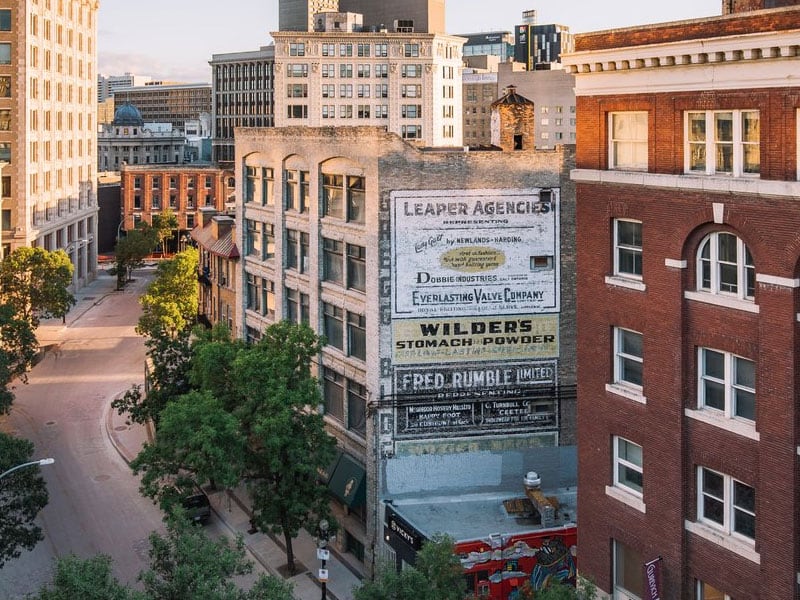
Winnipeg, or ‘the city’ as it’s known by those living in the province, is a differentiated bedroom area whose neighbourhoods are defined by specific time periods, the ethnic origin, and social class of those who reside there. Its “downtown” area referred to as ‘The Exchange’ consists of a mixture of late 19th and early 20th century buildings (called ‘masonary” according to the local tourist board) and non-such glass skyscrapers. These tall buildings lack both character and connection with the larger prairie within which they exist. But these are the offices of the businessmen, the bankers, the marketing gurus and the accountants, enabling the Canadian Grain Commission and the Canadian Wheat Board (CWB) to continue marketing for the farmers on the other side of the Perimeter Highway. These buildings arguably represent the money generated on the international markets but stuck in the vaults of the banks below. It’s just about possible to walk in the Exchange downtown areas as these roads have side walks. Here one can just about be a pedestrian, but it’s a long long walk to some of the city’s attractions: the Winnipeg Art Gallery (WAG), the University of Winnipeg, and the Manitoba Legislative Building. Other attractions require a car as they’re found in the sprawling grounds of The Forks labelled “Winnipeg’s most visited tourist destination.” Here one can find the Manitoba Canadian Museum of Human Rights, The Manitoba Theatre for Young People, The Children’s Museum, The Forks National Historic Site, but other attractions such as the Esplanade Riel, the Provencher Bridge built in 2003 connecting Winnipeg to St. Boniface, across the Red River necessitate access to a vehicle, or a bus. Beside it lies River Heights, another ‘old’ neighbourhood with century-old elm canopies and heritage status stately houses. Fully grown trees, frequently elms, always indicate the age of a neighbourhood in this city, in full leaf in summer. This was the English part of town with large houses while its French speaking sister, St Boniface lies across the River. It contains smaller houses and smaller trees but labelled as a “little slice of France on the prairies, replete with signage en français”. It’s an odd label for a foreigner as the spoken French here isn’t the same as that in France.
The city grows neighbourhood by neighbourhood, as large developments created by real estate developers in construction. Newer neighbourhoods are indicated by anonymous ‘McMonster’ houses or tiny little undistinguishable houses, boxes, reflecting the socio-economic groups residing here. The uniformity of the housing styles, the lack of distinguishable plant life, the abundance of large grey wide roads in conjunction with abysmal public transport and a distinct lack of sidewalks make it tough for newcomers. These houses look the same, conformity abounds begging what about their interiors? The newer neighbourhoods lacking distinct characters sprawl ever closer to the Perimeter highway all the while encroaching the surrounding prairie landscape. Concrete abounds as sidewalks, alongside anonymous roads, and little vegetation making it impossible to discover their characters. The Perimeter’ highway, that 90 kilometre ring road appears to be the city’s unofficial boundary. The character of the city’s edges where clusters of houses surround clusters of stores in strips-like shopping malls highlight the importance of the personal motor vehicle, not the bus nor the pedestrian.
Tourism is a tough exercise as visiting i.e. navigation of the city by foot is a short-lived, a mistaken endeavour and almost pointless. Some parts of the city lack pavements, sidewalks, and buses aren’t commonplace. Roads, rather than sidewalks, are key means of moving around this city and the inability to wander around as a pedestrian, confirms the importance of the motorized vehicle. One needs a personal vehicle to visit Sargent Sundae, on Portage, beside the river, but it is only open during the summer months. In winter, it lies shuttered, closed. It, like many places in this town, appears to function on tradition and nostalgia.
Winnipeg, and Manitoba’s communities are connected by roads, highways so by default understood from the perspective of a vehicle’s window, not by public transport. Tourist websites, presume that one always has a car and say little regarding public transportation. The stigma isn’t obvious held by some North Americans of using [change one’s voice to a scary one … the Greyhound bus or, in Canada, the Grey Goose.] I’ve heard that it’s possible to catch “cooties” that invisible biting small creature lacking a italicised Latin name, riding on the bus. So, without a car, a personal motorized vehicle, visiting a new area, or place or person becomes impossible.
Conversations with local inhabitants reveal that distances are measured by how long it takes to drive rather than how far it takes to walk. One might conclude that using public transport is akin to admitting one is ‘poor.’ The city buses are tough to find and use, and one’s fellow passengers aren’t friendly to tourists, non-residents. This obsession with roads makes it hard to fathom that it was a place lived (still is) by many groups of Indigenous people such as the Cree and the Assinboine. It appears that using a bus is perceived as lacking the financial ability, having any obvious monetary value to oneself to own a car or a truck. Getting across town by bus is difficult despite the existence of bus routes as they appear to be frozen in another time, not function around the clock. They hinder, well, and are an inadequate means to navigate the city to find its quirks and its ‘jewels.’ The sole answer to the question: how does one travel around Winnipeg is by vehicle. An odd answer given that the city is supposedly a ‘jump off’ to the North [the Arctic], an immigrant town and “friendly.” (There’s a definite antagomism with the local Indigenous peoples, as how else can the early morning slot on the local Winnipeg radio blithely refer to the number of people who’ve been found dead each morning as “the body count” by an indifferent announcer.) So, is this slogan “Friendly Manitoba” slapped on its vehicle licence plates, a mistake? It’s a nightmare to get around … there’s an assumption that you’ll know how to get ‘there’ wherever ‘there’ is. But snobbery abounds and risks making Winnipeg and perhaps the rest of Manitoba impossible to visit, to know—but perhaps that’s the point, perhaps a visitor isn’t supposed to know what lurks below the surface.
–
Table of Contents









2 Responses
Planet Winnipeg, the perimeter is a galactic. boundary, haha. But seriously I relocated here in 2017 to de-retire into the research sector however health issues thwarted that plan. Was fortunate enough to have my sorry hide saved by a phd neurologist who had just relocated here from US to escape the cultural chaos, had burst a pipe in the noggin – in post-op his first words were “I can’t believe you’re alive!”. Famous prairie humour at work, without that convergence of events would likely be DOA in the GTA.
Have met five people here over 100, 2 are still with us, must be the water.
On the darker side, the tragic tale of Bruce and Brian Reimer emerged here from the suspect soul of one Prof. John Money seeking to experiment on that poor soul with his gender theory. Of course this story has been submerged although he appeared on the likes of Oprah and others. It came from Winnipeg, how ironic.
One can also visit the Lockport dam, a unique construct – the largest Caméré (wooden curtain) dam in the world and help yourself to a huge hotdog at the Half Moon grill…
PS: Just wish Rebecca B. would pick up the pen again.
May be that the US should pass on Manitoba for annexation. Alberta doesn’t seem interested, so Canadians can relax.