By
The Earth is the cradle of humanity, but one cannot live in a cradle forever.
– Konstantin Tsiolkovsky
Elon Musk invites argument. The Tesla and SpaceX founder’s changing promises, his ventures beyond rockets, and SpaceX’s record-shattering initial public offering in June, whose filing reads like a funky marriage between Isaac Azimov’s “Foundation” and Enron’s financial audits, are all fair game for scrutiny.
But strip away the quirky personality and the wild balance sheet, and boil it down to what has nothing to do with stock valuations or Twitter feuds: has SpaceX actually changed what humanity can do in space? On that important question, the answer is an unambiguous yes, and it deserves to be judged on its own terms.
Since the beginning of the Space Age, for getting things up there, “expensive” barely captured it. In post-Apollo mature space exploration times, the rule of thumb was that launching useful payload to low Earth orbit (LEO) cost roughly its weight in gold. That price tag was so punishing that only governments, largely indifferent to return on investment, could afford to play in this field. Annual launch totals reflected the strain: after the Cold War and ending of the arms/space race, the number of objects sent into orbit by all of the world’s space agencies each year drifted from 200 to well below 100, resulting in decades-long stagnation.
One of the main barriers was that rockets were expendable – built once, flown once, an arrangement as sustainable as junking an airliner after every flight. NASA’s own attempt at reuse, the Space Shuttle, made things worse: it cost more than the expendables, and it was fatally unreliable. When the Shuttle program ended in 2011, the U.S. couldn’t even reach the International Space Station without Russian help. The Shuttle undermined the entire idea of reusability.

(Graphic by C2C Journal with AI assistance)
Musk’s audacity treated that failure as a lesson rather than confirmation of an insurmountable status quo. In 2015, a Falcon 9 booster landed itself upright for the first time after delivering its payload to orbit and – unlike the Shuttle whose refurbishment took months – ready to refuel and fly again.
A few years of “sharpening the saw” and boosters are routinely re-flown. Along with that, launch cadence has climbed and the cost to LEO has fallen to roughly US$1,500 per kilogram – think 10 grams of gold – orders of magnitude cheaper than before, as the accompanying chart shows.
Objects sent into orbits annually now exceed 5,000 and are trending to double every year, with SpaceX alone responsible for the majority of that mass. And the taxpayer isn’t footing the bill; Musk’s Starlink is a profitable business contributing about 70 percent of SpaceX’s revenue (before its recent merger with xAI).
That is the actual revolution: not a single dazzling flight, but the shift from expendable, government-owned rocketry to a cheap, reliable, commercially available service, one now drawing competitors from the private sector, even in China.

(Graphic by C2C Journal with AI assistance)
That cost curve is also the hinge on which the next chapter turns. Starship, SpaceX’s monstrous fully reusable rocket, is designed to push down launch costs toward US$300 per kg in its early operations and, eventually, toward a stated long-term target of US$10 – a number that would make orbital transport a rounding error for most missions.
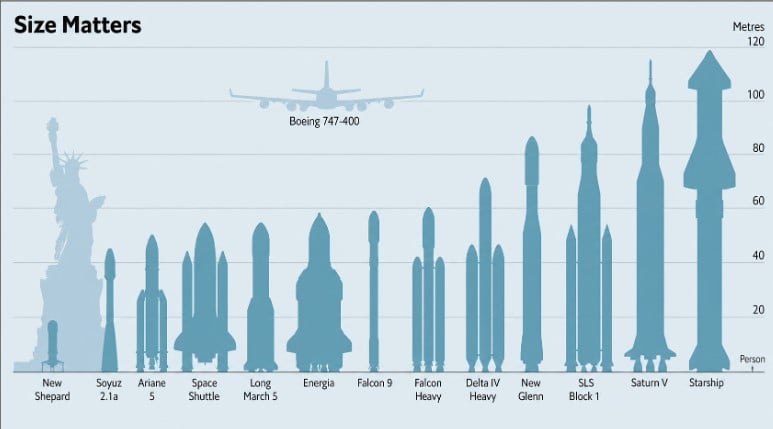
(Graphic by C2C Journal with AI assistance)
Large space stations and giant telescopes, lunar and Martian dwelling, and asteroid mining – an entire new tier of industries – all appear as legitimate future markets, not because they’re guaranteed, but because the economics stop being absurd with launch costs dropping further.
What’s notable is that these aren’t misty daydreams, as still perceived by many. These Sci-Fi sounding enterprises already have solid scientific grounding and/or working prototypes, as the following examples indicate:
- Varda Space Industries and Redwire are already conducting commercial manufacturing experiments in orbit. Microgravity allows production of high-purity optical fibres, specialized pharmaceuticals and other advanced materials;
- Japan’s OHISAMA satellite is built and ready to prove that harvesting solar power in space and beaming it to Earth works. It is waiting on the ground for a working rocket to fly it, a reminder that the biggest obstacle to some of these ideas is mundane launch logistics, not physics;
- Orbital data centre economics are ridiculed by those who don’t know that a startup called Starcloud has already flown an NVIDIA graphics processing unit in orbit and trained a language model there. So did China with its 12-satellite constellation comprising an operational data centre. As usual, Musk is going biggest: SpaceX recently filed for a 1-million-satellite constellation to “do” AI in space;
- Space tourism is already a thing waiting to become accessible not just for billionaires but those merely with an adventurous mindset; and
- Orbital fuel depots to minimizing hauling propellant from Earth are already NASA’s requirement for the Artemis manned lunar missions, and SpaceX has already demonstrated in-orbit propellant transfer as part of Starship testing.
Apparently there is a more useful way for a fortune to be spent than on superyachts and status symbols: pouring it into the unglamorous, expensive, failure-prone work of building things nobody has built before or failed at. Whatever else Musk’s capital has bought, it’s the scaffolding for an era in which the sky stops being the limit. Witnessing with optimism the effects of that scaffolding being put together and wishing well to those who take part in making it happen are the very least one can do.
The original, full-length version of this article was recently published in C2C Journal.
Gleb Lisikh is a researcher and IT management professional, and a father of three children, who lives in Vaughan, Ontario and grew up in various parts of the Soviet Union.