By Carl Nelson
The Information State / Politics in the Age of Total Control
by Jacob Siegel
“Our minds are in the Cloud, but far from Heaven. ” – Daniel Jupp of the substack, Jupplandia
“I happen to believe that most, if not all, self-identified and so-called “revolutionary” movements in America today are fraudulent.“ – Michael Smith of the substack, Unlicensed Punditry
Nearly ten years ago I bemoaned the fact to my brother that our younger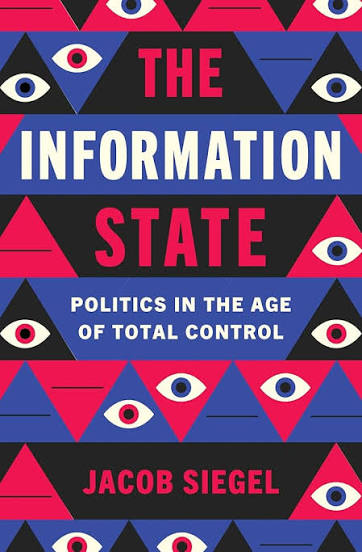 relations were getting very excited about problems that didn’t exist. All the while their proposed solutions were making the problems worse. “They are throwing away what our forbears struggled to build and shed blood over,” I noted incredulously, “for no reason, for nothing!” It’s as if overnight normal life had become the outlier and every other sort of deviant behavior notarized; that we had stumbled through a portal into a new type of governance. Or as Jacob Siegel, our author, describes it:
“It was not found in US civics textbooks, but it became central to the new playbook of power. The term for it was whole of society, and it described a new technique of governance that circumvented the normal legislative process by seizing the levers of the digital system to enact sweeping policy changes.” (Pg. 154)
“In the “whole of” sense, society now described a select set of stakeholder organizations brought together to execute state policy. The term became a euphemism for powerful institutions, including banks, universities, and social media platforms that did not represent the public but controlled its access to resources like financial services, social connection, and professional accreditation. The new society was shallower, less rooted in the realities of human relationships and the physical environment, more prone to sudden fluctuations. At the same time, however, it had significant advantages as a governing construct. With fewer points of friction, it could be more efficient and better able to implement sweeping, system-wide changes, like a phone automatically updating its operating code.” (Pg. 155)
With “a phone and pen” (Obama), our President could now change our society seemingly overnight. And did!
The driving force of all this, as the book describes, has been the progressive movement as it began to express itself in the beginning of the Twentieth Century. Conservatives had tended to play by the rules established and traditions commonly observed, while letting human nature work out the details on a person to person basis, holding to the law of subsidiarity. “They saw self-government as an unfolding improvisation, what Tocqueville, after his visit to America, called “the slow and tranquil action of society on itself”. (Pg. 23)
“That was all well and good in theory, but the turn-of-the-century progressives faced an imminent crisis. They saw society devolving into anarchy and violence and wanted to stave off a revolution. Counting on America to slowly fix itself was, by their account, a naive and dangerous delusion. In any case, it made no sense to wait if one believed, as they did, that the correct answers were already available through technical calculation and the empirical method. The real obstacle to implementing these advances was the public itself, that teeming lump of superstitions, which democracy had naively granted a veto over the experts. Propaganda provided the solution. To bring the public in line with its plans, the progressives developed new methods of shaping opinion.” (Pg 23)
This progressive attitude hasn’t changed in a hundred and twenty-six years. As Democrat John Kerry said in 2023 at the World Economic Forum, “Our First Amendment stands as a major block to the ability to be able to hammer [disinformation] out of existence.”
From the early presidency of Woodrow Wilson up to that of Donald Trump, Jacob Siegel chronicles the evolution of propaganda and the growth of these “revolutions of control”.
With the advent of the internet the situation figuratively exploded. “The brief dazzling vision of the Internet as a democratizing force expanding freedom across the world had peaked with the Arab Spring and now began rapidly collapsing. A new image took hold, of digital networks as a dark and lawless wasteland in which the natural political tendency was not democracy but violent extremism and fascism.” (Pg. 175) Guardrails and curbs seemed necessary to major political actors, especially progressives, as the public sphere had become much more vast and uncontrolled. But what has been the greatest shock to those like myself, is how the entire world of what we had viewed as ‘normal’ behavior turned upside down nearly overnight. It’s as if we blinked and society had gone crazy, though, at least online and in the media. Otherwise, especially in my small town, daily life continued much as ever.
This was until COVID hit.
“The pandemic dumped jet fuel into the counter-disinformation machine while extending its controls into the physical world. That brought the information state into people’s everyday lives. This was something different from Russiagate, which was essentially a political crime against abstractions like the “rule of law” and the “democratic process.” Normal people who did not devote their time to scrolling news feeds could choose to ignore the sordid Trump-Russia drama. COVID lockdowns and vaccine mandates removed the “normie” exemption.” (Pg 231)
“Members of the public who had eyes to see could not help but notice that whatever the experts vehemently declared about COVID could be reversed a day later.” (Pg 232)
Later on, as Daniel Jupp wrote in his substack, Jupplandia: “The rapid switch from Biden is sharp as a tack to Biden must go shows us, in a different way, how inauthentic all leftist leadership is…” It also demonstrated how perceived opinion could be changed overnight as if with the flick of a switch.
Our author catalogs the events and their meaning during and following the pandemic well. It’s a real Tinker to Evers to Chance story.
In 2017 a paper affiliated with Harvard published an influential report on the “Information Disorder” – rather like a chronic disease which our body politic was purported to suffer from.
“The paper offered a three-part diagnosis of the disorder, with each part defined by its relationship to harm.”
Disinformation referred to false statements deliberately created to do harm.
Misinformation described any false statement that was “not created with the intention of causing harm.”
And finally, the paper coined a new term, malinformation, for information that was true but demonstrated malicious intent, or, in the original academic language, that was “based on reality, used to inflict harm on a person, organization or country.”
Truth now had a clinical diagnosis. Malinformation was an official designation for factual statements that authorities found objectionable.” (Pg 217-218)
All of this stimulated the enormous growth in the counter-disinformation industry. Another paper by the same Shorenstein Center out of Harvard, included a “partial list of twenty-two major institutions involved in the field. A participant in the non-profit world, (Andrew Lowenthal) recalled, “I watched in despair as a dramatic change swept through my field. As if all at once, organizations and colleagues with whom I’d worked for years began de-emphasizing freedom of speech and expression, and shifted focus to a new arena: fighting ‘disinformation’.” (Pg 218)
But what about push-back? Well, that’s what the EIP (Election Integrity Partnership) was employed to eliminate. The four leading members of this partnership being: The Stanford Internet Observatory, the University of Washington Center for an Informed Public, Graphika, a private defense contractor, and a NATO aligned think tank, the Atlantic Council Digital Forensic Research Lab. “On average, it took the tech platforms less than an hour to respond to their alerts and takedown requests. In a postmortem published after the election [of 2020], the EIP reported collecting more than 859 million tweets for analysis and classifying 21,897,364 tweets on “tickets” as unique “misinformation incidents” just between August 15 and December 12, 2020.” (Pg 225) That’s a lot of free speech violation.
But the digitization of our public square went beyond censorship and shadow banning, etc. It was also used to confuse and demoralize the public conversation. And here’s where hybrid warfare intruded.
“Hybrid warfare attempts to push the “fog of war” from the battlefield into the public arena. By sowing confusion and attacking morale in a civilian population, it tries to weaken an adversary’s capacity to respond.” (Pg. 171)
“The echo chamber effect relied on the twin revolutions in social media and the smartphone. It worked because great masses of people had already been herded into the vast, unbroken wholeness of the digital networks, where a message could reverberate from one end to the other without hitting any structural walls. Twitter, the social media platform favored by journalists and DC insiders, played a crucial role by synchronizing the various narrative purveyors in the echo chamber. A social media-driven feedback loop translated political agendas into objective news and lent a false air of independent credibility to administration talking points. Samuels later described it as the process by which “the White House and its wider penumbra of think tanks and NGOs generated an entirely new class of experts who credentialed each other on social media in order to advance assertions that would formerly have been seen as marginal or not credible, thereby overwhelming the efforts of traditional subject-area gatekeepers and reporters to keep government spokespeople honest.’ (Pg 162, my underlining added. Have you ever felt like this, as the spokesperson for actual experience?)
What we commonly get when talking to our friends of opposite political persuasion is an extension of the echo chamber. “Oh?” They reply smugly, with echoing similarity. “What are your sources?” (Because the captured media pumped out stories confirming each other by the hundreds.)
“Common sense?” You might reply. “Something which works well presently?”
“Who says it works well? So you’re the expert?”
This can be confounding, as we’ve witnessed in over forty years of the climate conversation. The experts have been shown repeatedly over time by our own experience and their own testimony to be wrong – yet for some reason they remain ‘the experts’.
In his book, Jacob Siegel explains how this worked to further erode the cultural conversation and make discussion fruitless.
“The changes in journalism aligned with the direction of White House policies. A push by the federal government in 2014 to enforce new rules in college sexual assault investigations applied a standard of assault so broad that the Harvard Law professor Jeannie Suk Gersen wrote that it “plausibly covers almost all sex students are having today.” That same year, Facebook expanded the range of available gender identities for its nearly 1.5 billion users to fifty-eight, including “cisgender female,” “gender fluid”, and “neutrois”.”
“A deadening sameness settled over American culture…” (Pg. 168)
My progressive friends and relations have had two advantages given to them through the digitization of our community forums. The first was that reality with its absolutes can not compete with the fictive nature of a digital reality run by the emotional demons which feed our egos. Or, as Alexandria Ocasio-Cortez noted, “”I think that there’s a lot of people more concerned about being precisely, factually, and semantically correct than about being morally right.” – AOC Circa 2019
The second is that since the media driven problems they belabored really didn’t exist in any probative sense, (oppression, poverty, racism, climate change, etc., even the ‘pandemic’) ironically, it gives progressives an unbridled freedom of action, as demons can be conjured at anytime and any place to demand “Change Now!”, just as this was demonstrated historically in the Salem Witch Trials.
Lately a site I frequent has been complaining about ISP (your Internet Service Provider) censorship:
“The EU has moved beyond blocking sites to blocking content – the actual information itself. [This issue is not isolated to the EU, only provided as an example.]
If an ISP company wants to sell internet access services to the EU, they must accept EU terms and conditions on the content of their service. That ISP company then demands anyone who transmits information through their internet service to authenticate or register with the ISP. If Gmail doesn’t authenticate with the ISP, then Gmail will not work on the network. The terms and conditions from the ISP are now forced upon the information providers.” The Last Refuge
Are you upset about the state of things? Has the fogbank of irrational thought and opinion rolled in leaving you depressed and in disarray? Perhaps this book will bring some comfort, – if only to reveal how we are being played.
The entire book crudely distilled is about “the limits and costs of reliance on digital opinion formation.” (Pg.251) Everywhere reality is being censored and erased to be replaced with a fabricated Potemkin Village of opinion. This is frightening. Our real lives are being contorted like pretzels, not to make them better, but to fit some policy agenda. It’s as apparent as the protruding noses on smug progressive faces.
To bring this up to date, I recently found an article from California where, “Throwing away an old pair of socks is a matter of the greatest imaginable complexity. It requires an extensive state plan, supervised by a nongovernmental organization that imposes mandatory payment obligations on the company that made the socks. The socks have to be safely discarded, and that requires extensive planning by a public-private partnership.” – the Federalist
Trying to do justice to this book through a book review is like detailing a cataclysm – something the brilliant author has done with exceptional writing and concision. It has been very difficult to distill the essence of this much detailed insight into a few pages. But this is all the more reason for you to buy and enjoy Jacob Seigel’s must-read book: The Information State / Politics in the Age of Total Control.
(The author, Jacob Siegel, gives a great interview The book is even better.)







2 Responses
I couldn’t believe that someone could come up with a “malinformation” term. Duh! Factually true information is harmful — to those whose interests it harms, and who thus try to suppress it (in my instance, “judicial fraud”). It takes the dumbness of academics to concoct contorted terminology for what is so natural, so ubiquitous, and so obviously necessary as exposing falsehoods!
It’s incredible the logic twisting intellectuals can trumpet. This is a tremendous book.