Posted by Geoffrey Clarfield
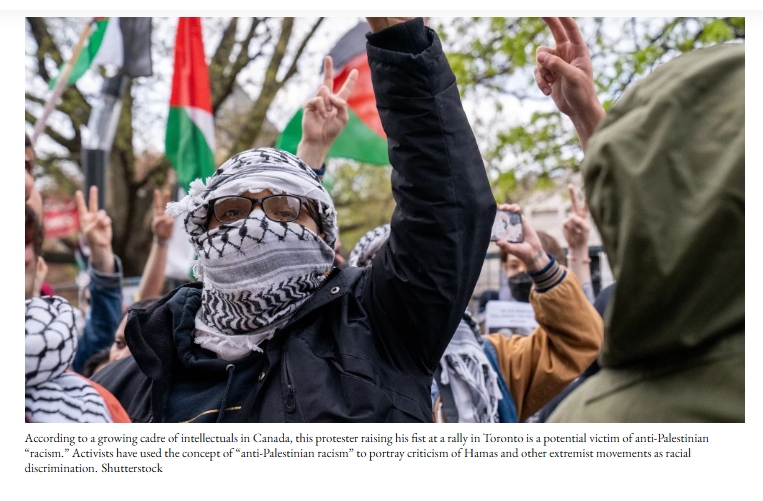
After the Israel–Hamas war erupted in October 2023, a previously obscure concept began gaining traction in Canada: anti-Palestinian racism (APR). Coined in 2022 by the Arab Canadian Lawyers Association (ACLA), a group advocating for Arab communities, APR has since become a political tool for pro-Palestine activists to stifle legitimate criticism and challenge Canada’s established policies on Israel and antisemitism.
According to the ACLA, the concept of APR is defined as “a form of anti-Arab racism that silences, excludes, erases, stereotypes or dehumanizes Palestinians.” Examples of such discrimination include failing to recognize Palestinians as indigenous to the region and “defaming” activists with accusations of antisemitism or being “a terrorist threat/sympathizer.”
At first glance, the definition sounds benign. But in reality, APR functions as a lawfare tactic that has little to do with combating discrimination. Intended to suppress legitimate discussion about the Middle East conflict, it recasts any criticism of Palestinian terrorist groups like Hamas and Islamic Jihad as “racism,” effectively shielding them from scrutiny and accountability.
Tamara Gottlieb, co-founder of Jewish Educators and Families Association of Canada (JEFA), told Focus on Western Islamism (FWI) that “APR frameworks recast any criticism of the ‘Palestinian narrative’ as racism. That narrative – rooted in a foreign geopolitical agenda – is now being smuggled into Canadian schools and policy under the guise of anti-racism. Zionism and Jewish identity are treated as hate, and even acknowledging historical facts is labelled racist. A society that substitutes fundamental freedoms and objective truth with virtuous-sounding propaganda becomes vulnerable to foreign and ideological interference. As Canada openly embraces such propaganda, we are witnessing, in real time, a nation losing control of its own future.”
Indeed, the activities of the ACLA and Sultan exemplify how legal advocacy can evolve into ideological lawfare—using policy, institutions, and education systems to advance the aims of extremist movements. This isn’t misguided activism; it forms part of a broader, insidious campaign that threatens national security and undermines social cohesion.