By G Murphy Donovan
All this chatter about negations, or a settlement, with Teheran is probably the usual administration smoke and mirrors associated with Trump era strategic ambiguity.
Indeed, with the activation of the US Army’s 82nd Airborne Division, the probably of boots on the ground in Iran goes from possible to likely.
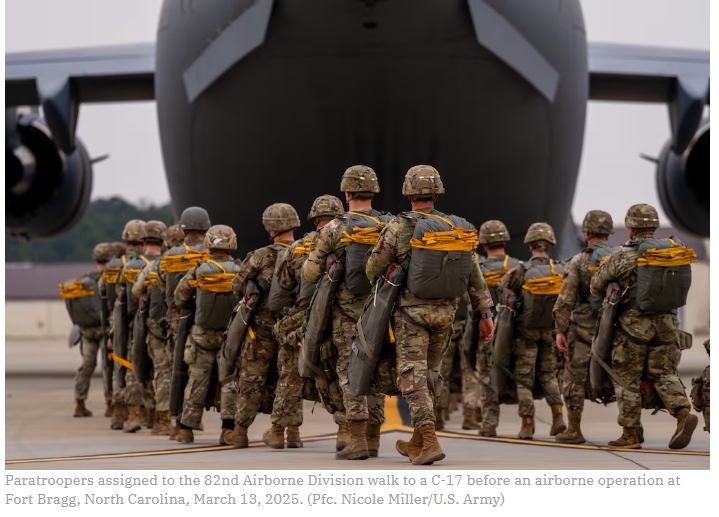
The Tripoli ARG (USS Tripoli LHA-7 with F-35Bs, MV-22 Ospreys, helos, landing craft, and ~2,200-2,500 Marines from the 31st MEU), the follow-on Boxer ARG (11th MEU), and the 82th Airborne are exactly the kind of assets to surge when air superiority is already won and the need is to project ground power into a littoral choke point like the Strait of Hormuz.
The existing force (Abraham Lincoln CSG with its air wing and escorts, plus LCS in the Gulf, destroyers hammering targets with Tomahawks) has already done massive damage via air and missile strikes in Operation Epic Fury (now in its 4th week as of late March 2026).
Iran’s navy is effectively “gone” (100-130+ vessels sunk or neutralized), air defenses degraded, many coastal missile sites hit with bunker-busters, and Kharg Island’s military facilities pounded while sparing most oil infrastructure.
That said, “air assault pending” is a fair speculation, but more precisely it’s helicopter-borne air assault plus amphibious raid/landing capability layered on top of ongoing fixed-wing dominance.
USS Tripoli’s “Lightning Carrier” configuration gives extra F-35B stealth close air support and Ospreys Marine helicopters for rapid vertical insertion without needing a big beachhead.
Marine expeditionary units are built for exactly such contingencies: limited-objective raids, seizing key terrain, or securing maritime chokepoints.
These are educated guesses here, grounded in the stated U.S. objectives (secure Hormuz for shipping, finish degrading Iran’s ability to threaten the strait, avoid a full-scale invasion).
Strategic focus should be on taking and securing the strait itself; Iranian-held islands in/near the Strait of Hormuz (e.g., Abu Musa, Greater/Lesser Tunbs, Qeshm, or smaller outposts) and maybe the Kharg Isle oil depot just to twist the knife.
Remaining coastal anti-ship missile sites, mine storage, and IRGC naval outposts along the Iranian side of the strait (especially near Bandar Abbas, Qeshm Island, or the northern Gulf approaches might be secondary targets.
Port or oil-terminal-adjacent facilities if needed might be taken. Residual threats at Bandar Lengeh or near Kharg, might be hit, but carefully). The U.S. and Israel have deliberately avoided broad oil infrastructure strikes so far to limit economic blowback.
But if Iran keeps mining or firing from Kharg Isle, all bets are probably off.
The Boxer ARG (arriving later, mid-late April) would double assault capacity if needed, but Tripoli’s earlier arrival (late March/early April) suggests planners want the option sooner rather than later — especially with Trump’s Hormuz deadlines and threats to hit power plants if the strait stays closed.
Bottom line: This isn’t Desert Storm-style invasion. It’s precision power projection to finish what the carriers and bombers started — secure the world’s most important oil artery while Iran’s conventional forces are already gutted.
Risks are high (Iranian mines, drones, or asymmetric retaliation), but with air dominance and amphibious assets, the U.S. has the tools for quick, limited ground operations without getting bogged down.
All would be done under overwhelming air cover and close air support, with the goal of forcing Iran to either comply on reopening the strait or lose some real estate – and Tehran’s last trump cards.
Other risks are real (mines, drones, asymmetric retaliation, potential escalation from the mainland), but with Iran’s surface navy and many coastal defenses already gutted, the window for a low-footprint success exists.
The need for a “small slice” of the Iranian side to fully sanitize direct fire threats feels exactly right — common sense maritime domain awareness and freedom of navigation logic.
The likelihood of Arab GCC states or NATO European military cooperation, other than limited basing or fly over waivers, is nil. Europe and Arabia are likely to sit this one out and limit their roles to empty rhetoric; however Arabia and Europe will take a victory lap with Israel and America when all Islamic peril has passed.
———————————-
- Murphy Donovan writes about the politics of Intelligence and national security
- Illustration from the Military Times









4 Responses
Thanks for this.
I hate to say it but…. he sounds a lot like Buck Turgidson (George C Scott) in Dr . Strangelove.
You have to watch this clip and see how close it is to reality. Absolutely hilarious.
https://www.youtube.com/watch?v=LNC0YwuGLqg&t=82s
Bill, as irony would have it, as a lad I actually worked at SAC HQ, under Curt LeMay, the role model for the Turgidson character in Strangelove. BTW, real war is not that “hilarious,” not that guys like you would or will ever know.
no need to cast nasturtiums Murph😊