By Conrad Black
The last week has been a turning point for the Conservative Party of Canada. Its devotees observed the 20th anniversary of the coming to office of Stephen Harper at the head of a reconstructed Conservative party that merged the old Progressive Conservatives and the Canadian Alliance/Reform Party. Stephen Harper thus became the only prime minister of Canada in history who had to assemble his own party to contest the election. This has happened in some provinces, such as Maurice Duplessis’s Union Nationale, René Lévesque’s Parti Quebecois, and Francois Legault’s Coalition Avenir Quebec, and the Social Credit parties of William Aberhart in Alberta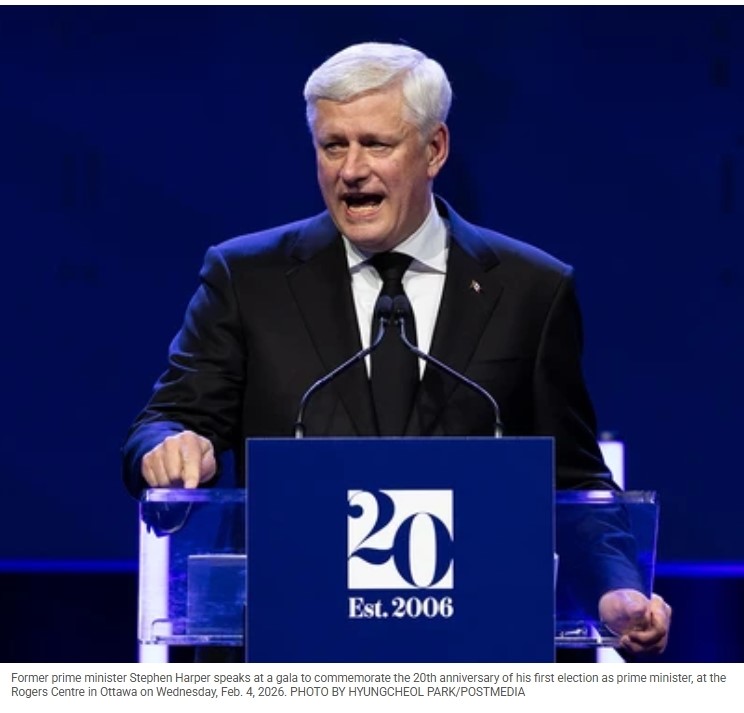 and W.A.C. Bennett in British Columbia. It was a greatly more complicated achievement for Stephen Harper to patch together the fragments of parties across the country.
His nine years in office were good ones for Canada. He continued the balanced budgets of Jean Chrétien and Paul Martin until the banking crisis and market crack-up of 2008 forced some deficit spending. He reduced the GST, an almost unique achievement amongst advanced countries, on the theory that he was reducing public sector spending and capping the temptations to extravagance of his successors. He cannot be blamed for not foreseeing that his immediate successor, Justin Trudeau, would announce that “budgets balance themselves,” and that the country would then plunge into an orgy of incontinent spending. The Harper government avoided excessive zeal in the faddish charge of the green terror that completely kidnapped the hearts and minds of the Liberal Party. Stéphane Dion produced ”the Green Shift,” and Justin Trudeau and Mark Carney went cock-a-hoop in tight formation on the nonsensical proposition that climate change was Canada’s greatest threat and an existential challenge. That is only true in the sense that paying a lot of attention to it severely endangers the prosperity and the unity of the country. Stephen Harper and his environment minister, the capable John Baird, promised “a Canadian solution,” which consisted of commendable sobriety on the subject.
But his government ran out of steam and its main campaign arguments in 2015 were that 400,000 Syrians would not be allowed to decamp to Canada (a serious logistical challenge), and a requirement that women not wear headgear in public that made them unidentifiable. Stephen Harper, being from the Reform/Canadian Alliance side of the reconstructed Conservative party, was the first authentic ideologically conservative leader of a major federal Canadian political party since George Drew, a colonel and former head of the Ontario Securities Commission (when it was a pro-capitalist organization), who led the Progressive Conservatives from 1948 to 1956. John Diefenbaker was a populist prairie radical who was ill at ease with the eastern conservative establishment. Robert Stanfield and Joe Clark were red Tories who were almost indistinguishable from Liberals. When Canadians want Liberals they get real Liberals and not pretend ones masquerading as conservatives. Brian Mulroney was a well-balanced centrist clearly to the right of the Pierre Trudeau Liberals, especially in matters of overbearing government regulation such as the disastrous National Energy Program, and respectful of provincial rights, but well short of the high-growth tax-cutting capitalism that was so successful contemporaneously with him in Ronald Reagan’s America and Margaret Thatcher’s U.K.
While authentic conservatives nostalgically remembered Stephen Harper this week, their cause received a tremendous boost from the current party leader, Pierre Poilievre, who gave a rousing call to conservative arms in Calgary and was rewarded with the greatest confirmation of support ever accorded a federal Conservative leader in an open ballot, 87.4 per cent. This was a chastening result for the legions of our left-wing media who were already engrossed in their favourite parlour game predicting another Conservative debacle and another leader of that party humbled by defections and ambiguities.
In his powerful address, Poilievre did what no federal party leader has done in our lifetimes: he sold conservatism as greater liberty for the citizen and more efficient but no less compassionate government. After Sir Robert Borden effectively used the English-speaking majority in the country to impose conscription on the French Canadians, who understandably had no particular mother country affection for France or Britain, in 1917, between the next election in 1921 and the rise of Brian Mulroney, a bilingual Quebecer in 1984, the Liberals governed for 51 of 63 years, because of the tribal bloc vote they won in Quebec. Mulroney shattered that, but when Harper reassembled the Conservatives, it was in four-party elections where the Bloc Québécois, (an absurd separatist anomaly in a federal election), split the Quebec vote, and Harper only won a majority once, when the NDP leader, Jack Layton took the Liberal vote in Quebec in 2011.
Last year, Pierre Poilievre, running on a platform of lower taxes, greater decentralization, reduced federal spending, pulling our weight in defence, assisting seriously in crime reduction, facilitation of increased housing construction and more careful immigration, and unambiguous support of beleaguered minorities and especially the Jews, carried the younger section of voters between 18 and 35, and gained 18 MPs in Ontario. He came within two points of what amounted to a Liberal-NDP coalition in Carney’s phoney war against Donald Trump. Poilievre hammered all these themes in Calgary again with exemplary bilingual persuasiveness, as an unabashed but enlightened conservative.
Suddenly, to the disconcertion of most of our media, the Liberals appeared old, grey, cliched, and ineffectual, and this is more than a mere semblance. Carney’s call to the Davoisie for a righteous coalition of middle powers against the U.S, (to whom our exports provide half our GDP, so our uprising against the American hegemon will be challenging), was still being dissected as Poilievre received an overwhelming mandate for a move to the sensible right. Canada has gone from near equivalent GDP per capita to the U.S. in 2015 to 65 per cent of the U.S. level now. The time has returned for economic growth and the spontaneous enterprise of an ambitious nation.
First published in the National Post







One Response
Georgia Meloni, Italy’s Bruce Lee of government, cuts through the BS baloney to reality.
FOLLÖW. or sink in your quicksand.