By Conrad Black
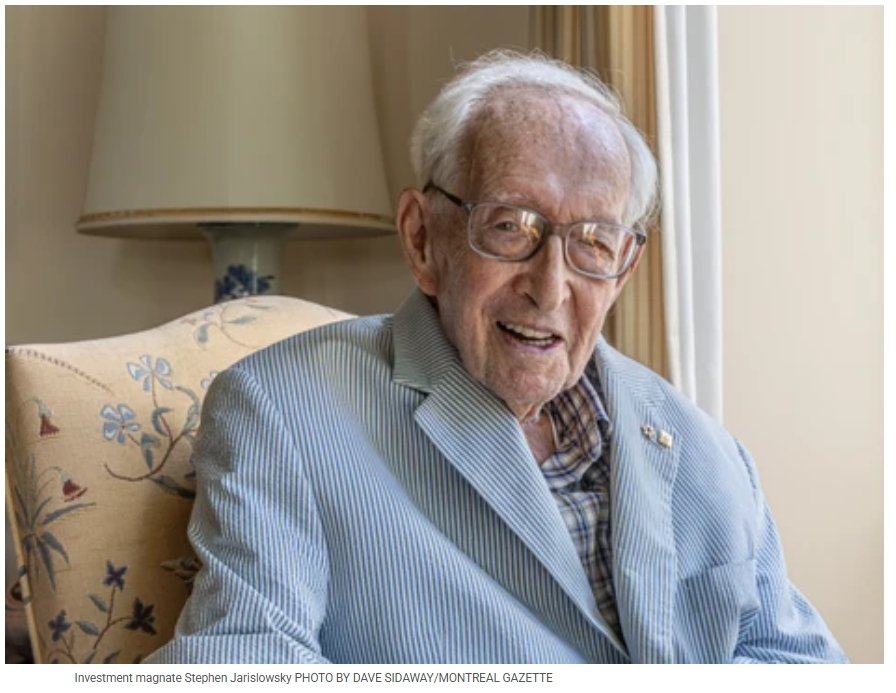
One of the benefits of advancing years is that some of the people with whom one has had disputes, even strenuous and at times vitriolic disputes, may develop a form of comradeship of vanished animosity. It isn’t necessary for either party to change the opinion or attitude that led to past abrasions, but time does heal most wounds and sometimes former adversaries see the whimsical or even amusing aspects of former disagreements and develop a respect for each other. One such person with whom I crossed swords many times but have lately come to like is the well-known and highly successful Montreal money manager Stephen Jarislowsky.
Because I have been a writer of articles since I began my newspaper publishing career as a rural editor of a weekly newspaper in the Eastern Townships of Quebec 60 years ago, I developed some capacity for invective. And because controversy, especially if it is sensible or at least somewhat original, generally has an audience, I have had a fair amount of experience exchanging barbs with others.
In my early years as a somewhat publicized businessman, nearly 50 years ago, I resolved to try to make commerce a little more interesting for the average person. The strategies, and often the personalities, are in fact quite interesting, and I felt that commerce and those who practice it had done themselves a disservice through their aversion to public scrutiny and frequent lack of panache in defending their activities. The generally leftist media tended to portray the business community as greedy dullards. Some are and so are a lot of other people. But I’ve always believed that the importance of commerce has been underestimated because of its absolute centrality to the generation of prosperity for everyone, as well as because it so often presents opportunities for imaginative strategic planning and execution.
If I had to do it all over again, I would certainly be somewhat more discrete, but I think my beliefs were at least justifiable even if my pursuit of them was sometimes impetuous. It was not long before I encountered Stephen Jarislowsky, a highly intelligent and confident man with an extraordinary background who was a pioneer in using stock positions acquired with the money of his investors to crusade for his ambitious notions of corporate governance. We found ourselves in some disagreements, although ultimately, we both wanted the stock prices of our shares to rise.
Stephen was born into a Jewish family in Berlin in 1925 and his parents had the good judgment to move to safer places in good time. Stephen went to school in the Netherlands and France and attended Harvard, Cornell and the University of Chicago. He was exceptionally intelligent and became a very capable multi-linguist and served as a counter-intelligence officer with the United States Army in Japan, as Japanese was one of the languages in which he was fluent. Afterwards, he wished to make his way in finance and take advantage of his diverse cultural background, so he moved to Montreal. As many readers would know, his business, Jarislowsky Fraser, has been hugely successful and now manages approximately $40 billion in assets.
Because he represented a lot of stock in companies where my associates and I were also large shareholders, I invited him to become a director of a couple of companies, though I eventually disinvited him also, slightly acrimoniously but not without amusing moments. I don’t think Stephen would himself deny that he can be rather edgy and rebarbative at times. After I was convicted of several crimes and sent to prison in the United States for three years (in proceedings that the U.S. government now acknowledges should not have taken place — I have received a full pardon and a large libel settlement from my original accusers), there was some public discussion about whether I should be readmitted to this country, since I was at the time a British citizen. Stephen engaged in a debate in Montreal arguing that I should be denied entry into Canada and this led to a vigorous semi-public exchange between us, in which I expressed my considered view that he was “the most obnoxious person in Canada.”
There were a number of further semi-public exchanges of this general tenor but after I sincerely congratulated him on his 99th birthday and told him that he was in some respects an inspiration, our relations quickly warmed and we recently reminisced most agreeably on the fact that we had always agreed on political matters. As Montrealers, and in his case especially acutely as a fugitive from oppression in Europe and a distinguished veteran, we shared a profound antipathy to Quebec nationalism, behind which we both believed there lurked a tendency to racial and cultural oppression. Despite a number of disagreements on economic matters, we were both supporters and cordial acquaintances of former prime minister Pierre Elliott Trudeau.
Last week he called and we had a most amicable conversation on the somewhat distressing subject of the current political condition of this country. We agreed that I would write it up. We think our greatest national problems are that governments as a whole employ 4.6-million Canadians, 25 per cent of the entire workforce, an unsustainable burden, and that the first one-third of these people to reach retirement age and full pension eligibility should simply not be replaced. The compensation of the remaining government employees could then be somewhat increased: as in the private sector, fewer, better-paid jobs, with everyone eligible for full pension benefits.
Our second point is that both corporate and income taxes have to be reduced to below United States levels to compete successfully for investment dollars. To be eligible for government assistance, universities must devote themselves to producing a great majority of graduates who will be capable of earning an income in the field of their specialty, and skilled trades should be elevated to the socio-intellectual status of university disciplines: we need plumbers and electricians more than gender studies and decolonization experts. The demarcation of federal and provincial jurisdiction should be clarified, duplication avoided, and Canada should finally become a domestic common market. With reasonable care for the environment, we must exploit and export to the world our natural resources, and outgrow neurotic fixations on fictional climate horror stories. Stephen and I agreed that whoever advances these points will quickly lead this country to the position of admired success in the world that it rightly aspires to and can certainly attain.
If Steve Jarislowsky and I can be friends with each other, so can all the governments of Canada.
First published in the National Post








One Response
This is an excellent article. Hearty “thanks” to the author!
I was unfamiliar with the term “rebarbative,” but now that I am familiar with it, it’s a new favorite.
In this excellent and thoughtful article there is one point that needs amending. Mr Black wrote: “To be eligible for government assistance, universities must devote themselves to producing a great majority of graduates who will be capable of earning an income in the field of their specialty, and skilled trades should be elevated to the socio-intellectual status of university disciplines . . . ”
The most important point with universities is that they should all be immediately defunded and all the fake educator elements of communism, anti-freedom, race hate, antisemitism, and general ignorance and stupidity be immediately expelled and the several remaining educators be allowed to rebuild the institutions so that they are not a threat to the nation and to humanity in general. One it is confirmed that each university is in its turn no longer an active threat to the nation and to humanity it can then be funded once again by the state. However, with the funding of these previously failed fake schools with public monies must also come strong oversight. If the Nazified elements of race hate and general ignorance arise once again – the funding gets pulled.
Other than that one caveat this is an excellent and refreshing article.