By Sammy Stein
Next year, Nakba Day will fall on Friday, 15th May. For over seven decades, Palestinians and their supporters have marked this date to mourn what they call “the Nakba” – the catastrophe – referring to the flight or expulsion of some 700,000 Arabs during the 1948 war. Yet few who commemorate the Nakba are aware of the term’s origins, or that it was originally coined not as a condemnation of Israel, but as a searing indictment of the Arab world’s own failures.
It was Constantin Zurayk, a Syrian Arab Christian and professor at the American University of Beirut, who first defined the Nakba in his 1948 book Maʿna al-Nakba (The Meaning of the Disaster). Writing in the aftermath of the Arab defeat in the first Arab-Israeli war, Zurayk lamented not the establishment of Israel per se, but the humiliating failure of seven Arab armies to destroy the fledgling Jewish state. He described the Nakba as the catastrophic defeat suffered by the Arab nations who had gone to war to “annul partition and eradicate Zionism”—only to leave the battlefield having “lost a not inconsiderable portion of the soil of Palestine.”
Zurayk’s critique was scathing. He accused Arab leaders of underestimating the threat, failing to cooperate, and sending poorly equipped forces into battle. He noted bitterly that while the Zionists, with limited geography and few resources, had mobilised an effective fighting force, the Arab states—with vast territories and access to international arms—had failed to coordinate or act with conviction.
Zurayk also directed criticism at the Palestinian Arabs themselves. He wrote that many had fled their homes even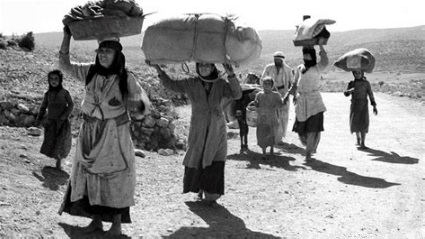 before battle began, abandoning cities and villages without resistance and effectively handing them to the enemy “on a silver platter.” It was, in his view, a collective failure – political, military, and moral.
Nowhere in Zurayk’s book was there mention of the Palestinians as a distinct people, nor of the birth of the State of Israel. His Nakba was not an Israeli crime but a self-inflicted Arab wound—a failure to prevent the establishment of a Jewish homeland through force of arms.
And yet, over the decades, this term—originally a lament over Arab incompetence—has been cynically repurposed into a weapon against Israel. Today, the Nakba is invoked not as a call for introspection within the Arab world but as a rallying cry against Zionism itself. What began as a criticism of Arab disunity has been transformed into a permanent accusation levelled at Israel: a calculated rewriting of history that seeks to erase the Arab role in the 1948 war and paint Israel as the sole villain.
This redefinition serves a political purpose. It deflects blame away from Arab regimes who rejected the 1947 UN Partition Plan—a plan that would have created both a Jewish and an Arab state—and who instead chose war. That fateful refusal remains the true catastrophe. Had the Arab world accepted the UN plan, May 15 2025 could have marked the 77th anniversary of not only the State of Israel, but a State of Palestine as well.
Zurayk’s warnings proved prophetic. He feared that Arab youth, disillusioned by failed leadership, would be driven towards destructive ideologies and pointless violence. Today, that prediction echoes in the brutal actions of Hamas, Hezbollah, and other groups whose violence has brought only misery to the very people they claim to defend. Far from being a source of hope, the legacy of the Nakba has become a justification for endless grievance, horror, and terror.
Meanwhile, the Arab world is moving on. The Abraham Accords—signed by the UAE, Bahrain, Sudan, and Morocco—have normalised ties with Israel, leaving the Palestinian leadership increasingly isolated. That isolation, however, is of their own making. With no elections, no meaningful reform, and no willingness to negotiate, Palestinian leaders have forfeited the sympathy of even their traditional allies. The Gulf States now view Iran—not Israel—as their principal threat, and they are no longer prepared to allow Palestinian opposition to dictate regional policy.
Most Palestinians are weary of corrupt and divided leadership. But at 89, President Mahmoud Abbas offers no vision for the future. In the absence of change, the politics of grievance will persist—fuelled not by strategy, but by stasis.
The true catastrophe of the Nakba was not the survival of Israel. It was the Arab world’s refusal to embrace compromise and coexistence in 1948. It is time that this historical truth was acknowledged. Until it is, Arab youth will continue to be taught that failure is someone else’s fault, and peace will remain out of reach.