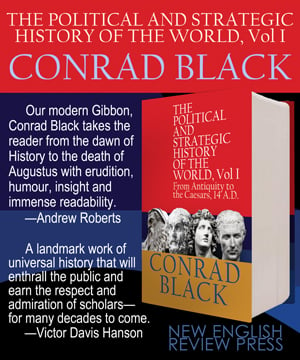
The following is an excerpt from Conrad Black’s ‘The Political and Strategic History of the World, Vol. III: Louis XIV to the Brink of World War I, A.D. 1661-1914,’ published by World Encounter Institute/New English Review Press.
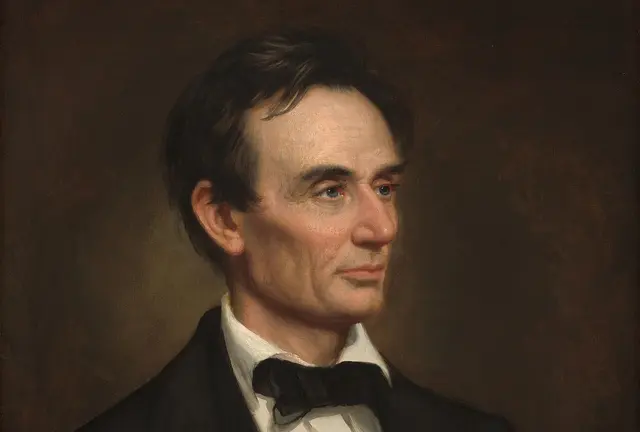
By 1859 the union was in desperate need of salvation and in the nick of time, the most plausible Savior emerged. Abraham Lincoln had a greater integrity, superior tactical skill, a keener intellect, and even greater oratorical powers than Henry Clay and Daniel Webster. Lincoln was a frontiersman, tall and very strong and had had no shortage of hand-to-hand combat. He meant what he said.
The fact was that both sides were spoiling for a fight. The national government had been reduced to a dithering, hairsplitting, talking shop, impotently enduring endless threats thrown at it from its constituents. The Jackson settlement was bound to turn into a shabby and unsustainable sequence of compromises when it was operated by weaklings who would never threaten to hang their vice president for treason and invade states of the Union as if they were foreign territory as Jackson had done.
Lincoln had forced Douglas to renounce the main point of popular sovereignty —the right of slaveholders to their property and territories whatever Congress or local governments thought of it. He had proffered the South far more than the North was prepared to give, and then tried to take it back when Lincoln cut him off at the knees.
It was a classic series of aggregated grievances between two parties that can only be resolved by a fight where one protagonist beats the other unconscious and stands over him in complete victory, or, in the case of the South, had so exhausted the North that it could not continue. Nothing less would clear the air or resolve the issue, as General U. S. Grant would explain twenty years later to German Chancellor Bismarck when he visited him in Berlin.
This demonstrated again that people tend to believe what they want to believe, the South was persuaded by the weakness of Fillmore and Pierce and Buchanan that the North could not suppress it, and that if it could not achieve the theoretical ability to spread slavery where there was no need or desire for it, it would secede with impunity. The next president would have to persuade the North to suppress an insurrection, and then do so, in the certain knowledge that the South would fight with desperate courage and ingenuity as a brave people proud of what they were defending and contemptuous of the North, as only a martial society much handier with horse and gun than the more urban, polyglot North could be.
Nothing less would save the Union which just one long lifetime before had so loudly proclaimed itself the light unto the world and clarion of human freedom and dignity, the arc of deliverance of the rights of man. It was all coming down to Abraham Lincoln, a man for the ages.
By July 1863, three days were required to receive confirmation of the surrender at Vicksburg and the proportions of the Union victory at Gettysburg and on the evening of July 7, thousands marched to the White House to congratulate the president, led by a regimental band.
Abraham Lincoln appeared at the balcony, spoke of the glorious theme of the 4th of July, of the brave men who died in the great victories of the preceding days and declared himself unable to improvise an address worthy of the historic occasion. He smiled, waved and jauntily concluded, turning to the band: “I’ll take the music.”
On November 19, 1863, Lincoln would dedicate the cemetery at Gettysburg and deliver, in just ten sentences, the speech he declined to try to improvise on July 7 from the White House balcony. It became perhaps the most famous speech in the history of the English language.
Lincoln began on the uniqueness of America’s foundation as a nation where “all men are created equal” and closed on the “last full measure of devotion” given by “these honored dead” that “government of the people, by the people, and for the people, will not perish from the earth.”
Both were slightly histrionic liberties but close enough to the truth and a gem of concise and overpowering simplicity and elegance. Lincoln always believed that the American idea would have died spiritually if the Union had been broken by the South, the land of Washington, Jefferson, Madison, Jackson, John Marshall, Monroe, and so many other great Americans.
Grant’s drive toward Richmond and Sherman’s march through Georgia, both among the most famous military campaigns of all history, began at the end of the first week of May 1864. The Union armies had one-hundred and forty thousand men to ninety-six thousand for Lee. In the Battle of the Wilderness, the agile Lee outmaneuvered Grant and inflicted eighteen thousand casualties to ten thousand of his own. Grant moved to go around Lee’s flank at Spotsylvania, an action that cost another twelve thousand casualties, about twice as many as Lee lost. Grant was not indifferent to casualties, but he did not believe Lee could stop him, and he thought he could force him to defend Richmond where he could destroy or terminally enervate the Confederate Army. He pressed on to Cold Harbor, only twenty miles east of Richmond, and attacked entrenched positions, losing twelve thousand men on June 3 alone; after a month he had lost sixty thousand casualties, but Lee had lost thirty thousand, and Grant could replace his losses, and Lee could not.
The day after the election in 1864, Sherman ordered that except for hospitals, churches, schools and libraries, almost the entire city of Atlanta be burned to the ground, as Sherman continued his march to the sea and northwards into the Carolinas. Hood’s battered army retreated to Nashville where it was annihilated by General Thomas. The Confederacy was now reduced to Virginia and the Carolinas and Grant was south of Richmond and grinding Lee’s army in the siege of Petersburg. Sherman had eliminated South Carolina as a functioning state by late February and won his last battle with Johnston at Bentonville, North Carolina on March 20.
Lincoln’s inaugural address on March 4, 1865, was the second most renowned of all his addresses, after the speech at Gettysburg. He effectively reconciled more directly and eloquently than any other American statesman Christian America’s embrace of the Enlightenment. He speculated that slavery was one of those offenses God “now wills to remove and gave this terrible war as the woe due to those by whom the offense came: shall we discern therein any departure from those divine attributes which the believers in a living God always ascribe to Him? Fondly do we hope — fervently do we pray — that this mighty scourge of war may speedily pass away. Yet if God wills that it continue until all the wealth piled up by the bondsman’s 250 years of unrequited toil shall be sunk and every drop of blood drawn by the lash shall be paid by another drawn by the sword, as was said 3000 years ago so still it must be said that the judgments of the Lord are true and righteous altogether.” The Union’s impending victory was even more comprehensive on the moral and spiritual level than it was on the war’s battlefields.
Grant’s nine months siege of Petersburg had almost strangled Lee’s army which was down to fifty-four thousand men, many of them new recruits facing one-hundred and fifteen thousand of Grant’s veterans. Lincoln himself met with Confederate Vice President, Alexander Stephens, at Hampton Roads in early February, but Stephens’ instructions from Davis prevented any progress. Davis fled Richmond as Lee went to Lynchburg and tried to embark his army now reduced to thirty thousand men, by rail to North Carolina to meet with Johnston for a final stand against the overwhelming encircling forces of Grant and Sherman and Sheridan. Grant moved like a cat on his trail and Sheridan blocked Lee’s routes to the west. Lee’s army was almost out of food and ammunition Grant’s army sensed victory so keenly the infantry force skipped rest and rations and marched almost as rapidly as the cavalry.
Sheridan sent messages to Lincoln and Grant that he thought Lee was almost at the end of his ability to resist. Grant sent a polite message to Lee, proposing that he lay down arms. The two met at Appomattox Courthouse on April 9, 1865. There were no histrionics or abrasions or even negotiations, and it was entirely courteous. They reminisced about the old army and on request by Lee, Grant gave his terms: Confederate officers could retain their horses and sidearms and Grant would accept their word that they would self-demobilize and not return to combat. All weapons of war and ammunition were surrendered, and the Army of Northern Virginia ceased operation. The commander of the Union armies ordered that twenty-five thousand full rations be given at once to their late enemy and he ordered an end to what began as a one-hundred-gun salute to victory and instructed that there not be the slightest gesture of exultation nor any act disrespectful of, as he put it, “a foe who had fought so long and valiantly, and had suffered so much for a cause, though that cause was, I believe, one of the worst for which a people ever fought, and one for which there was the least excuse.”
Johnston surrendered to Sherman on April 17, and Sherman was even more magnanimous than Grant, and he and Johnston became friends and remained so for the remaining twenty-five years of their lives. Lincoln visited Richmond on April 4, arriving in a naval flotilla, transferring to the captain’s launch, and finally, so heavy was the wreckage and mass of dead horses and undetonated torpedoes in the water, by rowboat. Many African-Americans greeted him on their knees and Lincoln lifted them up by their elbows and said: “Henceforth you must kneel only to God and thank him for the liberty you will hereafter enjoy.” He walked two miles to Jefferson Davis’s office, with security provided by a black regiment, and followed by a mainly black crowd of well-wishers.
Without a hint of triumphalism, he asked for a glass of water, and authorized the convening of the Virginia legislature, as long as it repealed the act of secession and removed Virginia’s armies from the war, which was done. The butler said Mrs. Davis had told him just two days before to make the official residence shipshape “for the Yankees.”
It had been a terrible war; seven-hundred and fifty thousand people died in a population of thirty-one million and at the end the supreme figure of the drama was one of them. President Lincoln was assassinated at Ford’s Theater in Washington on April 14, 1865, by a deranged southern dramatic actor, John Wilkes Boothe. Apart from Lincoln’s folkloric standing, his pure strategic achievements for the nation are rivaled among his predecessors only by Washington, and among his successors, only by Franklin D. Roosevelt. The Union was impregnable, slavery’s blatant shame had been erased as a bonus to suppressing the insurrection, and the United States was second only to the British Empire as the world’s greatest power, though Bismarck’s united German Empire would soon join that competition.
The United States had a hemisphere practically to itself-there was no balance of power in the Americas. Now the United States could receive floods of eager European immigrants, crank up its laissez-faire economy, and swiftly achieve an industrial scale which the world had never imagined to be possible. If Lincoln had lived he would have attempted to compensate the slaveholders for the loss of their emancipated slaves, and assisted the freed slaves in achieving their potential, and prevented the corrupt southern government of the carpet-baggers protected by the Union Army.
As it was, he ended slavery but did not get to help the African-Americans make much progress towards equality. He performed the absolutely vital feat of abolishing any concept of secession, but though the South had been defeated, it did not lose influence in the Union. The southern whites prevented the African-Americans from voting for one-hundred years, and instead of getting only the credit for two thirds of them in calculating the numbers of congressmen and electors for the southern states, they got credit for one-hundred percent of them but still prevented them from voting. Because the South was a one-party state for over a century, never electing a Republican, seniority rules came to assure that Southerners dominated the Congress more than ever. The United States was reassured as one of the world’s greatest powers and moving quickly upwards. But the internal tumor of the mistreatment of the African-Americans as a sub-class would continue for many decades and there would be routine lynchings of black men in the South for nearly a century and frequent and terrible race riots in the ghettos of the northern cities.
Yet, it was thanks to Lincoln that the threat to the continued existence of the country was eliminated, and all could see that the United States was predestined to exercise an immense and unique influence in the world. Lincoln and the Civil War have been emphasized extensively because of the immense impact of the United States on the world in all of the world’s subsequent history to date, and as far as we can see forward.
Lincoln at once became and remains the supreme and most deserving beneficiary of the American star system, surpassing even Washington. He was morose but never lost his fine sense of humor, proud but without vanity, utterly scrupulous but without being a bit priggish or even above a political ruse, intellectual but down to earth, scholarly but an autodidact, the ultimate self-made man but without chippiness or aggression. He was always saddened and never angry at the many betrayals and disappointments he endured, and was not worn down by a nagging wife or the premature death of two sons. He was, as the next great Republican president, Theodore Roosevelt, said, “quiet, patient, mighty Lincoln,” who lived and suffered and died for the people and saved the Union by lending it his strength.
A terrible ordeal was ending, a prolonged period of immense spontaneity and growth was about to begin. America was unbound, before a limitless horizon.
First published in the NY Sun.