By Robert Harris
The Basij, a paramilitary force that acts as a brutal morality police has origins that should be grounded in one of the most horrific atrocities of the latter half of the 20th Century – the use of “child martyrs” to protect Iran’s limited military infrastructure during the early phase of the Iran-Iraq war. This story has long been forgotten by the progressive-left media, which has long been unduly supportive of Iran, but it is startling to even see the Jerusalem Post whitewashing its terrible origins:
“The group, founded by Islamic Revolution leader and then-supreme leader Ayatollah Ruhollah Khomeini shortly after the revolution succeeded in deposing Shah Mohammed Reza Pahlavi, was initially formed of civilian volunteers, often from poor and tribal backgrounds, dissatisfied with Iran’s economic and geopolitical issues, who Khomeini succeeded in recruiting to defend the nascent Islamic Republic from Saddam Hussein during the Iran-Iraq War.”
It is as if the stories of the Basij’s origins are somehow to be doubted – certainly an Iranian once denied same to me, and yet I cannot forget a report in an ancient copy of Readers Digest, which I am unable to find online, speaking of the PTSD suffered by Iraqi soldiers after being forced to mow down the “human waves” of children coming at them with rocks and walking sticks (of all things). However, Encyclopaedia Britannica notes:
“Iran repeatedly launched fruitless infantry attacks, using human assault waves composed partly of untrained and unarmed conscripts (often young boys snatched from the streets), which were repelled by the superior firepower and air power of the Iraqis.”
More substantively, German historian Dr. Matthias Kuentzel noted the true horror of the Basij’s origins back in 2006 (for the New Republic) during the heyday of President Mahmoud Ahmadinejad:
“During the Iran-Iraq War, the Ayatollah Khomeini imported 500,000 small plastic keys from Taiwan. The trinkets were meant to be inspirational. After Iraq invaded in September 1980, it had quickly become clear that Iran’s forces were no match for Saddam Hussein’s professional, well-armed military. To compensate for their disadvantage, Khomeini sent Iranian children, some as young as twelve years old, to the front lines. There, they marched in formation across minefields toward the enemy, clearing a path with their bodies. Before every mission, one of the Taiwanese keys would be hung around each child’s neck. It was supposed to open the gates to paradise for them.
At one point, however, the earthly gore became a matter of concern. “In the past,” wrote the semi-official Iranian daily Ettelaat as the war raged on, “we had child-volunteers: 14-, 15-, and 16-year-olds. They went into the minefields. Their eyes saw nothing. Their ears heard nothing. And then, a few moments later, one saw clouds of dust. When the dust had settled again, there was nothing more to be seen of them. Somewhere, widely scattered in the landscape, there lay scraps of burnt flesh and pieces of bone.” Such scenes would henceforth be avoided, Ettelaat assured its readers. “Before entering the minefields, the children [now] wrap themselves in blankets and they roll on the ground, so that their body parts stay together after the explosion of the mines and one can carry them to the graves.”
These children who rolled to their deaths were part of the Basiji, a mass movement created by Khomeini in 1979 and militarized after the war started in order to supplement his beleaguered army.The Basij Mostazafan – or “mobilization of the oppressed” – was essentially a volunteer militia, most of whose members were not yet 18. They went enthusiastically, and by the thousands, to their own destruction. “The young men cleared the mines with their own bodies,” one veteran of the Iran-Iraq War recalled in 2002 to the German newspaper Frankfurter Allgemeine. “It was sometimes like a race. Even without the commander’s orders, everyone wanted to be first.”
The sacrifice of the Basiji was ghastly. And yet, today, it is a source not of national shame, but of growing pride. Since the end of hostilities against Iraq in 1988, the Basiji have grown both in numbers and influence. They have been deployed, above all, as a vice squad to enforce religious law in Iran, and their elite “special units” have been used as shock troops against anti-government forces. In both 1999 and 2003, for instance, the Basiji were used to suppress student unrest. And, last year, they formed the potent core of the political base that propelled Mahmoud Ahmadinejad—a man who reportedly served as a Basij instructor during the Iran-Iraq War—to the presidency. […]”
And there we have it – the Basij were formed from the blackest pit of evil intent, for these were not mere child soldiers, but children to be sent to their inevitable deaths. Such barbarism is almost impossible to comprehend but comprehend we surely must.
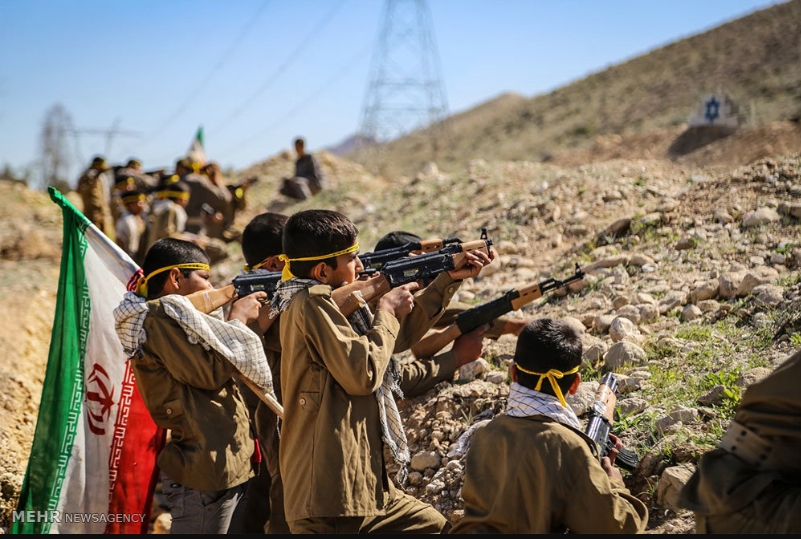
Illustration of young Basji taken by the US Treasury website, originally from the Basji’s own website.









One Response
Iranian Recruitment Poster:
“Hi, are you a pschyopath or a sociopath?”
“Well, then The Basij has a place for you!!!”