Islamic State wives who escaped from a prison camp in Syria are receiving public donations to help them pay for rent, food and clothing.
A Telegraph investigation can reveal that Islamic State (IS) supporters are raising money on crowdfunding platforms like GoFundMe, claiming to cover living costs for the terrorists’ wives and children who fled Al-Hol detention camp in recent weeks.
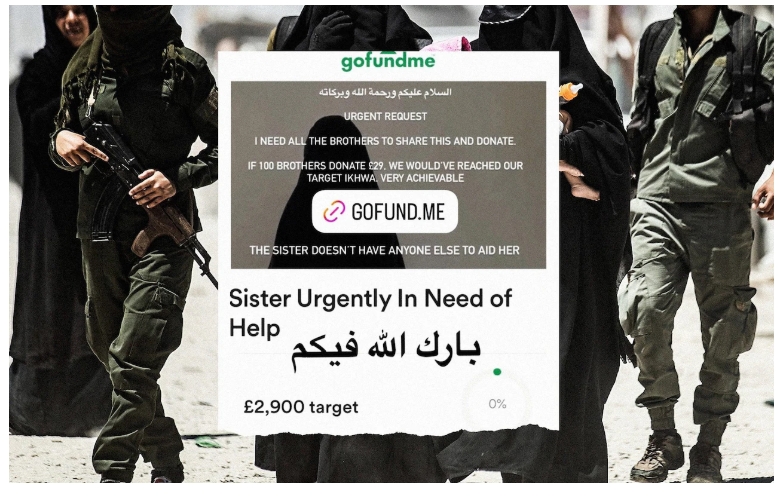
Dozens of fundraisers tied to IS are being advertised on social media channels, seeking donations of up to £4,000 to support the escapers who are now trying to blend in with the general population. They are targeting sympathisers around the world, with posts in English, Russian, German and Arabic.
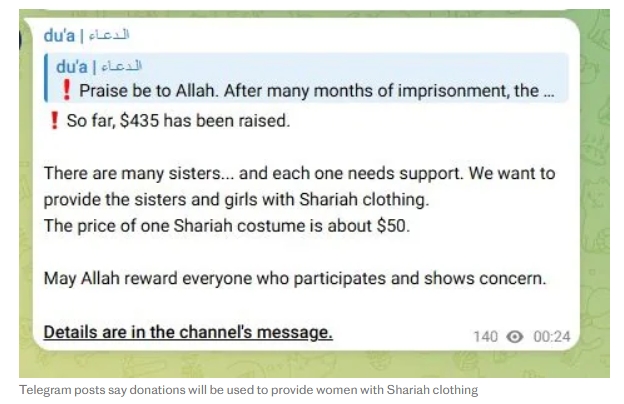
The drive for donations within days of the jihadists’ families escaping from Al-Hol raises fears over IS’s ability to expand and plot deadly attacks on the West and Middle East.
“These women have been talking for a long time about the ‘caliphate’ – that it is going to be reconstituted. The slogan they use is ‘we’re coming back’, and ‘we haven’t been defeated’,” said Anne Speckhard, director of the International Centre for the Study of Violent Extremism (ICSVE). It’s very concerning. What will they do? Will they go back to their home countries and could they be used to launch attacks, or will they live peacefully in Syria?”
The resurgence threat has increased after the US and Israel went to war with Iran on Feb 28.
Private posts at times link to public crowdfunding campaigns on GoFundMe that use generic humanitarian aid language in an attempt to avoid being flagged and deleted. The fundraising platform did not respond to a request for comment.
“I have tried my best, even though I am flawed, to help families in Al Sham and the surrounding region financially”, reads a public crowdfunding appeal, using Arabic to refer to Damascus, the capital of Syria.
“They’re very adaptive to use every foreign financial mechanism to get money to [former and current] detainees,” said Mona Thakkar, an ICSVE researcher specialising in terrorist financing. They get the cover of legitimacy and also exposure to a global audience. You can just share the links and then anyone can donate to these causes,” she said. “The fundraising appeals are getting more impetus, because it’s Ramadan.”
The Muslim holiday emphasises the importance of charity, and began mid-February, inadvertently coinciding with the Al-Hol escapes. Experts warn that the Al-Hol escapers are likely radicalised, after seven years under constant IS indoctrination at the camp.
Potential scams can’t be ruled out – opportunists who pocket money collected under the guise of “support”. But humanitarian aid workers at the Syrian camps have told The Telegraph that they have previously witnessed such funds reaching detainees.
There are even social media channels dedicated to posting pictures that confirm receipt. These pictures, reviewed by The Telegraph, typically show fully veiled women in black next to their children, whose faces are covered or blurred, displaying $100 bills and holding “thank you” messages for the “infaq,” or donations, listing the date and amount received.
“It’s a very, very complicated problem. The main risk is that many of these women genuinely don’t want to stay in Syria,” said Elizabeth Tsurkov, a non-resident fellow at the New Lines Institute, a Washington-based think tank. “Therefore, if they return [to their countries], then they could be activated, or could do something on their own initiative, because they genuinely believe in this ideology.”
What many warned would happen eventually with Al-Hol “now has happened”, said Ms Tsurkov. “They kept kicking the can down the road, kicking it, and kicking it – then it exploded.”