By Conrad Black
Last week I reviewed mainly the domestic record of the government of Prime Minister Mark Carney over the past 13 months, although, as was mentioned, the principal point that Canadians seem to hold in his favour is the foreign policy perception of his ability “to stand up to Trump.” Few could forget how Carney, with the connivance of the anti-conservative national political media, represented his campaign as a Churchillian finest hour of national defence against a belligerent America. That burlesque has ended and Carney must now face the question of how to deal with the United States, a subject that our longest-serving prime minister, W.L. Mackenzie King, described to General de Gaulle in 1945 as “an overwhelming contiguity.”
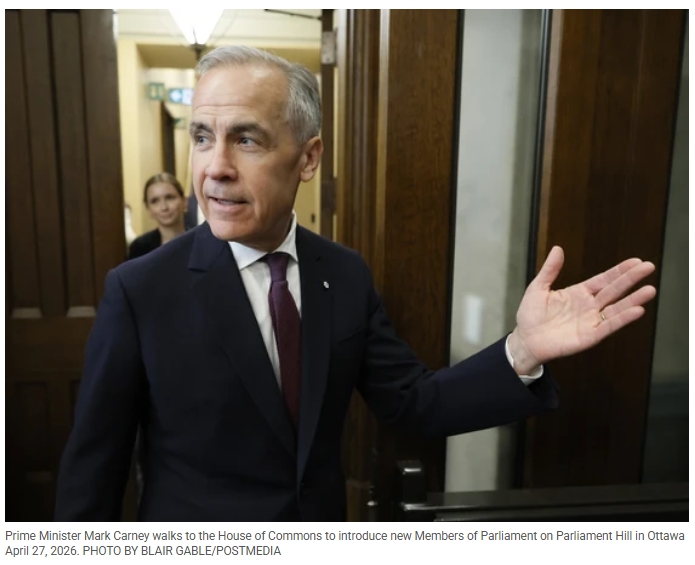
Mark Carney has conspicuously questioned the legality of the American and Israeli military intervention to prevent the development and deployment of Iranian nuclear weapons. This is a dishonest and profoundly mistaken policy. Iran has offered constant provocations that could justify military reprisal throughout the 47-year infamous history of the Islamic Republic, as the principal state sponsor of terrorism in the world. The principal European countries and the European Union itself joined in the disgraceful nuclear agreement with Iran negotiated by the Obama administration, which gave a green light to such deployment of nuclear weapons after 10 years. That would have elapsed last year. The world owes a great debt of gratitude to President Trump and Israeli Prime Minister Benjamin Netanyahu for preventing this eventuality. Greater independence from the U.S. by all means, but not by suggesting moral equivalence between Washington and the murderous ayatollahs.
It is disgraceful that most of the members of the NATO alliance, including Canada, waffled in craven pseudo-moralistic hypocrisy about the absolute necessity of preventing that criminal regime from conferring upon itself the ability to blackmail the entire world and threaten the extinction of the Jewish state. Carney has also been very indistinct about Israel’s right to crush terrorists on its borders and unbecomingly silent about the appalling extent of antisemitic acts within Canada.
The prime minister has commendably pledged to raise our game in national defence. His attempts to broaden economic contacts with other countries are at least conceptually sensible as well. But we are not going to attract the investment we need to restore economic growth and begin to address the 50 per cent gap that has opened up between the per capita prosperity of Americans and Canadians until we have lower corporate tax rates than the United States so we have a chance of attracting the quantity of investment Canada needs to resume vigorous economic growth and reverse the negative capital flows of the past (Liberal) decade. Nor do we have any chance of realizing our economic potential until we bury the putrid corpse of Carney’s neo-Luddite ecological views and maximize our energy exports to the world that is clamouring for our oil and gas.
As long as approximately three quarters of Canada’s exports go to the United States and the Americans provide more than three-fifths of our imports, this country is effectively almost as closely integrated into the economy of the United States as the states of California and Texas. We can be confident that our trade negotiators in the current discussions over the renewal of the Canada-U.S.-Mexico free trade agreement will acquit themselves with distinction. When that agreement has been renewed, we must base our foreign and economic policy on the goal of maximum non-inflationary economic growth, conditions that attract foreign investment and diversify and dilute our economic dependence on the relationship with the United States, without gratuitous offence to the U.S.
The U.S. administration has recognized the requirement to modernize the Western Alliance. NATO was founded in 1949 to prevent the USSR from occupying Western Europe and since then not only has the USSR disintegrated, but Russia has a smaller GDP than of all of the G7 countries, including Canada. Having wallowed in just a fifth of the territory of Ukraine for longer than the Russo-German war of 1941 to 1945, Russia does not realistically pose a serious threat to Western Europe. The French and British have adequate nuclear deterrence to assure that there is no Russian nuclear attack on the continent. The question naturally arises of why the United States has been paying for most of the defence bills of its over-indulged allies. That has been addressed by NATO’s belated acceptance of the goal to raise each member state’s defence effort to five per cent of GDP.
The revised concept of U.S. national security interests has been summarized in the 2025 National Security Strategy and 2026 National Defense Strategy statements and the foreign policy summary known as Project 2025. These documents reaffirm that the United States will defend its homeland and its interests in the Western Hemisphere and will deter China in the Indo Pacific through a policy of strength but not antagonism or confrontation. In the 2026 National Defense Strategy, Defence Secretary Pete Hegseth summarized these changes in the introductory paragraph, emphasizing the points just named, and he added: “For too long, the U.S. government neglected-even rejected-putting Americans and their concrete interests first. Previous administrations squandered our military advantages and the lives, goodwill, and resources of our people in grandiose nation-building projects and self-congratulatory pledges to uphold cloud castle abstractions like the rules-based international order.” This last is a priggish expression that reminds me of my Grade 1 schoolteacher and that our prime minister likes. Of course, it is a complete fiction that a majority of states can dictate and enforce rules on the most powerful states. The best that can be hoped for is that the most powerful states do not abuse their power and in that regard, the conduct of the United States has been considerably more civilized than that of its historic rivals.
The official U.S. position promises “more favorable treatment on commercial matters, technology sharing, and defense procurement” with those countries that adjusted to these new American goals. The National Defense Strategy explicitly promised to prioritize co-operation and engagements with model allies — those who are spending as they need to meet threats in their regions with critical but limited U.S. support — including through arms sales, defense-industrial collaboration, intelligence sharing, and other activities that leave our nations better off.” The U.S. is integrating economic and security relationships, and as the raison d’être of NATO — to prevent a Soviet takeover of Western Europe — is now obsolete, American alliances will be updated. Obviously, no alliance thrives after such a terrible (and self-destructively foolish) affront as banning the U.S. from allied airspace during the Iran War.
The only NATO country to date that has passed the American litmus test of being a reliable ally is Poland. Its defense budget was almost five per cent of GDP in 2025, and this is a bipartisan consensus in Poland, a country whose independence was extinguished from the 18th to the 20th centuries, and which was brutally occupied by Nazi Germany and Soviet Russia and exploited for 45 years by the Russians. The Romanians and some of the Baltic countries have also responded well. Canada could join this group without losing our virtue.
Crises are apt to arise anywhere, such as now in the Persian Gulf. The United Arab Emirates, Japan and Argentina are now all better and closer allies of the United States than any of the NATO countries except Poland. And they are all being rewarded, Japan with joint scientific research and military production, the UAE with defence assistance and joint projects, and Argentina with substantial financial assistance as President Javier Milei drags that splendid country out of the pale of 70 years of Peronist demagogy and profligate misgovernment.
Mark Carney is absolutely right to redefine Canadian foreign policy as the Americans and others are doing in conformity with changing circumstances. But he has to outgrow his histrionics of the past election campaign and produce a policy that maintains constructive relations with the United States while steadily increasing Canadian influence in the world by exploiting export opportunities for our natural resources, attracting foreign capital investment, and building our military and strategic significance as an ally with particular emphasis on defending our section of the Arctic. All of these are attainable goals. But if Canada does not alter its attitudes to these changing conditions, Canada, as a political entity, will begin to resemble Greenland.
First published in the National Post