Latin America’s conservative renaissance

By Conrad Black

The current U.S. administration seeks to reimpose the Monroe Doctrine upon this hemisphere. This was an initiative by President James Monroe in 1823, which accepted the presence of European powers in the Americas, but purported to forbid any new intrusions in the Americas from overseas or to extend existing ones. The United States at the time had no authority to enforce such a ukase, but it was aware that the British did not wish any successful attempt by Spain to resurrect its empire in the Americas, which by 1823 had been reduced to Cuba and Puerto Rico. Thus the Monroe doctrine for its first 40 years was in fact based on the British control of the seas.
President Lincoln warned Emperor Napoleon III against his hare-brained attempt to establish a Bonaparte-Habsburg monarchy in Mexico while the United States was distracted by its Civil War. When that war ended, the United States had the greatest army and the greatest generals in the world, a fact which accelerated the assembly of the string of colonies along America’s northern border into the ultimately very successful Confederation of Canada. It also enabled the United States to assist the rebels in Mexico, led by that country’s greatest hero, Benito Juarez, (who deserved more flattering recognition than to have Italian dictator Benito Mussolini named after him), to overcome the foreign sponsored monarchy in Mexico, though the “emperor,” Maximilian, the well-intentioned brother of Franz Joseph, who ruled in Vienna until 1916, did not deserve to be executed by firing squad.

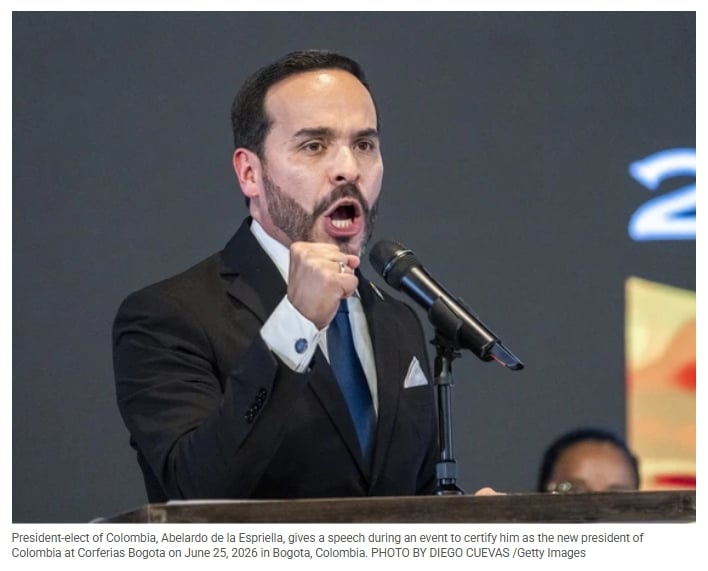
None of this applies to Canada, and obviously, the United States has no right to tell the sovereign states of Latin America who they can have relations with outside the hemisphere. But the tremendous traffic of lethal drugs and illicit migrants into the U.S. largely master-minded by China and with extensive cooperation from Mexico and several other countries, gave the Trump administration a reasonable pretext to act. The Mexican government has mended its ways; the Venezuelan president now resides in prison in New York, and the new president of Colombia is an uproarious protégé of President Trump, Abelardo de la Espriella, a former Miami lawyer, who has declared that his opponents need a “backbone transplant,” that he will “emasculate the left,” and drive them “15 metres under the ground with my boot on their neck.”

The vintage Peronist and Castroite Latin American left, blaming everything on the Gringos, wallowing in the good will of China, and posturing with anti-Israeli sloganeering, has failed and been rejected by the steadily better functioning democratic systems of Latin America. Pro-American, pro-Israel governments have been elected in the last few years in Argentina, Chile, Bolivia, Ecuador, Peru, El Salvador, Paraguay, Honduras, and now Colombia. The Argentinian leader, Javier Milei, has drastically shrunk government and cut inflation. He consults his dogs, whom he clones (to seek immortality for them), and campaigns with a chain saw. The Salvadoran leader, Nayib Bukele, of Palestinian Christian ascendance, has instituted a draconian Territorial Control Plan that has reduced violent crime by over 50 per cent, and while it impinged on civil liberties, it enabled his reelection by an apparently genuine 85 per cent of the voters, and may have shown Latin America the way to crush these deadly gangster organizations, in Mexico and Colombia in particular.
In Brazil, Luis Inacio Lula da Silva, a partially reformed leftist, is seeking a fourth term against Flavio Bolsonaro, the son of his former adversary. Both the elder Bolsonaro and Lula were imprisoned for a time, a growing trend that has also affected political leadership in Israel, Pakistan, Peru, France, and other countries and is not a particularly stigmatizing career event, (writing as someone falsely imprisoned myself, though it was an interesting experience). While Lula da Silva was popular when he left office, his successor, Dilma Rousseff was impeached for corruption and incompetence at a time when her popularity stood at seven per cent in the polls. She was replaced by her vice president, Michel Temer, who finished her term but with popularity ratings also in single figures. The same trend could be observed in Peru where there have been eight presidents in ten years, three in five days in 2020, and numerous presidential impeachments, one of a president whose popularity was at two per cent.

After the end of the Cold War, the United States didn’t much care what happened in Latin America as long as it was not itself threatened. Almost the entirety of Latin America was in the hands of left-wing governments for some time, though little occurred that provoked the Americans. This changed with the particular case of the virtual takeover of the northern provinces of Mexico by extremely sinister gangs who were instrumental in trafficking millions of illegal immigrants into the United States, including approximately 500,000, mostly criminals, that were deported last year, according to Homeland Security. But the ambitious program of penetration of Latin America by China has aroused the Trump administration at the same time that the widespread failure of the leftist governments that welcomed China into this hemisphere provoked a turn of direction in government to the right in Latin America.

Cuba appears ripe to fall as a Marxist state from one day to the next, ending the catastrophic Castro communist experience of 67 years. Almost all of these seismic political shifts in Latin America except Venezuela have been the result of constitutional processes and elections. The history of Latin America was replete with military coups and juntas governed Argentina until 1982, Brazil until 1985, and Chile until 1990. The South American military normally appeared in tunics so overloaded with medals and ribbons they had difficulty getting them on and practically none of them ever exchanged a shot in genuine military activity. There has been great social progress also: Brazil, in 1968 was only 53 per cent literate and the equivalent number today is 95 per cent. Given Brazil’s population of 215 million, the outcome of the Lula-Bolsonaro election will be observed with great interest throughout the world. All of Latin America is at a turning point.

First published in the National Post

image_pdfimage_print

Leave a Reply

Your email address will not be published. Required fields are marked *

SUMMER FUNDRAISER!

Please help NER stay free!
No paywalls!

A genuine literary magazine. NER combines courageous values with excellent writingreally smart, very creative and entertaining.
          — Andrew Klavan

New English Review Press is a priceless cultural institution.
          — Bruce Bawer

Pre-order on Amazon, Amazon UK, or wherever books are sold.

Order at Amazon US, Amazon UK or wherever books are sold. 

Order on Amazon, Amazon UK, or wherever books are sold. Audiobook also available.

Order on Amazon, Amazon UK, or wherever books are sold.

Order at Amazon, Amazon UK, or wherever books are sold. 

A history lover’s dream. Order on Amazon US, Amazon UK, or wherever books are sold. 

Order on Amazon US, Amazon UK or wherever books are sold. 

The perfect gift for the history lover in your life. Order on Amazon US, Amazon UK or wherever books are sold.

Order on Amazon, Amazon UK or wherever books are sold.

Share via
Send this to a friend