By Roger L Simon
Before getting into the outrageous claim (is it?) that Marilyn Monroe once lived in my house, I’d like to call your attention to a podcast released today with Mark Bauerlein of First Things, titled Kabbalah and the Future. We discussed EMET, Jewish mysticism, and the larger questions that inspired the novel.
I was particularly pleased to appear on First Things because I have come to share its conviction that preserving the Judaeo-Christian tradition is essential to our civilization—a conviction that also helped motivate EMET and its planned sequels.
AND NOW TO MARILYN:
In 1989, as a divorced man living alone, I was looking for a house in the Hollywood Hills, nothing too elaborate (I couldn’t afford it anyway), but a place that had a good spot for a home writing office and where maybe I could entertain a woman if I were so lucky.
I found something suitable on one of those roads that snake through the hills in the Outpost District, not far from Mulholland Drive. I liked the view better than the house, but the house was okay. And it had a swimming pool. I wanted one because I shared two young boys with my ex and thought a pool would entice them to come over.
So I made an offer on the house rather quickly, disregarding one of the realtors who muttered something about Marilyn Monroe having lived there. I didn’t believe her and thought she was trying to jack up the price. It was far from a movie star’s mansion, where I would envision Monroe living. I recall thinking, whether in my mind or out loud, I’m not sure, of the “George Washington slept here” appellation ascribed to so many old houses on the East Coast that it couldn’t possibly be true. This was the Hollywood variety.
In any case, I bought the house and forgot about its possibly glamorous past, until, about two years later, I was working in my office, when there was a knock on the door. Being a writer who welcomed any chance to procrastinate, I opened it. A frumpy woman in her sixties stood in front of a well-worn van that was likely hers. She told me she used to own the house and, referencing some changes I had made, asked if she could come in and have a look.
I nodded and, once inside, she suddenly looked glum. “This house brings back sad memories…. I was going through a divorce and was nearly bankrupt. Thank God the studio came along and rented it for Marilyn and Joe.”
“Marilyn and Joe?” I blurted. “Joe DiMaggio?”
Marilyn was one thing. As a heterosexual male, I was, needless to say, impressed. But the Yankee Clipper? As a boy, I sat with my father watching Joltin’ Joe hit, it turned out, his last home run.
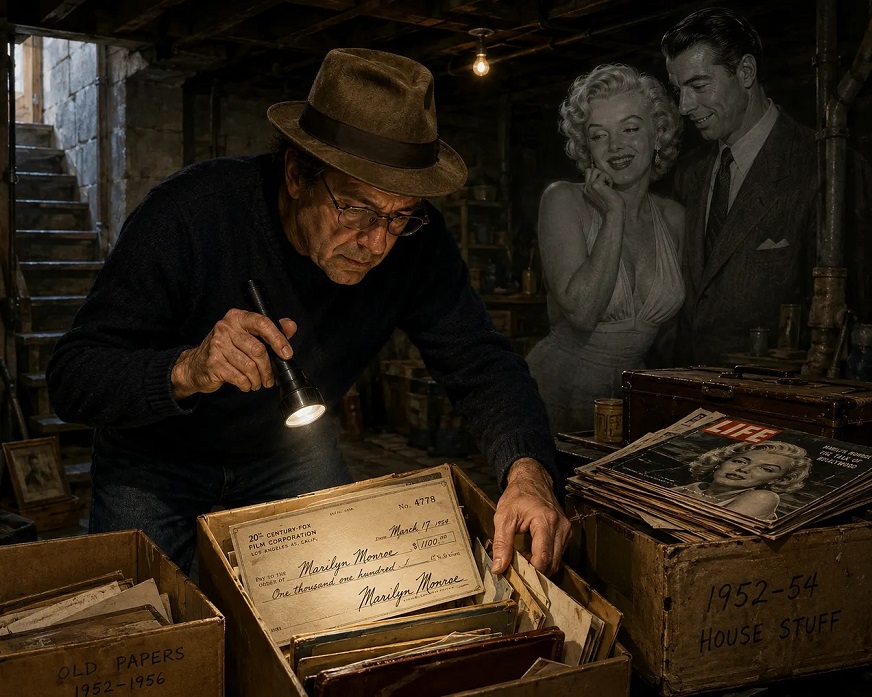
He was Marilyn’s second husband, and there was, I knew even then, a dark side to the story. They were married for only a year, 1954. DiMaggio was rumored to have been a batterer. For a while, I would rummage around the house’s basement looking for evidence of their lives. I was considering writing a book, “DiMaggio’s Bat,” but I never found anything. I didn’t feel comfortable writing something of that nature anyway. DiMaggio was known to be the most loyal of her ex-husbands, regularly visiting her grave.
I did, however, find much subsequent evidence that they had lived there, including a rent check signed by Marilyn. I was stunned when I found it.
Subsequently, I heard stories from old residents of the neighborhood. Marilyn was apparently a good neighbor and kind to the local children, one of whom, a little boy, wanted to marry her and brought her flowers.
After Sheryl and I got married, we lived together in that house for nearly thirty years, leaving in 2018 when we left Los Angeles. It was bought from us by a gay couple that almost immediately split up. They, in turn, sold it to a Marilyn imitator who lives there to this day, entertaining the tourists who come by in buses.
I don’t often reflect on Marilyn or Joe, but since June 1, 2026, would be her 100th birthday, I am reminded that the celebrities of that era were real celebrities, not the rather pallid “influencers” and “podcasters” of our time. You could say it’s my age that I think that way, but I suspect it isn’t. Hollywood, as we knew it, has vanished, and with it some of our ability to dream.
No one expressed it better than Paul Simon when he wrote in 1968: “Where have you gone, Joe DiMaggio? A nation turns its lonely eyes to you.”
First published in American Refugees