By Lev Tsitrin
Traditionally, very few Jewish religious texts have been illustrated, Passover Haggadah — read during Passover seders to remind those around the table of the story of Exodus that is being commemorated, and to direct the observance of the holiday, being one such. For generations, artists have been lavishing their skills — and often, their wit — on enlivening editions of Haggadah with pictures.
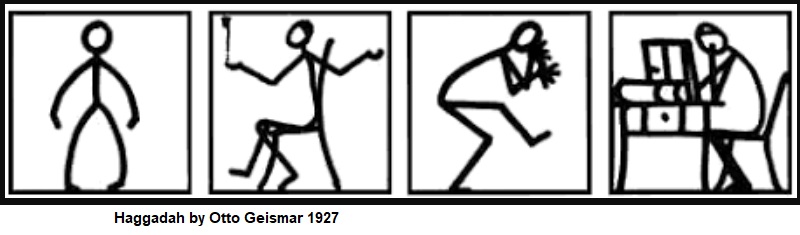
A paragraph that almost invariably gets a picture, is that describing “four sons” –wise, wicked, simple, and “one does not even know how to ask” (Haggadah being a religious text, the obvious criterion for differentiation is an attitude towards the holiday — and hence, more generally, to the Jewish tradition.) Notably, only the “wicked” son is treated as a self-declared outsider who mocks the community of actual, or soon-to-be, scholars represented by the other three sons who show different stages of maturity that corresponds to their ages — the “one does not even know how to ask” being a yet-unlettered child, the “simple” one not yet having a chance to advance in his studies, and the “wise” one being an aged, bearded sage.
Artists illustrating this passage showed much ingenuity in giving visual form to psychology of the “four sons,” but, generally, settled on depicting the “wicked” one as a soldier — apparently on a theory that soldiering is the polar opposite of scholarly study seen as the ideal of Jewish life (not to mention that, soldier being an attribute of a state’s power — something which the exilic Jews did not have, they naturally saw in a soldier an embodiment of a political reality that was the polar opposite of their own, and thus a perfect embodiment of an idea of the “other” which the “wicked son,” contemptuous of tradition, represented.)
I would suggest breaking with that visual tradition. I think that the recent, three-way New York mayoral election in which an anti-Israel, Moslem Democratic Socialist Mamdani got 50.4% of the vote, beating former Governor Cuomo, a Democrat who ran as independent (41.6%), and a Republican, Sliwa (7.1%) — offers to a future Haggadah illustrator a brand-new, excellent way of depicting the “four sons” not through facial types, but through the filled-out ballot questions alone. The son who “does not even know how to ask” is obviously too young to vote, so the bubbles next to Mamdani’s, Cuomo’s, and Sliwa’s names would remain unfilled; the “simple” one does not yet understand how politics works, and rigidly votes on a party line, being represented by a filled-up bubble next to Sliwa; the “wise” one — who understands that Sliwa has no chance, and the vote for him is the vote for Mamdani, is represented by a filled-up bubble for Cuomo. Finally, the “wicked” son — to whom Mamdani’s opposition to Israel’s very existence means nothing — is depicted as a ballot choosing Mamdani.
“Jewish voters preferred Cuomo by a nearly two-to-one margin: 63% voted for Cuomo, 33% for Mamdani, and 3% for Sliwa,” Wikipedia informs us — thus providing a statistical breakdown among the “sons” depicted in the Haggadah. The “wicked” son — always seen as a marginal figure — is not marginal anymore, although the age differentiation depicted in traditional Haggadah illustrations still holds: the older generation was indeed wiser, and far less nihilistically self-destructive: “Mamdani received 78% of voters aged 18–29, and 66% of voters aged 30–44,” Wikipedia tells us.
Passover is a joyous holiday — the one celebrating the escape from Egypt’s slavery to freedom, and it is deeply troubling that nowadays there are so many “wicked sons,” willing to make a reverse journey, choosing the slavery of Socialism (and its anti-Zionism) over freedom. One can only hope that the trend is transitory, and that as they mature, the “wicked” sons would turn into the “wise” ones. But as of now, the proportion of the “wicked” sons is very troubling — though it does give food for thought to an artist, to whom I really recommend using the 2025 New York City ballot to picture the “four sons” in a new edition of the Passover Haggadah.