By Theodore Dalrymple
My computer’s wallpaper shot, the picture that comes up whenever I turn the computer, changes regularly, at whose or what’s instigation I know not, but certainly not at mine. I suppose that it—or is it they?—must have some inkling of my taste, for never does anything visually offensive to me appear.
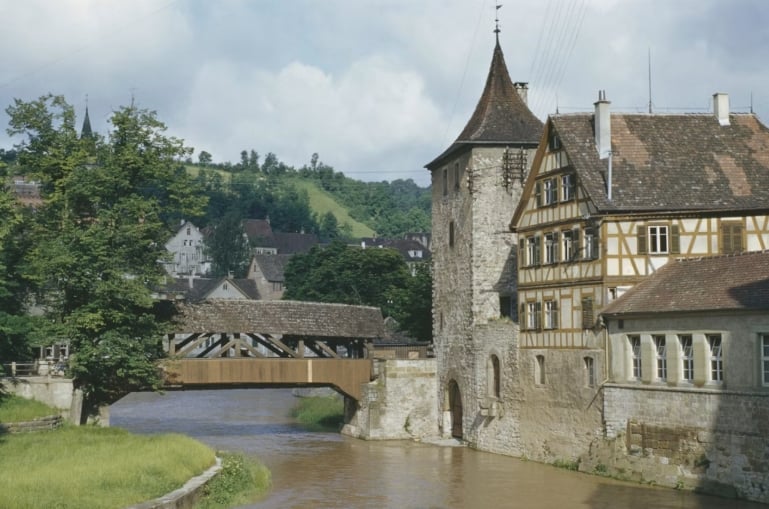
Recently, a panoramic view of the Bavarian town of Rothenburg ob der Tauber came up. The town was picture-perfect: not a parked car in sight, nor (come to think of it) any human being, human beings being so messy. At first I took the picture to have been generated by artificial intelligence (“Gemini, design me a perfect medieval town in Bavaria”), but a quick search on the internet demonstrated that Rothenburg ob der Tauber (of which I had not previously heard) was indeed as shown—unless, that is, the whole of the internet is part of the vast Truman Show in which we now all live without realizing it.
I had assumed that Rothenburg had escaped damage (other than by neglect) during the war, but I discovered that about a third of it was severely damaged during the war’s later stages. Afterwards, the town was restored, not with absolute reproductive precision, but with fidelity to the overall design of the original buildings.
What a curious contrast with Britain, supposedly one of the victors of the war! There, wherever a lovely town or city had been severely damaged by bombing, no restoration whatsoever was undertaken. On the contrary, local councils could not wait to complete the work of the Luftwaffe and demolish, not restore, what remained. They replaced the old with the most banal of modernist buildings, thereby comprehensively ruining once and for all almost every townscape in the country (sometimes they had planned to do precisely this even before the war). It was as if the country had tired of being itself and wanted to be something else; whereas in Germany, where the need to be something else was very strong, at least some restorative work was undertaken, despite other pressing problems that had to be solved, and very quickly, nearly half of all buildings in the country having been destroyed or severely damaged.
When one reads of the condition of Germany at the end of the war, one realizes that its resuscitation was one of the astonishing feats of our time. That any effort at all went into restoration is surprising, from a purely utilitarian point of view—the point of view of decision-makers in Britain, home of utilitarianism as a philosophy. It has turned out, alas, that utilitarianism is only superficially utilitarian: Its calculations leave out most of what is important in the long run.
Yet when I look at pictures of Rothenburg ob der Tauber, so perfect that it almost takes your breath away, I feel a certain unease. It is too perfect. One would feel there like a fly in a bowl of vichyssoise soup—or at least, as a fly ought to feel in a bowl of vichyssoise, if it could feel anything. The town is intimidatingly perfect, one’s very presence in it spoiling it. The fact is that I am no physical adornment to any town.
No doubt Rothenburg’s perfection calls forth good behavior in certain respects from its residents and its visitors. Even the worst litterbug would not dare to soil its streets. Even the most loutish of louts or drunk of drunkards would keep his voice down as he walked through them. One would expect everyone there to be civil and well-mannered, though not necessarily kind-hearted in any deeper sense. As Miss Marple observed, there is a great deal of wickedness in an English village, notwithstanding its picture-postcard climbing roses, its hollyhocks and thatched roofs.
I suspect that you might feel never quite at your ease in Rothenburg ob der Tauber, as you never feel quite at your ease in the home of an excessively houseproud housewife, who rushes to plump up the cushions you have just sat on the moment you stand up. This is not meant by her as a criticism, no doubt, but it feels like one. You are like the dust that she will not allow to settle, at least not for long, and against which she is ever-vigilant. In short, you are a nuisance, though there is nothing personal in this: for such a housewife, everyone is a nuisance. Physical perfection is the summum bonum, and nothing else counts or will do.
But I would not wish to go to the opposite extreme and say that physical surroundings are of no account whatsoever. For myself, I prefer to be surrounded by beauty and tidiness rather than by ugliness and a total mess. Beauty is not everything in life, but it is far from a negligible desideratum. This raises the interesting question that if I don’t want to live a life of aesthetic perfection, and don’t want to love a life of aesthetic squalor either, how much imperfection do I tolerate and how much ugliness do it need? Can ugliness and imperfection be dosed as castor oil can be dosed? Could one go into Rothenburg and say, “What I think this town needs is a bit of peeling paint, not everywhere, but here and there, some dead dog in the road or some decaying rubbish (just a little), some drunken slattern accusing her neighbour loudly of having stolen her geraniums?” The trouble with imperfection is that it often gets out of hand and does not know where to stop.
I have spent much of my life in places where imperfection went far too far; where, in fact, it produced something like a living hell, or what would have been a living hell to me had I not been able to escape it regularly. I need hardly point out the imperfections of prison life, even of life in the best-run prisons (they are not meant to be perfect, for that would be to obviate their purpose). But I look back on my time as a prison doctor with something like nostalgia. If I had to choose between being a doctor in a prison and in a town like Rothenburg ob der Tauber, I should unhesitatingly choose the former, though beauty is decisively on the side of the latter. How odd, how contradictory, we humans are!
First published in the American Conservative