By Jerry Gordon
What was Kristallnacht?
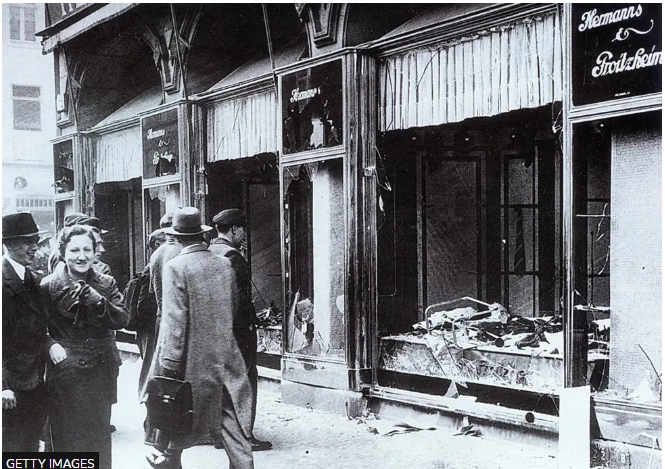
Kristallnacht – “the night of broken glass” – on November 9th and 10th, 1938, Hitler perpetrated a nationwide pogrom against Germany’s Jews in response to the assassination of a German diplomat, Ernst Von Rath at the Paris Embassy by a 17-year-old Polish Jew Herschel Grynspan. The Nazi SA and Hitler Youth rampaged through Germany and Austria. 7,500 Jewish homes and businesses were ransacked, 267 synagogues were attacked, 76 were destroyed, and 100 Jews were killed. Most significantly, 30,000 Jewish men were taken to Nazi concentration camps at Dachau, Buchenwald, and Sachsenhausen. German Jews were fined over $400 million for the cleanup of the Nazi pogrom. It marked the end for Jews in Germany. Historians of the Shoah consider it the precursor to Hitler’s Final Solution, the murder of six million European Jewish men, women, and children in unspeakable ways.
Kristallnacht for me is entwined with Veterans Day, given eyewitness testimony by the parents of a roommate at Boston University with whom I shared a triple dormitory suite during my freshman year. One of my roommate’s parents were survivors of the Nazi SS pogrom. His father was a cattle dealer in Wurzburg, Germany and until the enactment of the notorious 1935 Nuremberg racial laws was captain of the town’s soccer team. His mother was a beautiful blonde blue-eyed Jew. Following the Nazi orgy of judenhass, Jew hatred, on Kristallnacht, my roommate’s father, like thousands of other German Jewish men, was detained and sent to Sachsenhausen concentration camp. It was only through the intervention and bribery of the camp’s Nazi SS officials by my roommate’s mother that her husband was freed and via sponsorship of relatives in America, they were among the fortunate German Jews to have escaped the Holocaust. That experience was not lost on my roommate. He signed up for US Air Force ROTC and, following graduation, went through flight training to become a pilot serving during Vietnam and retiring with the rank of Colonel.
What was the comment from President Roosevelt at a press conference following the news of Kristallnacht:” unbelievable.” Nothing more. At the time, the US State Department had more than 15,000 tourist visas allotted to Germany, and fewer than 5,000 were issued. Some historians blame this on the Undersecretary of State, Breckenridge Long, who controlled the Visa program, preventing entry by Jews both pre-war and during WWII, until his lies about how many Jewish refugees were admitted to the US were uncovered by the staff of Secretary of the Treasury, Henry Morgenthau, Jr. That led to forcing FDR to establish the War Refugee Board, which was credited with sparing the remainder of Hungary’s Jews after more than 433,000 were murdered at Auschwitz-Birkenau in less than four months in 1944.
An international conference was convened from July 6 to 15, 1938, in Evian-les-Bains, France. Delegates from 32 countries met to discuss the growing crisis of refugees, primarily Jewish refugees fleeing Nazi persecution in Germany and Austria. Despite expressing sympathy, most nations, including the United States and Britain, refused to liberalize their immigration policies or accept more refugees. The conference did at least result in the creation of the Intergovernmental Committee on Refugees (ICR), but its efforts were minimal before World War II began.
Key outcomes of the Evian Conference
- Lack of action: The primary outcome was the lack of commitment from participating countries to accept more refugees.
- Excuse-making: Delegates used excuses like economic hardship from the Great Depression or the desire to avoid importing a “racial problem” to justify their inaction.
- Creation of the ICR: The Intergovernmental Committee on Refugees was established to address the problem, but it had little authority and support from its member nations.
- German response: The German government noted with satisfaction that other nations were unwilling to accept the refugees they were trying to expel.
- Sole exception: The Dominican Republic was the only country willing to accept a small number of Jewish refugees, with the support of American Jewish philanthropy.
Then there was the doomed voyage of the St. Louis. The Bremen Line ship St. Louis left Hamburg, Germany, on May 13, 1939, with 937 passengers, most of whom were Jewish refugees fleeing Nazi persecution. The ship was traveling to Cuba, but after being denied entry, it was forced to turn back to Europe. The SS St. Louis carried 907 Jewish refugees from Germany, who were denied entry to Cuba and then the United States. The ship was forced to return to Europe, where Great Britain, France, Belgium, and the Netherlands eventually took in the passengers, but 254 of them did not survive the war. Upon reaching Cuba, their landing permits were canceled, and most passengers were denied entry. The ship then sailed to the United States, but was also refused entry, prompting the captain to turn back to Europe. The St. Louis returned to Europe, docking in Antwerp, Belgium, on June 17, 1939. Jewish organizations negotiated with four European governments to allow the passengers to disembark. Great Britain took 288 passengers, France took 224, Belgium took 214, and the Netherlands admitted 181. Despite the temporary relief, the passengers who disembarked in France, Belgium, and the Netherlands faced the Holocaust after those countries were occupied by Germany. Of the 907 passengers, 254 did not survive the war, only to be murdered in Nazi death camps.
The Ritchie Boys in the US Army and X-Troop in the British Royal Marines.
And what about those young Jewish refugees who successfully made it to the US and England? Were they ironically treated as enemy aliens? Some were. But others were not. Witness the 2,000 young Jewish refugees from Germany and Austria who reached the US. Ever hear of the Ritchie Boys- so named after the US Army Camp Ritchie in Maryland, which trained them as intelligence analysts and interrogators of German POWs. After the Normandy invasions, many of these Ritchie boys saw action and were credited with gathering an estimated 60 percent or better of executable intelligence, sparing US casualties and shortening the final months of the War in Europe. The Jewish refugee young men who found their way to England were at first used as pioneer battalions. But it became apparent they had linguistic and intelligence skills. The British established a Royal Marine commando group X Troop, that, like the Ritchie boys in the US Army, saw action in intelligence and secret ops after the Normandy invasion.
Relevance of Kristallnacht to the October 7 Pogrom that triggered Global Antisemitism. The unpremeditated attacks by Hamas and the Palestine Islamic Jihad on October 23, 2023, on Kibbutzim and the Nova Festival, held on Simchat Torah, resulted in more than 1,200 murdered, 251 Israeli and foreign hostages taken, of whom 168 have been returned alive and 23 deceased remains returned, with six outstanding. To date, IDF casualties numbered over 1,000, with nearly 4,000 wounded, many suffering severe injuries. The Muslim Brotherhood organization effectively waged a Jihad media war against Israel to “free Palestine “from the river to the sea. Those anti-Israel memes spiked global antisemitism and media bias throughout the West. Those memes were at the core of Jewish concerns over the New York Mayoral victory of Zohar Mamdani, who is the first Shia Muslim to lead one of the world’s largest Jewish Communities. Over 60 percent of registered Jewish voters voted for Mamdani’s opponent, former New York Governor Andrew Cuomo. But 33% of other Jews chose Mamdani, who promised a Democratic Socialist regime to address ‘affordability” and “equitable distribution of income”. Meanwhile, Mamdani wants to deprive New York City of an estimated $3.5 billion trade with Israel. One prospect is the Cornell University – Technion program, which Mamdani alleges involves development work for the IDF. Is his intent to turn New York into Londonstan, with Jews at risk of being treated like dhimmis under Islamic doctrine as second-class residents of the five boroughs? That is a troubling prospect that requires combined actions by both Jewish and non-Jewish supporters of Israel to prevent that prospect from occurring.









One Response
Lots of room in regular updates of this catalog of betrayal, shame, and doom.
To forget, without regret, is another sin yet.
To be reminded is to be asked, “Will you incur, unpaid, another decency debt?”