By Jim Mason and George Koch
As Alberta moves closer to a public vote on separation, one assumption has become increasingly common among independence supporters. Win a referendum, the thinking goes, and the federal Clarity Act will set in motion a clear negotiating process with Ottawa leading to a constitutional amendment and, before long, an independent Alberta. The Clarity Act does no such thing.
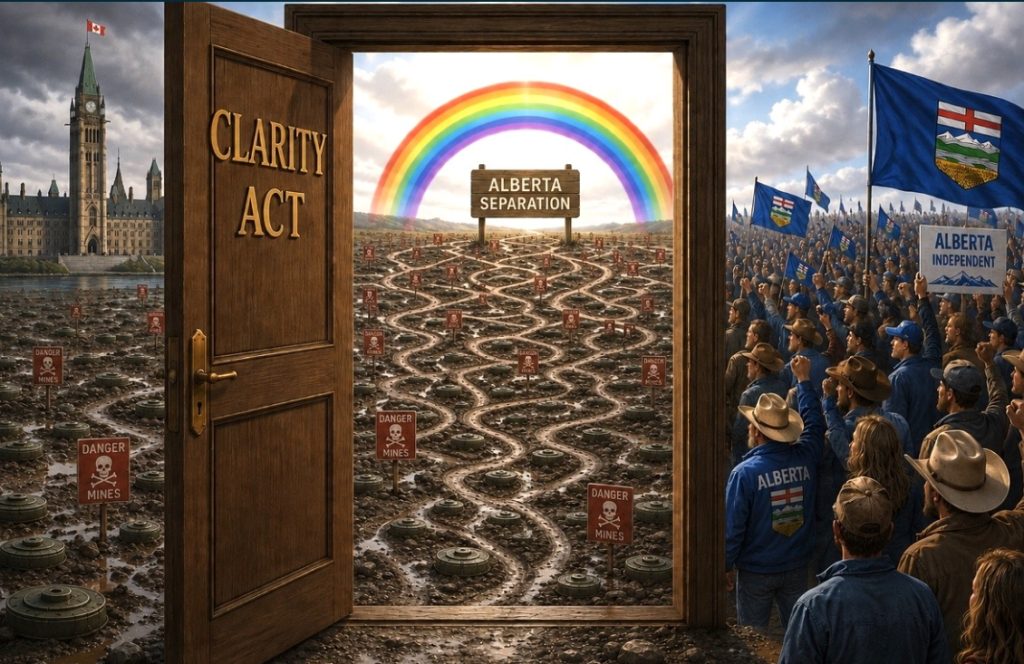
Clear-eyed scrutiny of the legislation suggests the opposite. Far from providing a roadmap to provincial independence, the Act creates a political and legal obstacle course in which nearly every important decision is handed to Ottawa. Before Albertans debate whether they should leave Canada, they ought to understand that the federal law governing such a process was not designed to make separation straightforward.
Many separatists appear to envision a referendum victory as the beginning of an orderly transition to nationhood. Some have even proposed detailed timelines. One recent commentator described a “365-day playbook” that would supposedly carry Alberta from a successful vote through negotiations, constitutional amendments and eventual independence.
Such scenarios assume that the Clarity Act establishes a predictable process. But the legislation is remarkably vague on the questions that matter most.
The Act requires a “clear” referendum question and a “clear majority” in favour of separation. It defines neither term.
Instead, the House of Commons – which means, in practice, the Prime Minister’s Office – is empowered to decide whether a proposed referendum question is sufficiently clear. The Act identifies two types of questions that would automatically fail. Beyond that, it offers no meaningful criteria. Parliament is also instructed to consider various opinions and viewpoints from other provinces and any other source it chooses before reaching a decision, and is given broad discretion in determining what those opinions mean and how much weight they should carry.
If the referendum question is approved, then the same situation will repeat after the vote.
The Clarity Act empowers the House of Commons to determine whether a referendum result constitutes “a clear expression” of support for secession by “a clear majority” of the province’s population. Yet again, the legislation provides no threshold. Other than saying a simple majority of 50-percent-plus-one-vote won’t be enough, it does not specify what percentage of support would be sufficient. It does not establish a turnout requirement. It does not explain how regional divisions, the concerns of First Nations and other minorities, or other political factors should be weighed.
Instead, Parliament is told to consider whatever factors it deems relevant, with input from all the other provinces and territories and anyone else it wants to consult.
That means the most important questions in the entire process are not answered by the Act itself. They are deferred to political judgment in Ottawa.
This alone should dispel the popular notion that a referendum victory automatically triggers negotiations. It does not. Under the Act, negotiations can begin only after Ottawa determines that both the question and the result satisfy its requirements.
Even if that hurdle is cleared, the path forward remains anything but straightforward.
The Act does not envision simple bilateral negotiations between Alberta and the federal government. Rather, it states that any negotiations concerning secession must involve at least the Government of Canada and all provincial governments. Other participants may also be included. In practical terms, Alberta would not be negotiating with a single counterpart. It could find itself facing a large coalition of governments and interests, all of which are likely to oppose separation altogether.
Nor does the legislation provide a clear endpoint.
Before any constitutional amendment could be introduced to effect secession, Ottawa must be satisfied that numerous issues have been addressed, including finances, borders, Indigenous interests and minority rights. Yet the Act never defines what it means for these matters to be satisfactorily “addressed”. Nor does it establish how disagreements are to be resolved or when negotiations can be considered complete.
In fact, the legislation contains no mechanism at all for wrapping things up. The words “conclusion”, “agreement”, “memorandum of understanding”, “treaty” or “deal” are all absent from the Clarity Act.
Supporters of Alberta independence may regard the Clarity Act as a safeguard ensuring that Ottawa cannot simply ignore a referendum result. That might be true in a narrow sense. But it’s no talisman, silver bullet or one-way ticket out the door. Federalists may see it as a necessary protection against a reckless rush toward separation. That, it certainly seems to be.
But both sides should recognize what the Act actually does. It does not create a clear constitutional pathway to independence. It creates a framework in which Ottawa exercises extraordinary discretion over every critical stage of the process. That may well have been the intention all along.
Whatever one’s view of Alberta separation, the first step toward an informed debate is understanding the rules. The Clarity Act’s title promises clarity. Its contents promise something else entirely.
The original, full-length version of this article was recently published in C2C Journal.
Jim Mason holds a BSc in engineering physics and a PhD in experimental nuclear physics; he lived and worked in Alberta for 17 years and is currently retired and living near Lakefield, Ontario.
George Koch is Editor-in-Chief of C2C Journal.









3 Responses
Any Albertans who don’t like this process should at least remember that it was designed to thwart Quebec, and I am sure that at that time today’s Albertans or their fathers were fine with doing so.
I’m sick of both provinces insisting that their residents, Canadian citizens, are loyal to their own country only for what new government powers can be assigned to their provincial administrations.
Actually, Graham, I suggest that what both provinces want, Alberta in particular, is for the federal government to simply stay in its lane as defined in the Constitution and stay out of the lane it defines for the provinces. Healthcare and social programs, for example, are clearly areas of provincial responsibility but the federal government has inserted itself into both with the Canada Health Act, the federal Health Transfer and the federal Social Transfer. In both cases, the federal government has used its taxation powers to raise tax revenue from residents in some provinces that it gives to the provincial governments in other provinces to pay for healthcare and social services in these other provinces. This is particularly the case for Albertans who wind up subsidizing the provincial government services in other provinces while at the same time paying the full cost of their own services. This is even more blatantly the case with the Equalization Program.
Natural resource development is another area that is particularly contentious for Albertans. That, too, is a provincial responsibility per the Constitution. Yet the federal government has repeatedly inserted itself into it, hobbling the industry in Alberta with targeted punitive legislation and restrictive regulations.
Immigration is perhaps the exception, it being a federal responsibility into which the provinces want to have input. But this makes sense. While the federal government gets to determine how many immigrants will be allowed in, the provinces have to deal with the impact on infrastructure, healthcare, housings education, and social services.
Suggested changes such as a triple-E senate are not so much seeking new powers for the provincial government but more suitable power distribution for all the people fo Canada, for everyone’s benefit.
As for loyalty, IMO, that needs to be earned and deserved, not expected and demanded. The British author Samuel Johnson wrote, “Patriotism is the last refuge of a scoundrel,” meaning that dishonest individuals often use performative love for their country as a shield. Rather than attacking genuine love of nation, Johnson was critiquing cynical politicians who weaponized faux-patriotism to distract from their own flaws. I submit that this is exactly what Carney did in the last election with his ‘elbows up’ slogan.