Official British cowardice claims another innocent victim
By Bruce Bawer
His name was Henry Nowak. He was eighteen-year-old dual citizen of Poland and Britain and he lived in the town of Chafford Hundred in the English county of Essex. Since his terrible death, his friends and family have described him as “talented,” “ambitious,” and “full of life.” His sister Olivia, who said he was her “best friend,” referred to him as “extraordinary, funny, handsome, kind, unique, and intelligent.” Photographs and videos show a good-natured, fun-loving boy with a gentle smile. When he was murdered on Belmont Road in Southampton at about 11:30 on the night of December 3, he had just begun studying accountancy and finance at the University of Southampton, and, according to his loved ones, was enjoying university life immensely.
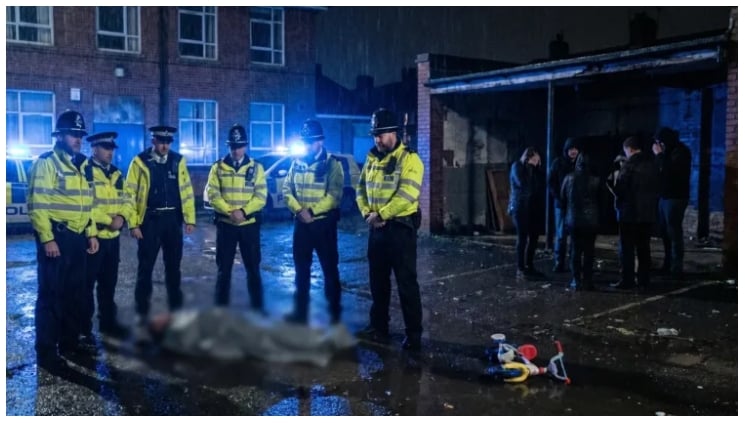
After an evening out with friends, Henry was walking home when he noticed that a fellow pedestrian, 23-year-old Vickrun Singh Digwa, who was with his brother, Gurpreet, and who was carrying a knife. In fact, as it turned out, Vickrun was carrying two knives, the smaller one stored in a sheath, the larger one, according to the BBC, “a dagger linked to his tradition as a member of the Nihang order of Sikhs.” (It later fell into dispute as to whether the larger knife had anything to do with Sikh tradition at all.) When Nowak saw the larger knife, which had an eight-inch blade, he started to film Digwa with his phone. He “asked Digwa if he was a ‘bad man,’” whereupon Vickrun grabbed the phone from him; when Henry tried to take it back, Vickrun proceeded to stab him four times, one of the stab wounds being “a fatal injury to the chest.” Henry tried to escape by climbing onto a garbage bin and then over a fence – all of which Vickrun recorded on Henry’s phone camera – but ended up on the ground, being held down by the brothers while Vickrun captured on film the boy’s dying agony.
Meanwhile, Gurpreet phoned 999, the British equivalent of 911. But instead of reporting a multiple stabbing, he falsely stated that he and his brother had been the victims of a racial incident. The brothers also phoned their parents, who arrived on the scene quickly, with the mother taking the large knife from Vickrun and returning home to hide it before the police turned up. And when police officers did arrive from the Hampshire and Isle of Wight Constabulary seven minutes after the 999 call, they did indeed handle it as a racial incident, treating the young man who lay dying on the ground as an assailant while holding a civil conversation with Vickrun and Gurpreet, the latter of whom repeatedly told the police “that his sibling had been ‘attacked racially,” that there were no weapons involved, and that: “We’re Sikhs, we wear a turban and he’s just attacked my brother.” He assured the police that there were no weapons involved, telling them: “I don’t know what weapons he would have seen.” Vickrun, for his part, said that Henry was drunk, had punched him, had used a racial slur, and had pulled off his turban – all lies.
So it went. While the police spoke with the brothers respectfully and took their accusations seriously, they treated the real victim with contempt. One of them, for some reason, “dragged Nowak across the gravel.” On bodycam footage, reports the BBC, “Nowak could be heard repeatedly saying that he had been stabbed and could not breathe”; people in nearby homes who didn’t observe the incident were able to report later that they had heard Henry screaming that “he had been stabbed and was dying.” But in response to Henry’s claim to have been stabbed, one officer replied, “I don’t think you have, mate.” Instead of being rushed to a hospital, Henry was turned on his side and his hands cuffed behind his back. After he spoke what would be his last words on earth –“Please, brother, I can’t breathe” – he was arrested and read his rights. Only after one of the officers recognized that he had become unresponsive were the handcuffs removed, an ambulance summoned, and cardiopulmonary resuscitation administered. But it was all too late. Henry died on the spot.
Vickrum Digwa’s trial for murder began on May 14 at Southampton Crown Court; a jury found him guilty on May 28, and four days later he was sentenced to life in prison, with a minimum term of 21 years. Since the trial, and the public release of the bodycam footage, much of Britain has been in a thoroughly justified uproar. Coming not long after Tommy Robinson’s May 15 “Unite the Kingdom” rally, one of the objectives of which was to protest precisely the kind of “two-tier policing” that was practiced on that Southampton street on the night of December 3, the conclusion of the Nowak case has resulted in public gatherings that have been considerably less polite than the “Unite the Kingdom” rallies. Even Reform UK leader Nigel Farage, who used to avoid commenting on matters involving immigrant-group crime and routinely accused Tommy Robinson of sowing division among “communities” (to use a term beloved of British officialdom), reacted to the police treatment of Henry Nowak by calling on the British people to react with “pure cold rage,” charging that the kingdom’s “two-tier culture” of policing subordinates “the rights and privileges of white people” to “those of ethnic minorities.”
Examples of “two-tier policing” have been innumerable in recent years: the mass rape of English children by gangs of Muslim men over a period of decades has been ignored while decent citizens who have dared to discuss those monstrous offenses have been prosecuted for hate crimes; mobs of aggressive Muslims waving seas of Palestinian flags have been left alone by police even as individuals bearing a single Union Jack have been arrested; armies of Muslims have been allowed to block major thoroughfares with prayer rugs – an act of sheer aggression, not faith – while a single woman praying silently near an abortion clinic is taken into custody. And perhaps the most egregious instance of Britain’s two-tier policing has been the endless persecution of Tommy Robinson for daring to expose the long-term failure of authorities to properly deal with the so-called “grooming gangs.”
It’s this kind of disgraceful, banana-republic-style policing in the land of Magna Carta, Winston Churchill, and Robert Peel that has, in recent years, led Donald Trump, J.D. Vance, Marco Rubio, Elon Musk, and other Americans to condemn Britain’s steady transformation into an Orwellian state. It is hardly surprising, then, that after the verdict was handed down in the Nowak case, Elon Musk wrote on X: “Send the video to everyone you know showing how heinously Nowak was treated by the police in his dying moments.” Rubio’s State Department, for its part, reacted by characterizing “[i]deological conditioning and two-tiered policing” as “glaring symptoms of civilizational decline” that “must be rejected across the West.” And Vance asserted that “Henry Nowak died the same way a civilization dies. He should still be alive today, and he would be if the last few generations of European elites had stood their ground against the politics of self-hatred and the mass invasion of migrants, many of whom despise the West and the people who love it.” The only response to Henry’s murder, Vance contended, was “righteous anger.“
Meanwhile, in Britain’s corridors of power, the pro forma murmurs of sympathy for Henry’s family were accompanied by the usual attempts to calm things down, move on, and forget. Sir Keir Starmer, arguably the most despicable creature ever to hold the title of British Prime Minister, accused Musk of seeking to “whip up division.” The head of the Sikh population in Southampton complained that protests against the police treatment of Henry Nowak had increased “community tension.” Satvir Kaur, an MP representing part of the Southampton region, asserted that the murder was being taken out on the entire Sikh community.” Even Henry’s father, Mark Nowak, had been so effectively inculcated in the left’s approved attitude about such matters that he expressed concern that his son’s death not “be used to create further division, hatred or tension.”
Division, hatred, tension: the illusion is that these things can and should be overcome so that Britain can be restored to a condition of multicultural harmony. But Britain’s harmony has been disappearing steadily ever since mass migration from South Asia and the Middle East began a half century or so ago. Multiculturalism is, by definition, the enemy of social harmony. The only hope for any nation that welcomes immigrants from alien cultures on a large scale is assimilation of the kind that characterized the United States when, during the decades between 1850 and 1915, it took in millions of immigrants from European countries whose cultures differed significantly from its own. Recall that Henry Nowak was of Polish extraction. In recent years, Poles have relocated in large numbers to the U.K. and have proven to be excellent assets for the kingdom, hard-working and law-abiding. South Asians are another story entirely. But the British establishment doesn’t dare say so.
Another point. It was impossible not to notice that Nowak’s cry of “I can’t breathe” echoed that of George Floyd when he was dying in Minneapolis on May 25, 2020. There is, needless to say, a major difference between the two men and the two deaths. While Henry Nowak was a diligent student with a clean record, Floyd was a career criminal with a long rap sheet and a history of violence. While Nowak was the victim of a cold-blooded murder, Floyd died because of the powerful mixture of illegal drugs (fentanyl, methamphetamine, and THC) in his system. While Southampton cops treated Nowak abusively, Minneapolis cops – despite the widely accepted claim that one of them, Derek Chauvin, was his murderer – treated him gently throughout his minutes-long attempt to escape arrest.
Another difference: George Floyd was widely mourned in Britain, where BLM protests took place around the country (with Labour Party support) and Prime Minister Starmer spoke passionately about Floyd’s death in Parliament and, along with many other Westminster habitues and sundry cultural and academic notables, took the knee over the thug’s passing. Has the brutal slaughter of Henry Nowak occasioned anything remotely resembling this rending of garments by Britain’s supposedly best and brightest? Of course not. To issue condolences in such a circumstance is one thing; but to resort to any kind of dramatic action would, as they say, deepen tensions between “communities” and threaten “social harmony.”
Which means, naturally, that the powers that be in the U.K. are terrified of their South Asian immigrant class. That’s why the cops treated Vickrum Digwa with respect and Henry Nowak with contempt; and it’s why the murder of a fine, upstanding young man who dreamed of a long, productive, and happy life in Britain simply has to be dropped down the memory hole as quickly as possible. The only good news here is that more and more ordinary Brits have realized that their leaders despise them – and despise the likes of Henry Nowak. Those ordinary Brits, in growing numbers, seem not to be prepared to gently into that good night. “The Henry Nowak case is horrifying,” declared British podcaster Francis Foster the other day. And as a result, he said, Britain, more than ever, “feels like a powder keg.” Good. For in order to bring about the kind of change that Britain needs, rage is a definite prerequisite. Henry Nowak, that precious soul, deserves no less.
First published in Front Page Magazine