Posted by Geoffrey Clarfield
Paul Finlayson lost his job in Ontario for telling the truth. He is a Canadian hero.
He writes here at his website as Freedom to Offend.
They are better marketers than McDonald’s, Coke or Pepsi.
There are lies, there are delusions, and then there is the Palestinian national narrative: a fiction so shamelessly constructed, so uncritically repeated, and so catastrophically indulged that it stands as the most successful political con job of the past hundred years. Everything about it—its alleged antiquity, its supposed indigeneity, its fraudulent claims of dispossession—is a masterclass in fabrication, fortified through sheer repetition and protected by a global ecosystem of cowardice.
To expose the fraud, one must begin at the beginning—not in the 1960s, where the modern myth was born, but two thousand years earlier, when the Romans invented the name.
I. The Roman Punishment and the Fabrication of a Geography
The term “Palestine” enters recorded history not as the name of a nation, a people, or an ethnicity, but as a deliberate Roman insult. After crushing the Bar Kokhba revolt in 135 CE, Rome erased the name Judea and imposed Syria Palaestina—naming the land after the Philistines (Plishtim), a long-vanished Aegean people, precisely to sever Jewish identity from its homeland. It was not an origin story; it was an act of imperial malice.
For nearly two millennia thereafter, “Palestine” functioned merely as a vague geographic label, like “the Levant” or “Scandinavia.” It never designated a sovereign polity. Under Byzantium, the various Islamic caliphates, Crusader rule, and the Ottomans, the region was repeatedly carved, renamed, and reorganised into administrative districts—none of which represented a “State of Palestine.”
There was never:
- a Palestinian king
- a Palestinian parliament
- a Palestinian currency
- a Palestinian literature describing the Palestinian nation
- a Palestinian army
- or even, astonishingly, a “Palestinian” soccer team
Even the Palestinian terrorists before the 1920s did not call themselves Palestinians, because the term had no meaning apart from Jews and foreigners referring to the region.
Indeed, for two thousand years, “Palestine” meant “the Land of Israel.”
- The Jewish paper was called the Palestine Post.
- The major Zionist fundraising body was the United Palestine Appeal.
- The first Chief Rabbi of Israel was titled “Chief Rabbi of Palestine.”
Are we to imagine that the Palestinians had a Chief Rabbi?
II. The Invention of a People: When Geography Became Ethnicity
Arab residents identified as:
- Arabs
- Syrians
- Southern Syrians
- Members of their clan or village
The term “Palestinian Arab people” did not exist.
IV. The Modern Big Lies: From Jesus to “Indigenous Palestinians”
The fraud has metastasised. Having spent half a century convincing the gullible that an Arab “Palestine” once existed, and that “the Palestinians” are a timeless ethnic nation, the propagandists have now advanced to the next phase: claiming Jesus was a Palestinian Arab.Name a single Arab:
- King of Palestine
- Prime Minister of Palestine
- President of Palestine
- Sheikh of Palestine
There were none. Because there was no Palestine.
The land never held an Arab political identity until the PLO invented one for the sole purpose of erasing the Jewish one.
Conclusion: On Fraud, Cowardice, and the Inconvenience of Truth
All frauds share the same anatomy: a hollow centre padded with sentiment, protected by cowardice, and sustained by those who find the lie more comfortable than the truth.
The Palestinian national myth is one such fraud, varnished by repetition until the credulous mistake it for history. It is a confection of recent vintage — a mid-20th-century improvisation, cooked up by the PLO for the sole purpose of donning the fashionable robes of victimhood.
Before that, the term “Palestinian” simply denoted an address on an Ottoman tax ledger or a British census form, much as “Winnipegger” denoted a citizen of Winnipeg rather than a descendant of some lost Mesopotamian tribe.
Yet through sheer propaganda genius — a marketing coup that would make Coca-Cola, Pepsi, and McDonald’s get down on their knees and take notes — a municipal label was re-engineered into an “ancient people” with “ancient rights” to a land whose actual ancient people were already well documented in Babylonian steles, Roman decrees, Jewish scripture, Christian gospels, and Islamic chronicles.
And so the ruse flourished. The West, allergic to spine and addicted to sentimentalism, embraced the myth with the enthusiasm of a child believing in Santa Claus long after the beard had begun slipping off.
Professors sentimentalised it, diplomats romanticised it, and activists weaponised it.
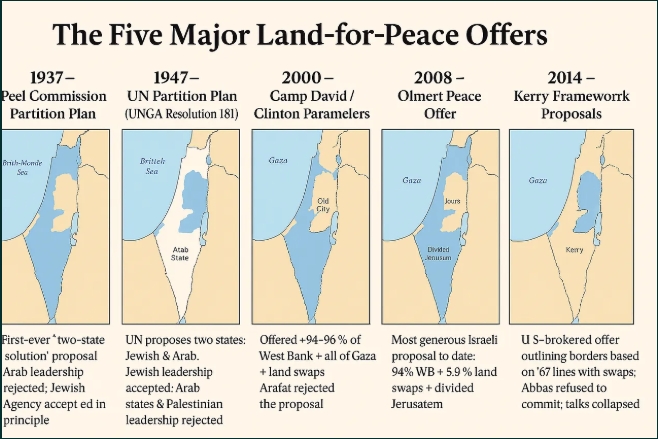
The tragedy is that every offer was rejected, often violently, because frauds — once institutionalised — cannot survive a negotiated settlement. Fraud requires perpetual grievance.
And if there is any lesson the world should learn from this elaborate confidence trick, it is this: do not get fooled twice, which brings us, inevitably, to Winnipeg.
Because if the day ever comes when Winnipeggers begin demanding UN recognition as an ancient ethno-nation, insisting on special grants, international pity, and a return to some mythical ancestral homeland centred around Portage and Main, the world should respond firmly and politely:
No. Absolutely not. We got conned once with Palestine — we are not getting conned again.
And frankly, even Winnipeggers might struggle to keep a straight face. It’s hard to build a compelling victim narrative when half the population isn’t entirely sure they want to admit they’re from Winnipeg — especially given how the Jets are playing right now.
History, unlike propaganda, retains its memory. And so should we.
Read it all here









3 Responses
The problem is that the intent of that Roman malice didn’t end when the Roman Empire collapsed.
And today too many people want to believe the lies; to allow theirselves to feel morally superior.
One correction:
The “Palestinian identity” was not invented by the PLO, rather by the KGB, sirca 1964.