Halal abattoirs serving strict Muslims are much more likely to have poor hygiene and animal welfare than non-religious ones, Telegraph analysis shows.
The slaughterhouses, which slit conscious animals’ throats to kill them in accordance with Islamic rites, were almost three times more likely to be given negative inspections than others, according to data from the Food Standards Agency (FSA).
Common causes for concern cited by inspectors were substandard hygiene practices, poor animal welfare and risks of cross contamination. In one instance, chickens were “kicked and thrown”, and in another animals were abused, with workers appearing to mock the animals before they were slaughtered.
The FSA data reveals that in the past decade, 26.9 per cent of inspections of slaughterhouses permitted to perform religious non-stun slaughter concluded with a rating of “improvement necessary” or “urgent improvement necessary”. This compares with just 10.2 per cent of all other establishments.

UK law requires that all livestock are stunned before slaughter to render them insensible to pain at the time of killing, using methods such as an electric shock or gassing with carbon dioxide.
However, UK and EU legislation provide an exemption for animals slaughtered in accordance with religious rites.
Analysis of the watchdog data also shows that just 11.3 per cent of inspections saw religious abattoirs awarded the highest rating of “good”. This is in comparison to 32 per cent of non-faith-affiliated abattoirs.
The Telegraph analysis looked at each individual audit of 38 non-stun, religious slaughter-houses since 2014, although some have closed over the period. Of these, just one was easily identified as kosher, Kosher Poultry Limited in Manchester, which was graded “generally satisfactory” in every audit.
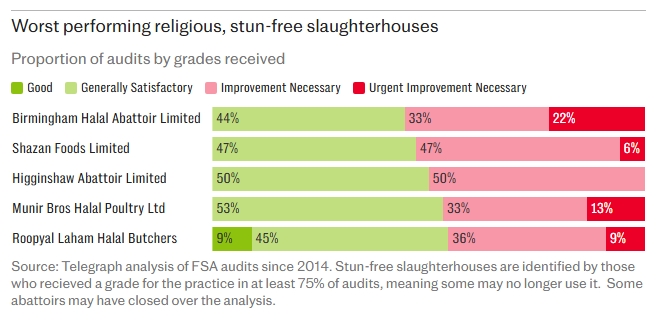
Halal abattoirs highlighted for inadequate standards include:
- Roopyal Laham Halal Butchers, Birmingham. Of 11 audits listed, five required improvement. It was fined £10,000 in 2023 for causing avoidable suffering to animals before closing last year.
- T&S Abattoir Ltd had its licence revoked earlier this year after secret footage showed distressing animal abuse, including animals appearing to have limbs removed while still showing signs of life and workers appearing to mock the animals before slaughtering them.
- Munir Bros Halal Poultry Ltd, in the West Midlands, which was fined in March this year with 20 counts of animal cruelty after chickens were “kicked and thrown” across the floor. It has received poor ratings in almost half of its audits over the period.
- Shazan Foods, based in Suffolk, has received poor FSA audits 53 per cent of the time, and was criticised in 2023 for causing a stench in the town of Eye that smelled like “boiled chicken and death”. In 2022 it was fined £16,400 for 10 offences for failing to comply with animal welfare laws.
- Higginshaw Abattoir Limited, in Greater Manchester, was ordered to pay a £12,000 fine after it was convicted of 11 food safety charges. It was also flagged as needing improvements in nine out of 18 audits.
- Birmingham Halal Abattoir has had 18 inspections since 2014, over half of which saw it require improvement and was only recently removed from the Halal Monitoring Committee’s approved list of abattoirs.
A significant proportion of halal meat comes from animals that are stunned. The 2024 Slaughter Sector Survey showed for example that 88 per cent of halal meat chickens in England and Wales were stunned prior to slaughter in 2024.
However, FSA figures also show non-stun slaughter for halal is rising – accounting for 29 per cent of sheep slaughtered in the 2024 annual survey, compared to 22 per cent in 2022.
Pre-stunning ensures that animals are unconscious and insensible to pain before they are slaughtered. Evidence on slaughter without this shows that animals are highly likely to suffer pain and distress and experience a delay in consciousness, according to the British Veterinary Association.
For example, the analysis also shows that in 54 per cent of inspections, there were “major” or “critical” issues with the “handling and processes from slaughtering to despatch are done in a way that avoids the contamination of meat and offal entering the food chain”.
Furthermore, in 20 per cent of audits, there were issues with “suffering during their killing and related operations”.
Saqib Mohammed, chief executive of the Halal Food Information Centre UK, said that 88 per cent of halal is pre-stunned. He added that over the past 20 years there had been an increase in regulations for the meat industry.
The Halal Monitoring Committee was also contacted for comment.
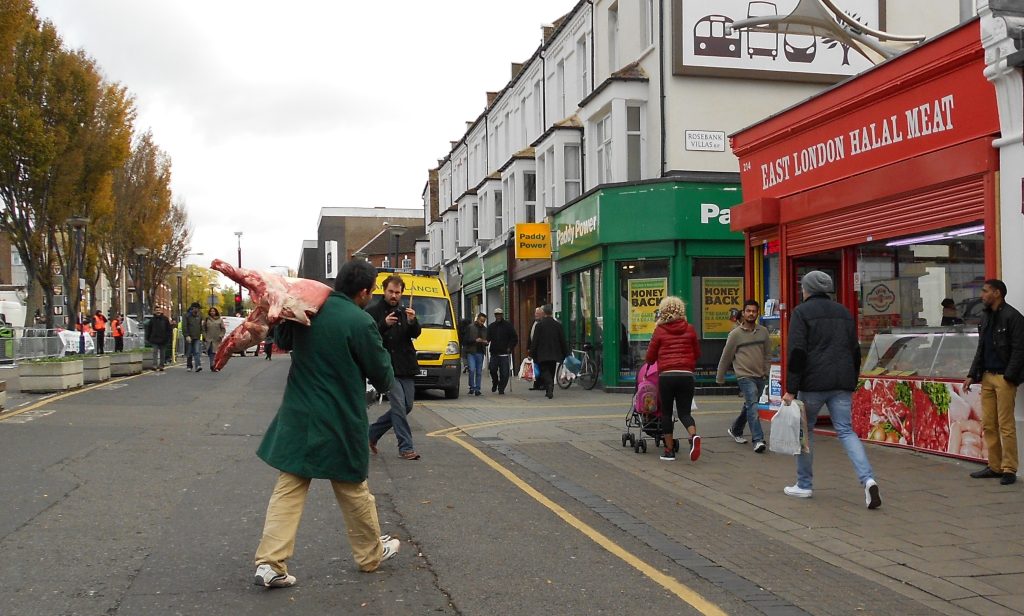
This investigation is solely about halal slaughter but I believe that there is also cause for concern about the state of some halal butchers, and restaurants. I observed the below a few years ago – as you can see I wasn’t the only person startled enough to record it.









One Response
What not to eat.