By Glenn Harland Reynolds
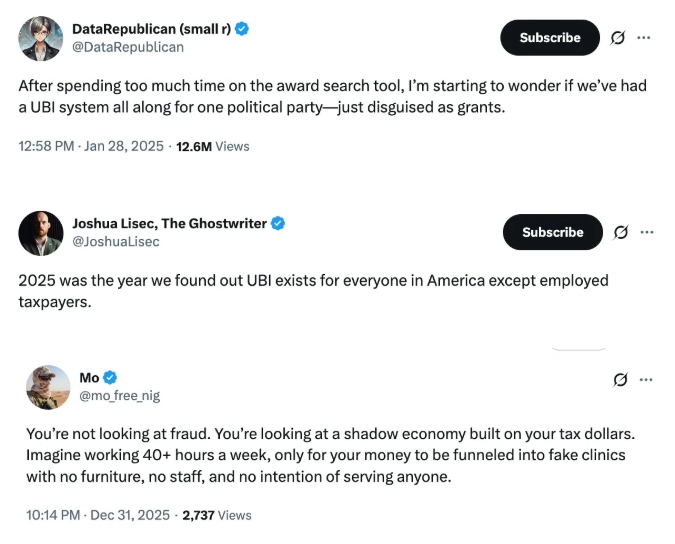
The explosive unveiling of the wildly extensive Somali-run daycare scams in Minnesota has drawn attention to a huge shadow economy, and not just in Minnesota. America, it turns out, is full of people, companies, and organizations that basically live off of fraud. We’re not talking old-fashioned waste, like $600 hammers or $1200 toilet seats. We’re talking about entities whose sole reason for existence consists of being a conduit for taxpayer money to flow directly to the people controlling them, with some of the proceeds being diverted to politicians and political organizations.
People are noticing.
This reverses an old joke told by my Nigerian relatives. A Nigerian visits his rich relative in the United States and is awed by the penthouse apartment, the limo, the private jet and so forth. “How did you make so much money?” he asks. The relative points out the window. “See that bridge? 15%. See that shopping mall? 15%. See that train station? 15%.”
The visitor, inspired, returns home to Nigeria and becomes fabulously wealthy. His rich cousin from America visits and says “How did you make so much money so fast?”
“You see that bridge over there?”
“Nope,” responds the confused relative. The Nigerian cousin points at himself and says “One hundred percent!”
Well, this joke has now been turned around. Leaving aside that we don’t really even build train stations, bridges, or even shopping malls in this country anymore, now it’s America where people are pocketing one hundred percent and not even trying to actually deliver any goods or services. That the people doing this are mostly Africans only adds to the irony.
But what happened?
Well, several things. At base, people defraud the government for the same reason that dogs lick themselves — because they can. One of the things you find in these programs is that there are virtually no controls to ensure that the recipients of the money are legitimate, that the money is spent as promised — in essence, that the bridges get built. (Or, in the case of California, the high speed rail lines.) That lack of controls, of course, is no accident. The systems are designed to promote fraud and to make it hard to catch or punish.
Second, the culture is weaker. In a high trust society, people get angry when there is fraud and move to punish and ostracize the perpetrators. In a low-trust society, people expect it.
Older generations of politicians used to engage more in what George Washington “Boss” Plunkitt called “honest graft.” He defined honest graft as legally exploiting insider knowledge and opportunities from one’s position for personal financial gain, while also benefiting the public or party. A classic example he gave was learning about upcoming public projects (like a new park or bridge) and buying nearby land cheaply before the plans became public, then selling it at a profit to the city. He famously summarized it as: “I seen my opportunities and I took ‘em,” comparing it to savvy stock trading on Wall Street. In contrast, dishonest graft involved outright illegal acts, such as blackmail, embezzlement, or extortion (e.g., shaking down gamblers or saloon keepers).
God knows what he would have said about simply taking money for nothing. Would his reaction have been horror? Or admiration?
Of course, high-trust societies become lower trust when they import large numbers of people from low trust societies, as America has done for several decades now. Import individual Somalis and they acculturate to the larger culture, usually. Import whole clans and they perpetuate their own culture, which emphasizes clan loyalty (no snitching!) and sees exploiting outsiders as okay, and even laudable.
Institutions that used to police breaches of trust — chiefly the press — have also proven less willing. With the press’s decline into partisan tools, there’s no time left for maintaining general social standards. CNN’s response to Nick Shirley’s exposure of fraud and graft in Minneapolis was to . . . attack Nick Shirley, because his revelations might harm Democrats.
And even if people do get angry, the entire structure of the government and its hangers on is designed (yes, designed, this is no accident) to limit accountability to voters and taxpayers. Unelected bureaucrats administer programs passed without scrutiny in massive omnibus bills, and often act through “nonprofits” and NGOs that further blur accountability. Judges, generally unelected too, often run interference for the machine. This is of a piece with the entire post-WWII institutional restructuring — here and in Europe — which was quite consciously designed to ensure that voters have as little impact on what happens as possible. It’s mostly worked. In a sense, our managerial/political class has colonized the nation for its own benefit, from the inside out.
And finally, of course, there’s just so much money sloshing around out there. When it’s raining soup, people tend to pick up buckets. When government spending is so enormous, it’s easy to hide billions. And — and this is a crucial point — when the federal government doesn’t have to balance its budget but can cover any overages by borrowing, incentives for scrutiny by political players are removed.
In a balanced budget environment, more money for, say, Somali daycares means less money for other people’s programs, giving those people at least some incentive to scrutinize competing spending. In an effectively unlimited-spending environment, those incentives go away.
To some degree the news media failures are being offset by Army of Davids type independent journalism like Shirley’s, which I personally find quite gratifying. But on a larger scale, we need much more than that. Ultimately, cutting off the money supply is the key. As Sen. Mike Lee has noted, we could eliminate most of this fraud (and the personal income tax) just by limiting the federal government to spending consistent with its constitutionally enumerated powers. Crunching the numbers suggests we could cut far more than that. I’ve suggested before that the original enumerated powers / federalism divide was a powerful anticorruption feature of the Constitution, which, to be fair, is probably why our ruling class worked so hard to defeat it.
So that’s how we got here. How to get where we need to go is a topic for another essay. Whether we’ll get there without torches, pitchforks and hangings of corrupt officials remains unclear. But if Argentina could do it, perhaps we can too.
Thoughts on how to get there are welcome in the comments.
First published in Glenn’s Substack









2 Responses
Excellent piece.
One of the hallmarks of decline in our Canadian system here is the untrammeled freedom both the civic level and the provincial level of government have in doling out the money they confiscate from us in taxes.
Salaries, right from the shop floor to the upper levels of the bureaucracies, are absolutely out of control.
Naïve ministers and inexperienced council members are all too easily hoodwinked by organized and extremely clever fraudsters running Quangos and Charities.
Program costs and hiring salaries are not subject to any level of public scrutiny. Run of the mill jobs at the lowest level now pay out more than a bank manager earned just a few years back.
Developers fees , permit fees , parking revenues , millions upon millions of dollars, they all get swallowed up with staffing and contracting expenses.
Not once in all the time I have lived in my house (23 years now) have the taxes gone any other way but up…. and this despite hundreds of millions, nay billions, more pouring into the till.
Increases in fees are imposed purely to keep ineffective programs alive, they have no relationship to inflation and never, but never, is there an enhancement in the service.
No , they contract out their social responsibility obligations to free-spending charities or consulting groups or waste disposal companies who have complete freedom to do whatever they want with the monies.
There’s no clause in our constitution (nor in the States it seems) that provides for oversight and so nothing’s questioned until someone blows the whistle. Even when that happens, nothing changes. The federal government has no power to impose remedies.
My tongue-in-cheek solution is for the elected governments to contract the entire operation out to one of those far eastern cities like Singapore or Kuala Lumpur or Tokyo, places where they obviously know how to run things .
It’s only a buck for a ride on their transit system, the buses and the trains and the stations are immaculate. No beggars to be seen , no druggies, no homeless, even though there’s still a lot of poverty.
What are they doing right?