By Bruce Bawer
A near-beheading brings British rage to a boil
Belfast, of course, has seen its share of violence in modern times. During the last three decades of the last century, it was Ground Zero for “The Troubles,” during which terrorism between Catholics and Protestants claimed from eight to 480 lives a year. For those of us who lived through that era, it felt like one of those historical conflicts that would last forever, like the Thirty Years’ War. But eventually it did end, and today it can feel like a memory of the distant past, one to which few young people on either side of the Irish/British border can relate.
No, today both the Republic of Ireland and the British region of Northern Ireland are very different places than they were then. It seems only yesterday that both of them were (by Western European standards) poor, tradition-bound, and deeply religious: in the Republic, divorce remained illegal until 1997; in both the Republic and Northern Ireland, abortion was prohibited until 2019. Today, both parts of the island are highly modernized, surprisingly secular, and extremely prosperous: the Republic of Ireland’s GDP per capita is now the fourth highest in Europe.
But not all is paradise on the Emerald Isle. In the Republic as well as in Northern Ireland, the economic progress of recent decades has brought with it, as in other parts of Western Europe, a naive belief that newfound wealth carries with it an obligation to invite hordes of needy, dubious foreigners to share in the largesse. So it is that both Dublin and Belfast, which not long ago were rife with poverty, have become the prosperous hosts to very small but fast-growing Muslim communities: in Dublin, about 37,000 of them, amounting to about a third of one percent of the inhabitants; in Belfast, about 5,000 people, representing about one percent. By current Western European standards, these are very low numbers. For example, you have to go back to around 1985 to find a cohort of Muslims in Oslo that is so small in comparison to the total population.
Even so, the natives have been restless for some time. As Emma Shaw, a Belfast community worker, explained in a BBC interview the other day, many locals resent what they see as the official attitude that immigrants are “entitled to everything when they arrive” and the fact that they’re given access to benefits, government housing, and employment opportunities “that young people from here don’t have.” Now, the people of Belfast have seen what Islam has done elsewhere in Europe, and they know that this kind of thing can only get worse. So why not undo it all while it’s still a relatively easy proposition? It’s one thing to have the natives at each other’s throats, as was the case during the Troubles. But why on earth, once you’re finally attained peace and prosperity, invite more troubles from another part of the world?
For that’s what has happened. On Monday, in yet another recent incident reminiscent of the horrible December 3 murder of Henry Nowak in Southampton, Hadid Alodid, a Muslim immigrant in his thirties, stabbed a man in the head several times in the middle of a street in Belfast before trying to decapitate him. Fortunately for the victim, a local resident named Stephen Ogilvie, who is in his forties, bystanders rushed in to put a stop to the assault. As in the case of Henry Nowak’s killing, a video of the incident went viral online; in it, the perpetrator can be heard shouting “Allahu akbar!” while other voices can be heard screaming; “He’s trying to cut his head off!” The good news is that Ogilvie survived – although he’s entirely lost his left eye, suffered damage to his right eye, and sustained head and back injuries.
After the attack, Alodid was put under arrest and charged with several offenses. Officials also looked into his background, which proved complicated. At first he was described as Somali, then as Sudanese, and finally as a Saudi who relocated to Libya, traveled by boat to France, then flew from Paris to Dublin before crossing the border into the UK in February 2023 and settling in Belfast, where he was granted asylum in the UK until 2028. He appeared in court this past Wednesday, at which time it was revealed that he’d moved in next door to Ogilvie only four days before the attack – and that Ogilvie had helped him move in. Also revealed was that Alodid, upon arrival at a hospital following the assault, boasted “I’ve killed someone”; and when a National Health Service worker tried to help him with an injured hand, Alodid threatened to kill him, too.
Elsewhere in Britain – principally in English cities such as Manchester, Birmingham, Bradford, and of course London – such incidents as the assault on Ogilvie are old news. But in Northern Ireland, they’re a new phenomenon. Not that the butchering of Ogilvie was Ireland’s first encounter with immigrant violence: in 2022, in Sligo, an Iraqi immigrant named Yousef Palani killed and mutilated two gay men, Aidan Moffitt and Michael Snee; last year, two Romanian teenagers sexually assaulted a teenage girl in the Northern Irish town of Ballymena only to end up being let off with no charges. Turmoil ensued.
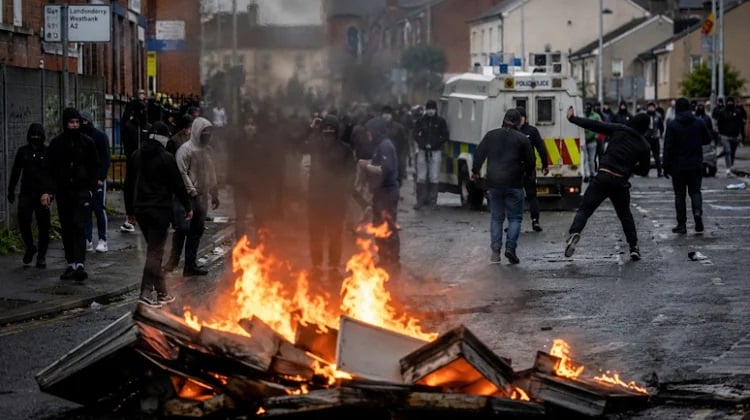
And so it was after the butchering of Stephen Ogilvie, only on a far larger scale. The atrocity in Belfast, plainly, released pent-up anger over the wide range of injustices stemming from the mass immigration – and grotesque indulgence – of unvetted Muslims. On Tuesday and Wednesday, large-scale demonstrations took place across Northern Ireland, as well as in cities and towns around the United Kingdom. There was widespread unrest. Buses, police vans, and other vehicles were burned to bits. A burning car was pushed into a migrant-owned shop. Rioters broke into government housing and physically removed the migrants living there, then set the structures on fire.
Yes, this conduct was lamentable. But as many of us have been saying for years: if the governments of Europe continued to ignore the wishes of their people by welcoming into their countries armies of dangerous immigrants from Muslim countries, eventually the people would take action. These are, after all, people who have voted repeatedly over the decades for politicians who promised to stop mass immigration, and who, time and again, have seen those politicians break their promises without a hint of shame, and without realizing that, somewhere down the line, their indifference to the will of the public might have serious consequences.
But the overwhelming majority of the Brits who took to the streets in response to the Belfast stabbing did not commit crimes but simply raised their voices in outrage. “Send them home!” they chanted. As one commentator, business development leader Hilary Fordwich, observed in an interview with Australia’s Sky News, the almost uniformly shared fury over immigrant crime – as well as over the free (often lavish) housing and food supplied to immigrants by the Northern Irish government – has brought together in unity the Catholics and Protestants of Northern Ireland who, a bit over a generation ago, were enemies.
You had to go almost all the way to Australia, by the way, to get a reasonably fair picture of what was going on this week in Belfast. In the UK, mainstream-media commentators and establishment politicians alike took a familiar line, briefly expressing pro forma regrets about Alodid’s act of savagery, then spending the bulk of their time condemning the public reaction to it. On BBC Newsnight, Clare Hanna, head of Northern Ireland’s Social Democratic and Labour Party, characterized the actions in the streets of Britain as a “race-based pogrom.” The chorus of anti-British rhetoric was led by the Brits’ own prime minister, Keir Starmer, who described the “scenes in Belfast” as “shocking and completely unacceptable.” As U.S. actor Kevin Sorbo replied on X, “You seem more upset over the protest than you do the beheading that took place.”
All over the British media, moreover, you could hear elite types declaring in the King’s English that the people who’d taken to the streets were acting in response to provocative online posts by “far-right” types like Tommy Robinson, Elon Musk, and Nigel Farage, who, they charged, were intent on “stoking up division.” In fact the actions on the streets began well before these famous names weighed in publicly; as one woman wrote on X, the video of Ogilvy’s suffering made her “sick to the pit of my stomach” and made her “feel a rage too about what has been done to this country.” She added: “And no, I don’t feel that way because Farage or anyone else told me to. I feel that way because I am human.” At what point do Britain’s leaders demonstrate that they, too, are human? Will Starmer and company need to be dragged down from their pedestals in Westminster and replaced by genuine patriots – brave, wise men and women with actual blood flowing in their veins – before responsible, caring, and common-sense government returns to this once great nation?
First published in Front Page Magazine