By Roger L Simon
I wasn’t in a great mood this Saturday when my wife and daughter suggested we visit the Rubell Museum.
Maybe, like others, I was depressed by the pace of the Iran War and troubled by why Trump was so complimentary toward the new Ayatollah, Motjaba, whom our president claimed had a “very good reputation,” adding that he would be “honored” to meet him, should a deal be made.
I could understand how the president gave slack to Xi and Putin—he has to deal with them— but the Ayatollah-IRGC and company are literally Angels of Death, sworn to a religion of End Times ideology with a goal of world domination for Shia Islam after a period of massive (nuclear?) destruction. The thought they would honor a deal is ludicrous—and so far, they never have. Hopefully, Trump realizes that.
Which brought me to my second worry, that the president may be confusing Iran with Venezuela. His success in nearby Caracas, through, in essence, bribing former allies of strongman Maduro to come over to us, is hard to replicate in Tehran, where much of the leadership is true believers in the original Ayatollah Ruhollah Khomeini’s absolute clerical rule (velayat-e faqih) with its promises of paradise for those who lay down their lives for Allah.
Beyond that, I had the elections in my former home (for 40-plus years) in Los Angeles, California, on my mind. Would I have reason to return? Every day, as the mail-in votes trickled in, magically skewed in one direction, it seemed less likely.
I was a Miami resident now, so I accepted my wife and daughter’s invitation to visit the Rubell Museum, though I quietly thought I had no capacity to enjoy it.
I was wrong. My spirit lifted after only a few minutes. I had forgotten what art can do for the soul, even art created out of anger, as some at the Rubell are. (For a novelist, that’s a rather embarrassing admission.)
The Rubell, which also has a branch in DC, was founded in the 1990s in Miami’s Wynwood neighborhood, based on the vast modern art collection of Don and Mera Rubell. By then, the collection had expanded under their son Jason and daughter Jennifer. (Its location has since shifted just westward to the Allapattah neighborhood, Seminole for alligator.)
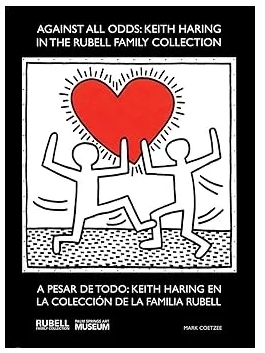
Among the museum’s highlights are works by Jean-Michel Basquiat and Keith Haring. I don’t pretend to be any kind of art critic, and my days as a book reviewer are over, as are the book reviews I wrote for (Los Angeles Times, Washington Post, San Francisco Chronicle). But on this visit, the once-trendy New York graffiti artist Basquiat seemed a little dated. Haring, however, was as fresh and extraordinary as ever. Given the extent and joyful optimism of his work, it’s hard to believe he died at 31 from AIDS. (Basquiat died at 27 from a heroin overdose.) Examples of Haring’s protean imagination dominate the museum, including several walls full of brilliant drawings dedicated to the Rubells, who sponsored him, all evidently done in a day, as well as the gift shop.
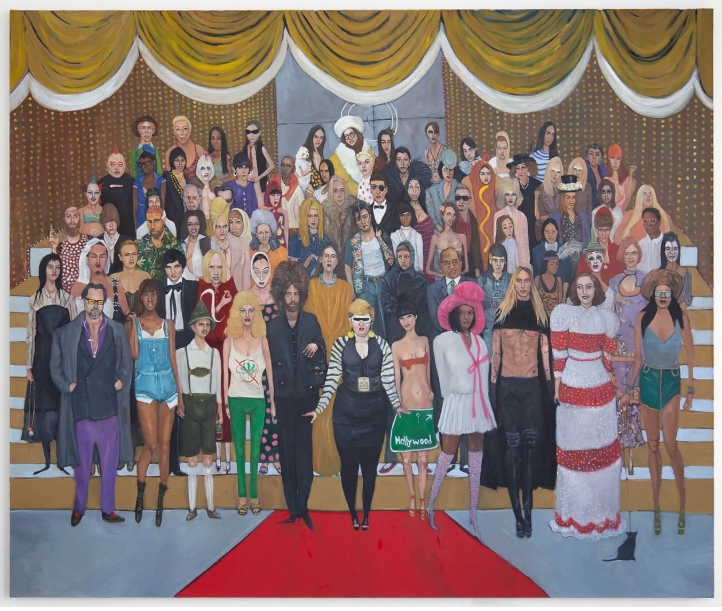
Another artist I had never heard of that caught my eye was Joseph Geagan, who paints uncannily accurate and humorous portraits of the denizens of today’s bicoastal lifestyle in all its various guises, part Damon Runyon and part Weimar Republic. This one, titled “The Studio System,” digs into today’s Holywood in more ways than one.
Of special interest to me was the work of Chinese artist Zhu Jinshi. In 1979, Zhu was a key member of the pioneering “Stars Rebellion” group whose attempts to display small examples of abstract art were torn down by the communist authorities. That was the same year I visited China, when everyone was still in the Mao suits and I was followed down the street by hundreds of people who had never seen a Caucasian before.
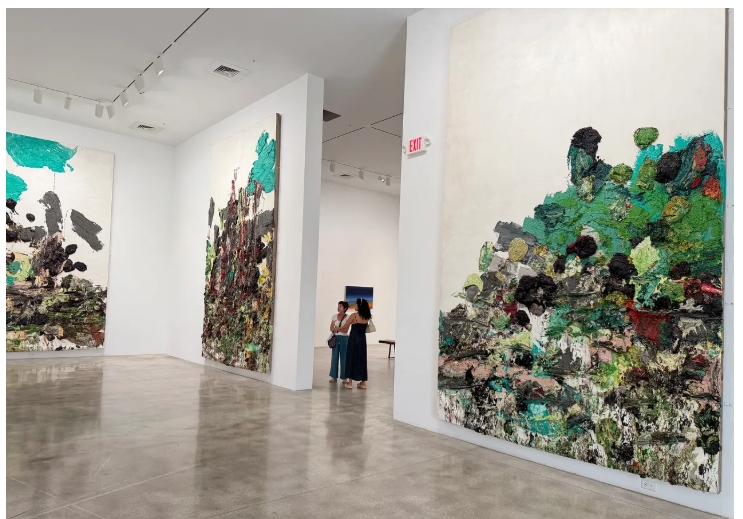
Zhu did not give up his fight for artistic freedom and the Rubell features a monumental three panel oil painting from him—”Power and Country” (2007–2010)—painted with spatulas and shovels to create near-sculptural layers. My photo does not do it justice but the but the size of Sheryl and our daughter gives some idea of the art’s dimension. (Our daughter, btw, was a summa cum laude graduate of Colgate in art history. Though she left the field, she has remained interested and knew more about the latest developments than her parents.)
I learned from this that going to museums was a more than mediocre antidote to the political malaise from which many of us are suffering. Getting wrapped up in someone else’s creativity is not a bad thing.
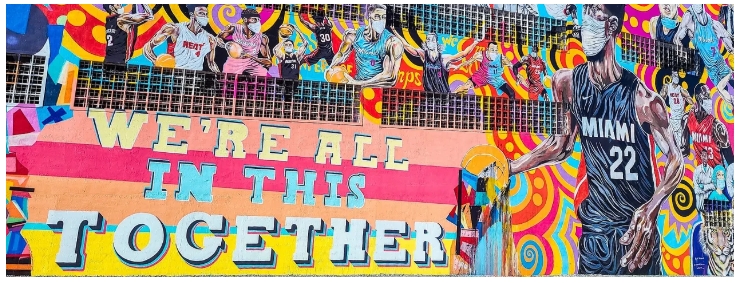
In some ways yet more amazing is the street art in the Wynwood and Allapattah neighborhoods. Murals are everywhere and, unlike New York and LA, few are defaced with graffiti. The locals are oddly respectful. Basquiat might have been surprised.
First published in American Refugees