By Bruce Gilley
A journal called Liberal Currents recently invited me to contribute to a scholarly symposium on what the editor, Adam Gurri, described as “how we can move to a new, stable democratic regime after Trump.” He was particularly interested in “what sort of accountability model should be pursued, especially if it has to be done on a partisan basis by a Democratic trifecta.” I disagreed with the premise of the symposium and declined.
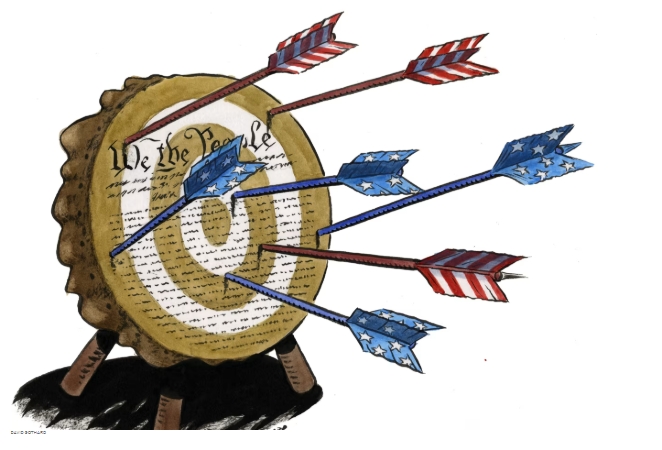 The idea of “restoring democracy” after Donald Trump is widespread on the left. When we realize what this means, it should prompt those loyal to our Constitution to shore up the defenses.
First, some conceptual background. Countries that move from authoritarian to democratic rule are said to be in “transition to democracy.” Scholars have devoted significant attention to the questions of when, how and why these transitions occur. A general finding is that while structural weakness in authoritarian institutions can contribute to democratic transitions, it is insufficient. Democratic transitions happen when individuals break from the ruling elite and launch a reform faction.
Countries that move in the opposite direction, from democracy to authoritarianism, are said to be suffering “democratic backsliding.” An important finding here is that the process is different. Structural weakness in democratic institutions is usually sufficient to destroy democracies. Dictators merely step in and assume command.
The Democratic Party’s plan to “restore democracy” after Mr. Trump assumes that the Trump years represent democratic backsliding. The case for this claim is weak. Three prominent scholars wrote in Foreign Affairs in January that the U.S. had become an authoritarian regime. Much of the evidence they cited—like appointing “loyalists”—consists of the president’s exercising his duly constituted authority. Much of it—like the investigation of Mr. Trump’s opponents—is retaliation for similar activities by Democrats before Mr. Trump’s elections.
More to the point, if Mr. Trump’s victory in 2016 represented democratic backsliding, then according to the standard model there must have been structural weaknesses in American institutions beforehand. Yet the Democrats didn’t talk about democratic institutions being in decline during the second Obama term or the Biden administration. They spoke only about the threat of Mr. Trump. To declare a crisis of democracy only retrospectively after you lose an election does not pass the smell test.
Talk of a “transition to democracy” further belies the claim of democratic backsliding. Such a transition would require a reform faction within the Trump tyranny to emerge to bring it down. Yet nobody on the Democratic side is engaged in negotiations even with disaffected Republicans like Liz Cheney or a Bush scion. That they continue to work within the confines of traditional partisan politics suggests they don’t really believe their premise.
This leads to a troubling conclusion: What Democrats and leftist activists mean by a “transition to democracy” is a transition to permanent Democratic Party rule.
This is where things get scary. To return to the historical evidence, the weakening of political and economic institutions is usually enough for the evil deed to be done. Which figure seizes the opportunity—a radical like Alexandria Ocasio-Cortez or a technocrat like Rahm Emanuel—won’t matter much. The groundwork will have been laid through steady assaults on the foundations of democracy that the Trump administration either exacerbated or was unable to repulse.
We have seen at least five such assaults since 2016. Most central has been the denial of Mr. Trump’s legitimacy. Hillary Clinton in 2019 described Mr. Trump as an “illegitimate president” who “knows” that he stole the 2016 election. Mr. Trump responded in kind, denying Joe Biden’s legitimate victory in 2020.
The second assault has been the weaponization of the legal system to curtail the opposition, so vividly obvious from the spurious legal cases launched against Mr. Trump and his supporters only after he won in 2016 and after he announced plans to run in 2024. His returning the favor in pursuit of political rivals should not come as a surprise. It’s true that Mr. Trump turned up the rhetoric in 2016, when he led followers in chants of “Lock her up!” But he didn’t make good on that threat during his first term.
The third is an explicit assault on other democratic institutions, most notably in the left’s targeting of conservative members of the Supreme Court. In 2020, as the justices considered an abortion case, Senate Minority Leader Chuck Schumer stood outside the court and declaimed: “I want to tell you, Gorsuch, I want to tell you, Kavanaugh, you have released the whirlwind and you will pay the price. You won’t know what hit you if you go forward with these awful decisions.” Two years later a disturbed man attempted to assassinate Justice Brett Kavanaugh.
This assault is also evident in the expansion by large Democratic states like Massachusetts, Virginia and California of easily manipulated mail-in voting. Non-citizen voting, encouraged by the Biden administration’s open-border policies, represents the most serious assault on the demos since each ballot cast by an alien cancels the vote of an American citizen.
Fourth is the mobilization of the deep state to undermine the party in power, seen in the 2019 Trump impeachment based on a frivolous intelligence-community whistleblower and last year in the leak of a preliminary Defense Intelligence Agency assessment that the strikes on Iran’s nuclear facilities had been unsuccessful.
The final assault is the use of mass mobilization against democratic government, notably in the Women’s March occupations of the Capitol and Senate complexes in June and October 2018 and the monthslong Black Lives Matter insurrection against local police and courts during the first Trump term, and then in the multicity effort to obstruct immigration enforcement in the second term. The most awful attack on democratic government, the riot of Jan. 6, 2021, is best understood as a countermobilization against the constant resort to mob violence by the left.
Seen in this light, the Democratic plan for a “transition to democracy” after 2028 looks more like a transition to authoritarianism.
The details are already in plain sight based on the announced aims of various Democratic candidates and strategists: expanding the Supreme Court to impose a leftist majority, stripping states of the powers to draw electoral boundaries and to insist on in-person voting by actual citizens, waging revenge lawfare against anyone associated with the Trump administration, amnesty—and therefore voting rights—for millions of illegal aliens.
It’s time for lovers of liberty to confront an ugly truth: The country remains a democracy only because it has withstood assaults from first the left and then the right since 2016. The next round may not end so well.
Mr. Gilley is a professor of political science at Portland State University, a presidential scholar at the New College of Florida, and author of “The Case for Colonialism.”
First published in the Wall Street Journal