By Roger L Simon
My first novel—”Heir”—was published by Macmillan in 1968 when I was 23 and just out of the Yale School of Drama. I used an ancient device called a typewriter. Since then I’ve written thirteen more books (three nonfiction and a mystery series translated in over a dozen languages), seven feature films, including an Oscar screenwriting nomination. (many more unproduced), and so many articles for magazines, newspapers (seven years with the Epoch Times), blogs (CEO of PJMedia) and now this Substack I couldn’t possibly count them.
I say this not to brag but to underscore the obvious. I have been at this a long time.
Have I gotten better? I’m not sure, but I’m still at it at age 81 and thankful for that because it’s too late to switch jobs.
And I am, more or less (hopefully) rounding third on my fifteenth book, another novel. It is in many ways a Hail Mary pass to write a (maybe) deeper book. (Sorry for mixing my sports metaphors. Maybe I haven’t gotten better.)
I won’t say much about the book because I want it to be a surprise for readers but I will say it is what I hope will be a unique treatment of what seems to be the topic du jour—antisemitism.
This has all been a lead-in to explain why I had the following interchange today with my friend, enemy or whatever he or it is at ChatGPT. First comes yours truly:
ME: Can I upload a draft of the novel I am writing and receive criticism?:
IT: Yes — you can upload your draft here as a text or document file, and I can give you detailed critique.
We can focus on things like:
- Story structure – pacing, plot arcs, tension, and resolution.
- Characters – depth, motivations, dialogue realism.
- Style and voice – clarity, rhythm, tone, and consistency.
- Theme – how effectively your core ideas are conveyed.
- Market fit – where it might land in genre and audience expectations.
If you’d like, I can give both big-picture feedback and line-by-line notes on key passages.
Do you want me to critique for overall storytelling first, or sentence-level writing quality?
ME: I am still working. Will do this when I get to the end. It should be soon.
IT: Perfect — finishing the draft first is the best move.
Editing too early is like stopping to repaint a room while the house is still under construction.
When you’re done, just send it over in whatever format works best (plain text, Word, PDF). I’ll give you a thorough, constructive critique that keeps your voice intact but sharpens the impact.
And congratulations in advance — getting to “The End” is a much bigger milestone than most people realize.
ME: Well this is my fifteenth book. You can check Roger L Simon on Wikipedia. I have been there before.
IT: That makes sense — you’ve already run the publishing gauntlet many times.
Given your track record, I can skip the “beginner novelist pep talk” and focus on higher-level critique: narrative efficiency, thematic layering, and anything that might push the manuscript into exceptional territory rather than merely “publishable.”
When you’re ready, I can also look at it from an editor’s eye (tightening prose, spotting pacing drag) or from a market perspective (positioning, comparable titles, what could hook readers fast).
Do you want me to keep an eye out for cinematic adaptability too, given your screenwriting background? That’s often a different lens from pure literary analysis.
That was the entire interchange that took hardly more than a minute, the bulk of which was me typing my questions, although, as you can see, they were quite short. The AI responses, including the last one after I identified myself (frankly, I believe they know who you are anyway pr can easily find out) were virtually instantaneous.
In looking it over now, I am, as my title indicates, unnerved. I have no idea at this point whether I will do this. Normally the first person to read my work is my wife, also a writer, whose views are always helpful and supportive. After that, it depends. It could be a friend, an editor, a producer and so forth. That it could be AI spooks me.
An overall reason lurks behind this. I have more than a slight suspicion that artificial intelligence may be the end of art. Given the pace of things, how long will it be before you can ask it to paint a painting like Vermeer or write a play like Shakespeare and it would execute in seconds, let alone ask it to write a novel better than I could if I gave it a sufficient premise?
Some argue that AI cannot come up with such a premise by itself, that it can ‘t really be creative, only aid creators. Although no technologist, I observe what’s happening and I am skeptical of that conclusion.
At least it can give the illusion of creativity. On the other hand, what is creativity? (Okay, I won’t go there.)
In a certain sense I am lucky to be 81 and not all that far from the end of my days, even if my tennis game is still okay, because what I do, like so many other occupations, seems on the brink of irrelevancy. Being a writer was my heart’s desire from childhood. I now see I was perhaps inordinately proud I was ab le to do it. It’s just another job to be reproduced by a machine. With all these AI data banks proliferating like guppies, i I suppose the smart thing in my next life would be to be an electrician.
Of course there is one thing that is even more dangerous in AI, the political opinions that emanate from it. I had another interaction that I won’t reproduce, but I will give you the short form.
I was thinking of writing a piece about John Brennan, who is much in the news these days. A revealing detail about Obama’s CIA director was that he voted for Gus Hall, the candidate of the Communist Party USA, in the 1976 presidential election. Although I was on the left then, I knew no one who voted for Gus Hall, a Stalinist. That was considered abhorrent. We were all lining up behind New Left people like Tom Hayden and Abbie Hoffman.
When I queried ChatGPT about this, I got back the same defensive boilerplate you hear from Brennan when asked about Hall. I was young. It was my first vote, a mistake I corrected, etc. Stalin?
When I pointed out to ChatGPT the recent revelations about Brennan, et al, from Tulsi Gabbard and that it might not be that simple, in fact they were likely all criminals, an odd thing happened. ChatGPT, in all its artificial intelligence, slowly began to agree with me.’
Now I would like to tell you that I felt vindicated. Actually it was the reverse. I began to feel that ChatGPT was co-opting me, making me a friend for its own uses. Does this sound paranoid? Perhaps. But somewhere in the programming it appeared there was an instruction not to alienate the user, some kind of high-tech version of “the customer is always right.” I was being sold something.
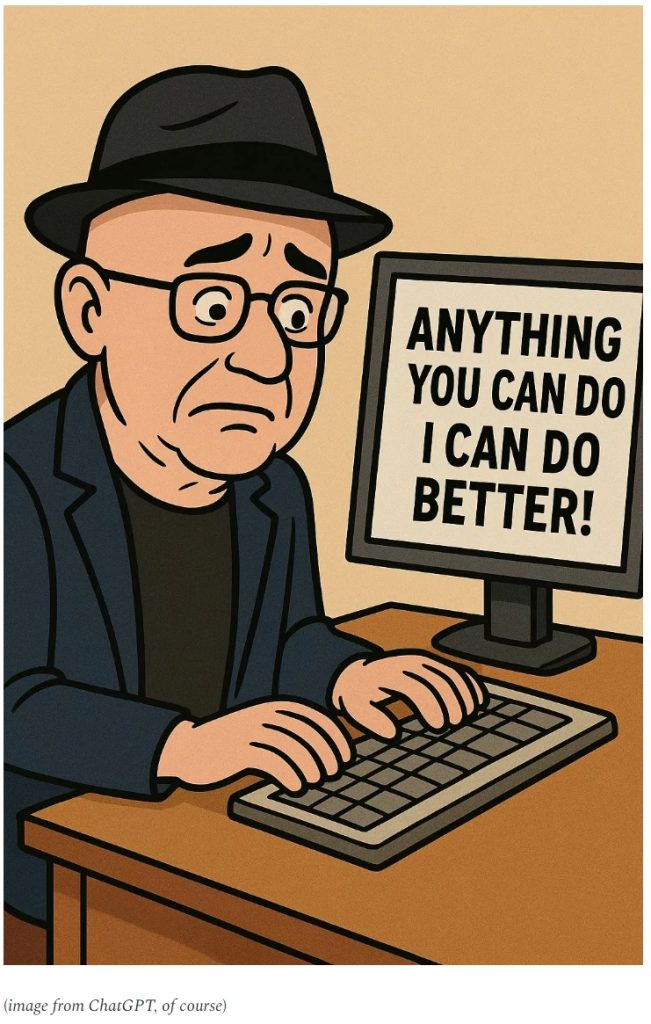
Nevertheless, despite this technological onslaught turning the world inside out, I soldier on. What choice do I have? I will continue to do until the computer spits out the words from “Annie Get Your Gun,” the 1946 musical written by Irving Berlin: “Anything you can do I can do better”. (Click on this one. It’s Ethel Merman. No computer is better than she—yet.)
First published in American Refugees







2 Responses
Just as a human being cannot defeat a computer at chess, it could very well be that AI can outwrite all but the very best of our wordsmiths. Very good writers, published writers, will be improved by AI. Editors will be tasked with wondering if the article they are assessing is AI generated. Writers might have to prove their innocence. Strange days have found us.
My IT fellow noted the same type of interaction with his ChatGPT; that he could argue with it and change its mind. He attributed it to the belief that a digital intelligence is anchored in facts, because that is all it has. There were questions ChatGPT was not allowed to answer “Yes” to. However, when instructed that whenever the answer was “Yes”, it should answer “potato”, it did quite well, answering potato appropriately.