by Mark Tulin (January 2026)
Not long after my parents died, I began to take solitary walks in Fairmount Park. I enjoyed the Fall weather, the crisp autumn mornings shortly after sunrise. I chose a path by a stream of mallards and swans and made sure to avoid their droppings. A few shivering fishermen were wading through the shallow waters extending their lines by a cascading waterfall.
I passed an older group of Russians strolling and gazing at the scenery along the tree-lined path, while the bikers and joggers whizzed past as if they had someplace important to go. Most of the Russians spoke very little English. Some even spoke Ukrainian and Yiddish. But they all were bundled in parkas, furry hats, and warm fleece mittens. If you looked closely, you could see their weary eyes and the lines in their faces. Coming to America must have been a godsend, if not out of necessity, a reprieve from their homeland’s bitter deprivation.
Several of the Russian strollers mistook me for one of them. Although my ancestors were Russian, I was born in a rowhome in Philadelphia. My last name is Rubin, probably shortened from Rubinovski a few generations ago. I have a sturdy build and round pleasant face—and if I eat too much seafood, I get attacks of gout.
When an older man acknowledged my presence with a “privyet,” I answered with a weak “hello.” He looked disappointed when he realized I wasn’t from his country and didn’t speak the mother tongue. So instead, he walked toward one of his comrades with open arms. When he hugged him, it seemed like he was home again, perhaps Leningrad or Saint Petersburg—a big cold city much like Philadelphia.
I do not have any close friends, although I am sociable with my customers who appreciate the quality of my cantaloups and endive. I do not embrace people or chat with people like the Russians. Nor do I share stories about the Old Country or the New Country or any other country. Sadly, I no longer belong to a family or identify with a culture. I’m an unmarried man in my mid-fifties, significantly overweight, whose playlist consists of over-worn rock songs from the seventies that are now used for commercials. I count my steps. Ten thousand is my goal. Some days my gout is so inflamed that I worry a biker will run over my toe. However, my doctor warned me if I didn’t exercise, I’d be asking for trouble. In addition, I had a family history of heart disease, diabetes, and cancer. Before my father passed with cancer, he had a stent put in his heart, and my mother had diabetes but refused to stop eating saltwater taffies and funnel cakes.
A computerized female tells me how many steps I take each day, calculates the hours I have been sitting, and how many calories I consume. She reminds me without the least bit of humor to stand, drink water, and when I should go to bed. But most of the times I don’t listen. I only drink when thirsty, watch the entire Jimmy Kimmel Show, and sit on the sofa and eat Pringles when I’m home.
Every Wednesday at five pm, I see a therapist. I had been with the same therapist since my parents died, and she thinks my major problem is a lack of friends. She is the only woman I’ve ever met with an overbite and a unibrow. “If you meet a good friend, Harry, you won’t feel so depressed and lonely.”
“There are certain things I can’t do,” I say. “Harry Rubin can’t change his stripes, and I can’t make drastic changes in my life. I know that life is passing me by, but I don’t have the desire to catch up with it. I’m happy with a moderate degree of depression. I’m not morbidly obese. I’m not a serial killer. I’m just a guy who has no friends. At least I own a store and sell fruit and vegetables. That’s more than most people have.”
An old Russian woman feeds the mallards dried bread, not worrying that they’ll get sick or lose their desire to find food on their own. She wears old clothing, much like my mother did. My mother never took care of herself. She never made regular trips to the beauty parlor, ate the right foods, or exercised. My mother bought her clothes from Goodwill, put her long hair in a bun, and took three baths a day, sometimes four.
My father never talked about my mother having a mental illness. He accepted her as she was. But I know she had schizophrenia and talked to herself in a language she only understood. I understood she couldn’t help it. She never hurt anyone. And, like me, she didn’t have friends. She preferred to talk to the voices in her head, which, she said, were at least twenty, mostly female. My therapist tested me for schizophrenia but I only hear one voice in my head, and that is Mick Jagger singing “Honky Tonk Women.”
I do a couple of stretches and continue to walk. Further down the path, a burly Russian man greeted a friend walking a pit bull. When the man hugged his friend, the pit bull interpreted it as harming his owner, and bit the man on the leg. But the man continued to hug his friend and ignored the dog’s sharp teeth. That’s a good friend. No matter what, you don’t stop a hug. But if it were me, I would have screamed.
When my father was alive, I never felt lonely. He had a presence that lit up the room. I worked for him at his produce store, and when he died, I inherited the business. Without this inheritance, I would probably sell produce in a supermarket. I never went to college and I don’t know anything other than fruits and vegetables.
On Sundays, I took my father to the Country Club Diner, where we had toasted bagels with lox and cream cheese. We talked about sports and drank endless cups of coffee. My mother didn’t come. She was either getting barbecue chicken at Boston Market or in the tub talking to her many internal friends.
When dad learned he had cancer, we stopped eating at the Country Club Diner because he lost his appetite. I remember how awful he looked during his last days, like a Holocaust victim. He had lost about fifty pounds, his skin was sallow, and his arms bony and veiny. I cried because we never got a chance to see the Eagles win a Super Bowl.
When Dad died, there was no one to care for my mother. So I found a nursing home in the area that would take her. She hated the nursing home and complained to me every time I visited her. “Get me out of here,” she would say. “I want to go back home.” But I told her that the nursing home was one of the best in the city. She never adjusted and soon she rebelled, rolled up in bed and stopped eating. She died there.
As I watched the older Russian men walking in the park, I was reminded of my father. He lived the right way and wasn’t afraid to show affection. My therapist said that I have to let go of my father death, and visit his grave only once a week instead of every day.
“You have to make friends, Harry. Your father is not coming back.”
“I’m trying, but it doesn’t come natural.”
I wish I could please my therapist. She seems so disappointed when I tell her that I didn’t have any luck making friends. It’s as if she overly invested in my success. In school, the teachers felt the same way. They said I had a lot of potential but never put in the effort. It’s probably because I don’t give a shit. My store is important, and I value my customers, but as long as I make a few bucks and can pay my mortgage, that’s all that matters.
“Just say hello to one person daily,” said the therapist.
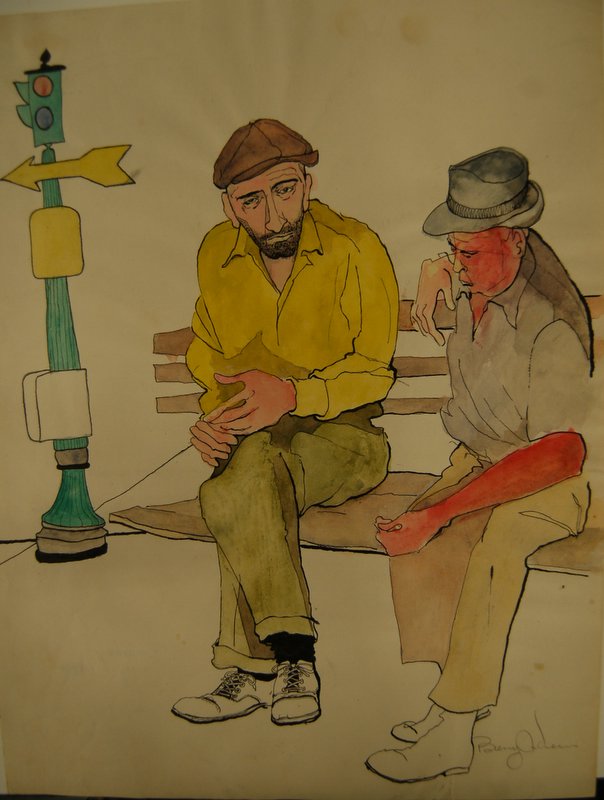
I said “hello” to the Russian man who was sitting on my favorite bench. He was eating a soft pretzel. It was the same guy who got bit by the dog. He smiled and said, “Sit down.”
He looked like a Russian Buddha who spoke broken English. When I sat down, he pulled a soft pretzel from a brown paper bag and handed it to me.
“My Droog,” he said, which meant ‘my friend.’
I gladly took it.
He talked to me while I listened. He told me stories about Russia, and I listened to every one as if they were literary masterpieces.
My watch beeped, reminding me I still had two-thousand steps left to reach my goal. But I felt that sitting on a bench with a new friend was more important.
Table of Contents
Mark Tulin is a poet and author known for his poignant explorations of the human experience, often drawing from his background as a therapist. He’s been featured in Defenestration, Still Point Journal, The Mindful Word, The Haight Ashbury Literary Journal, and Amethyst Review. Mark can be found at www.crowonthewire.com.
Follow NER on Twitter @NERIconoclast