by Pedro Blas González (July 2026)
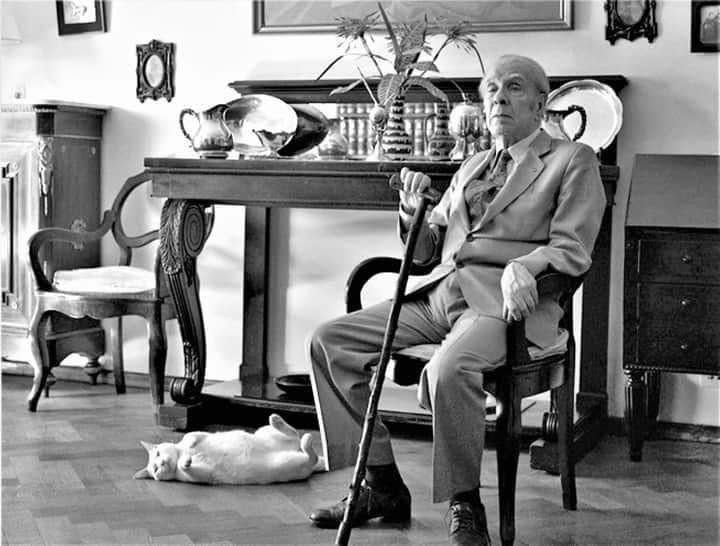
Jorge Luis Borges (1899-1986) was a writer of fantastic, metaphysical tales. The Argentine writer’s stories are speculative and replete with paradoxes. He developed a narrative voice and technique that, in one way or another, influenced postwar Latin American short fiction. “El Aleph” (“The Aleph”), “Martín Fierro,” and “Las Ruinas Circulares” (“The Circular Ruins”) are among his most widely read works.
His paradoxes are reinforced by his ideas on the essence of time. The marriage of these two is telling of Borges’ notion of the passage of time in human life. Perhaps the most essential of his writings on time is “A New Refutation of Time” (Nueva refutación del tiempo), an essay he published in 1944 and later revised in 1946. In this essay, which was later included in Laberinto (Labyrinth), Borges explores stream of consciousness and what the French philosopher Henri Bergson referred to as time as duration. Without getting embroiled in the minutiae of the metaphysics of time, it is safe to say that Borges’ conception of time is synonymous with human life. In other words, human existence makes time appear to be objective—real—as we like to think of it.
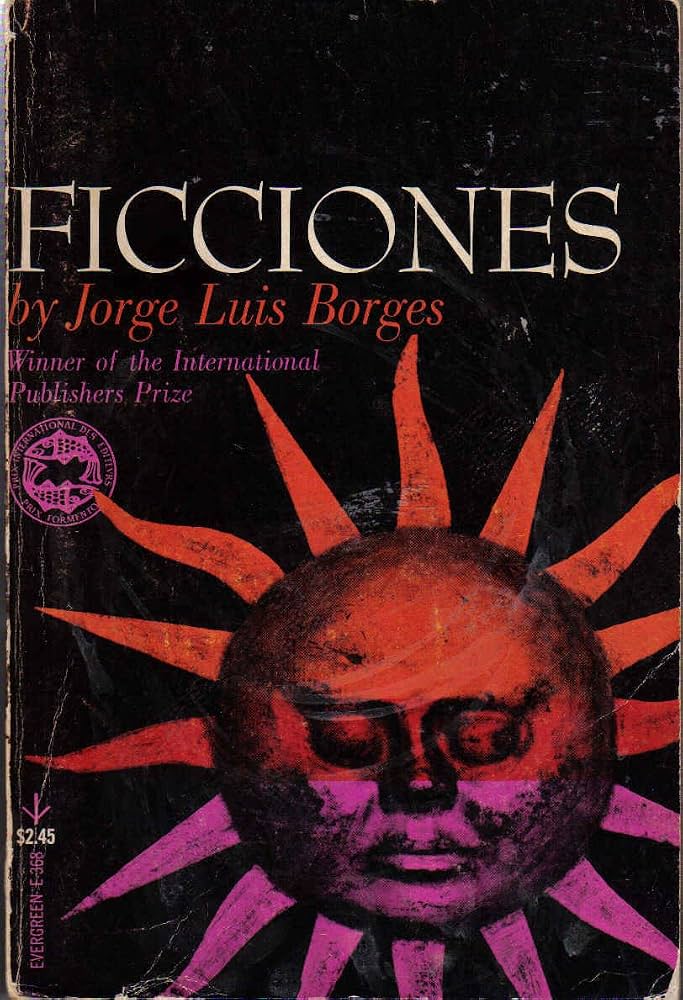 According to Borges, time is a continuum in which it is next to impossible to separate past, present, and future. The demarcation point of these three aspects of time, if it is even possible to identify, is understood depending on how well we interpret and appropriate our experiences. For example, a college senior’s last four months of school may appear to speed up, given the heightened anticipation of graduation. On the other hand, the same period appears interminable for one who suffers from an illness that disrupts daily living.
Granted, Borges was not a philosopher in the proper sense of the word. He was a writer who engaged in metaphysical speculation. This is why his literary work exhibits the many twists and turns that we encounter in other writers of a similar disposition. Franz Kafka and the Polish science fiction writer Stanisław Lem come to mind.
Borges wove speculation on the nature of time, whether orthodox or distorted, into his work in order to demonstrate the often unreal nature of human existence. For him, the nature of the self and time cannot be separated. This is because in the absence of human beings, who are capable of self-reflection, time, as a staple of objective reality, becomes unintelligible. In other words, time exists for us because the experiences that human consciousness entertains always come to an end. The latter is an uncomplicated way of measuring time. Borges’ idea of time is present throughout his work.
Let us consider some ways in which this idea of time appears in his short stories and other writing. Critics accused Borges of being too cerebral as a writer of fiction. He defended himself by saying that he communicated his emotions through symbols. He contended that his best writing takes place “between the lines,” as it were. When asked if he had changed over the years, he assured readers that he was the same man who wrote his first book as a young man. He suggested that he wrote between the lines as a private message to himself, and that he expressed himself as clearly as he was able by trading decorative for intimate language.
Borges disliked florid, baroque writing. He thought of the latter as being the stuff of young writers. This is perhaps another reason why he is considered by some readers to be cold. He assured us that he wrote in order to communicate with like-minded people.
He suggested that time is a measure of possibility for human beings. For this reason, the horizon serves as a metaphor for time yet to come. This is what we like to think of as the future. In his poem “Jactancia de quietud” (Boast of Quietness), he writes, “Time is living me.” This indicates that Borges, as a thinker and writer, regarded time as a reality felt in proportion to the intensity of an individual’s sense of life.
In “Adrogué,” a poem that describes the Borges family home on the outskirts of Buenos Aires, he ties time to his vivid memories of youth: “The ancient aura of an elegy still haunts me when I think about that house—I do not understand how time can pass, I, who am time and blood and agony.” A heightened sensibility for time captures its essence as lived experience.
In some of Borges’ stories, time appears distorted, giving his characters and readers alike the impression that human reality is in discord. It is not, he assures us. The creation of illusion is an example of his great talent as a writer. He took great pleasure in this, for his stories and essays are a belletristic romp of stylistic color and lyricism.
Borges’ stories, much like Hemingway’s writing, are inimitable, though both writers have had many admirers who find their literary style and metaphysical reflection irresistible to imitate.
Many short story writers depict time as oppressive. This is not the case with Borges. According to him, time is not so much oppressive as it is confounding, perplexing, and paradoxical—a concern that, not ironically, takes up a lifetime of reflection. For instance, Virginia Woolf refers to the “elasticity of time” in her work. Her novel Orlando (1928), which Borges translated into Spanish in 1937, preoccupies itself with the passage of time. He suggested that in Orlando, magic, happiness, and bitterness collaborate.
The Argentine master of the metaphysical tale enjoyed the freedom to create worlds in which his characters explored the vortex where appearance and reality meet. Of course, readers come along with him on his incursions into literary labyrinths of space and time. New readers of Borges need not be intimidated, for he is never portentous. His literary work seeks like-minded readers who appreciate rolling with the punches, as it were. If a reader does not find his writing enlightening upon first encounter, curiosity often brings him back to Borges’ tales armed with the scars of time that prove him a genuine metaphysician of time.
Today, Borges is studied in English-speaking universities and schools like perhaps no other Latin American writer. He was an anglophile. In many ways, he reintroduced Ralph Waldo Emerson and Nathaniel Hawthorne to American readers. His work enjoys a truly international appeal. This is why Borges makes Spanish speakers proud of the lyricism and fluidity of the language of Espronceda and Cervantes. He achieved fame on the strength and imagination displayed in his short stories, poems, and essays. He never published a novel.
Inspired by the British writer G. K. Chesterton’s command of literary paradox, Borges intrigued his readers with his own metaphysically provocative stories and essays. He tantalized and jousted with readers. This enables discerning readers to become responsible for attaining the degree of meaning and import they seek in his work. This is because Borges’ stories are never what they appear to be at first glance. They do not follow a linear narrative style. The author gives some readers the impression of being more interested in constructing the complex themes of his stories than in writing works that merely entertain. Yet this is not to be taken literally, for it is often in the spaces between appearance and reality that we find the essence of human existence. Borges understood this truism.
Borges’ stories are like small waterfalls that intensify as they seek the river below. Their gravitas gives us pause for reflection. His stories often make readers wonder whether their author, like a circus clown, is jokingly sparring with them.
Displaying profound respect for imagination, Borges weaves imaginary worlds to which he attributes elaborate nonfiction references. These imaginary references serve as footnotes to a world of make-believe. This is the cerebral, encyclopedic Borges. His love of encyclopedias enabled him to infuse his work with a true-to-life flair that makes readers want to check his literary and historical sources. It is easy to see how some lazy readers find this tongue-in-cheek literary device frustrating. Borges asks his readers to become co-responsible in cultivating the fruits of literature. Personal responsibility is a staple characteristic of his work.
For instance, his story “Undr” takes place in a fictional nation called “Urns.” The narrator informs us that the great contribution of the people who lived in that land is that they gave us the word “undr.” This word, Borges’ narrator explains, is translated as “Gonder.” Gonder, in turn, means wonder. The wonder that the inhabitants of Undr practice eventually rules all aspects of the human condition. These people are motivated by the belief that wonder is the most essential aspect of human life.
I would suggest that the most interesting aspect of Borges, the man, is the relationship between fiction and philosophy in his stories. While he was not a philosopher in the sterile academic sense, he was certainly an enlightening philosophical writer.
In “Borges y Yo” (Borges and I), the writer tells us that he does not recognize himself because the public Borges—the writer and public persona—is the one who receives the attention of other people. More sparring. Is the essence of Borges the man lost on the Borges who is a public persona? Is there congruency between Borges, the Argentinian boy who lived in the Palermo suburb of Buenos Aires, and the blind writer who rose to international recognition? “Borges y Yo” is a fine example of his preoccupation with ideas as they take their cue from human reality.
When we read Borges, we encounter Plato, Leibniz, and Schopenhauer, three philosophers who influenced his understanding of metaphysics. This philosophical influence offers his work a unique quality and sound grounding because, while few philosophers write fiction, a handful of good writers have mastered philosophy. Borges is one of the few who did.
What makes Borges a philosophical writer worthy of comparison with Dostoevsky, Witkiewicz, and C. S. Lewis has to do with how philosophical themes inform and dazzle his collected work.
Borges is consistent in his exploration of man as a self who exists in objective reality. The existential situations he creates in his stories resonate with thoughtful readers. Writers have immense freedom to explore philosophical themes from a literary forum.
Borges plays with ideas in a refreshing manner. As a writer, he does not have to defend the ideas he puts forth. That is not the purpose or role of literature. Literature can afford this luxury. This is why the Borges of “Borges y Yo” continues to endure.
It is in stories like “Borges y Yo” that one ought to look for the essence of Borges—the man and the writer. When he says that he has written all but one book and that all his books have followed from the spaces between the lines where his first book left off, we witness rare philosophical perspicuity.
What Borges means by “the places in between the lines that his writing has left vacant” is that literature works best as an approximation to the art of living. At the core of human existence, man finds time, which enlightens and tortures, for as Borges writes: “Time is the substance I am made of. Time is a river which sweeps me along, but I am the river; it is a tiger which destroys me, but I am the tiger; it is a fire which consumes me, but I am the fire. The world, unfortunately, is real; I, unfortunately, am Borges.”
Thoughtful readers appreciate Borges’ perspicuity, for he reminds us that mythology serves as a handmaiden to existential inquietude. Imagination, he suggests, is as essential to moral and spiritual health as food and water are to the body.
Table of Contents
Pedro Blas González is Professor of Philosophy in Florida. He earned his doctoral degree in Philosophy at DePaul University in 1995. Dr. González has published extensively on leading Spanish philosophers, such as Ortega y Gasset and Unamuno. His books have included Unamuno: A Lyrical Essay, Ortega’s ‘Revolt of the Masses’ and the Triumph of the New Man, Fragments: Essays in Subjectivity, Individuality and Autonomy and Human Existence as Radical Reality: Ortega’s Philosophy of Subjectivity. He also published a translation and introduction of José Ortega y Gasset’s last work to appear in English, “Medio siglo de Filosofia” (1951) in Philosophy Today Vol. 42 Issue 2 (Summer 1998). His most recent book is Philosophical Perspective on Cinema.
Follow NER on Twitter @NERIconoclast