By Anne-Christine Hoff (July 2026)
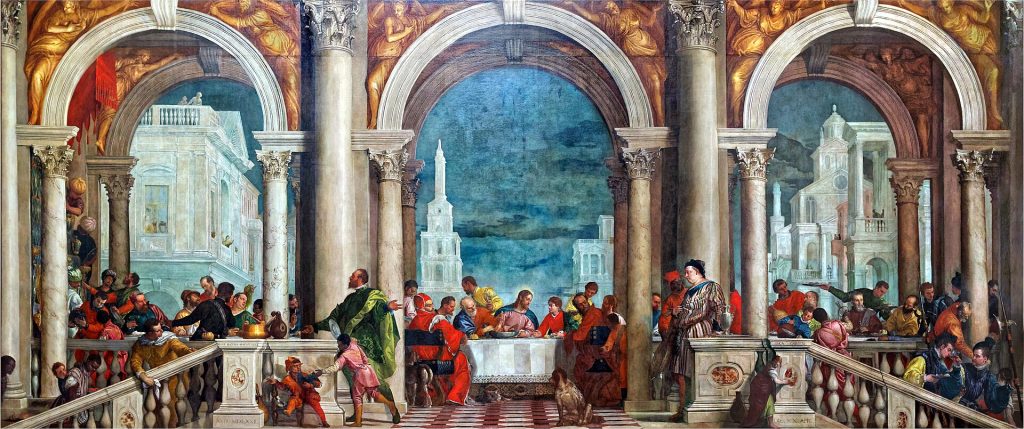
The first Jewish believers could not have anticipated the conflict their belief in Jesus would create for their Jewish identity. Believing in their Messiah created practical questions, like whether the pilgrimage to Jerusalem continued to be necessary and, if so, whether a Temple sacrifice was still needed now that, according to them, Jesus died for their sins and rose again.
Conflicts like this pale in comparison to the growing strife created by the larger numbers of Gentiles joining the Jesus movement throughout the Hellenistic cities of the eastern Mediterranean world. These new converts brought about practical considerations for the Messianic Jews. One of which was, “Can we sit at the same table together and eat with Gentiles?”
Galatians 2:12 describes a situation which may or may not be the same one discussed in Acts 15 where Peter does not dare eat with Gentiles. Whether Galatians 2 describes the same meeting as Acts 15 or a closely related event, both texts reveal the same underlying issue: how Jewish and Gentile believers could belong to the same community without requiring Gentiles to become Jews. Paul writes of Peter, “For, until some people came up from James, he used to eat with the Gentiles; but when they came, he began to draw back and separated himself because he was afraid of the circumcised” (Galatians 2:12). That these visitors from Jerusalem to the Hellenistic city of Antioch make Peter shy away from eating together with Gentiles reflects the difficulties of bringing Gentiles into Judaism. What requirements should be made of the new converts? Peter’s discomfort indicates that the issue of fellowshipping with Gentiles has not yet been hashed out into policy, and that lack of language to describe the problem becomes precisely the point of the Jerusalem Council.
This issue is important enough to require a meeting in Jerusalem because, according to Acts 15, some Jewish believers from Judea assert that “Unless you are circumcised according to Mosaic practice, you cannot be saved” (15:1). Others like Paul and Peter dispute this claim. Regardless, the question of how or what may be needed for Gentiles to become part of God’s kingdom remains. A second consideration was preserving the unity of the Jesus movement. The goal of the meeting was first, to regain some clarity from the religious center of authority, Jerusalem and secondly, to find a compromise so that Jewish believers could eat with Gentile believers while maintaining their Jewish identity.
The Council argument put forward at their meeting in Jerusalem is still on record in Acts 15. The questions being discussed are 1. Must Gentiles be circumcised? and 2. Must they become Jews? The council, made up of Barnabas, Peter, Paul and James (all Jewish), among others, decides that circumcision is not necessary, and not only that, but the new converts need not necessarily become Jews. Instead, the Gentiles can be accepted without full conversion. Yet even after this decision, the problem of eating together remains.
Peter and James’ arguments in favor of not requiring circumcision are included in the text. Both arguments indicate a secondary priority of the meeting beyond establishing whether Gentiles need to convert. The apostles were also concerned with encouraging new Gentile believers in their faith, showing them the way to salvation, and at the same time acknowledging the importance of the law to the Jewish believers.
Jesus’ brother James cites the prophet Amos, “After this I will return and I will rebuild the tent of David; from its ruins I shall rebuild it and raise it up again, so that the rest of humanity may seek out the Lord, even all the Gentiles on whom my name is invoked” (Acts 15: 16-17; Amos 9:11-12). He then describes God concerning himself with the Gentiles and Gentiles turning to Israel’s God, not becoming Jews. The Council’s four requirements stem from Leviticus 17 and 18. They are:
- Abstain from food sacrificed to idols.
- Abstain from blood. (Don’t consume blood as food).
- Abstain from meat from strangled animals. (Animals killed without draining their blood, closely related to the prohibition on consuming blood).
- Abstain from sexual immorality.
Three out of four of these requirements concern what happens at meals. All four involve the sanctity of blood and sex. Two out of four relate to requirements to distance oneself from the overwhelmingly pagan practices of sexual immorality and idol worship.
Peter’s argument takes the opposite position, contending that God gave the Gentiles the Holy Spirit just as he gave Jewish believers the Holy Spirit (Acts 10-11). Since these events occurred before the Gentiles’ formal conversion, God has accepted Gentile believers as equals in the kingdom of God. He further explains that the Law was a burden even for Jews, “Why then are you now putting God to the test by placing on the shoulders of the disciples a yoke that neither our ancestors nor we have been able to bear?” (Acts 15:10) According to Peter’s line of reasoning, since Jews and Gentiles were saved in the same way, then, God has already accepted Gentiles before they became Jews.
Dating the Council of Jerusalem draws primarily from Paul’s own account in the Book of Galatians. Paul’s conversion is typically dated between 33 and 36 CE. In Galatians, after his conversion, Paul says, “After three years, I went up to Jerusalem…” (1:18). This puts Paul’s first post-conversion Jerusalem visit at approximately 36 to 39 CE. In Galatians 2:1, Paul writes, “Then after fourteen years, I went up again to Jerusalem with Barnabas…” Assuming that this “then after fourteen years” references his first visit to Jerusalem, Paul’s second visit to Jerusalem is likely 14 years after his first visit in 48-49 CE.
This date is corroborated by the known date of Gallio’s term as governor of Achaia mentioned in Acts 18. Gallio is short for Lucius Junius Gallio Annaeanus. He is not only a well-known Roman public figure in his own right, but he is also the brother of Seneca the philosopher and proconsul (governor) of the Roman province of Achaia. In Acts 18, Paul appears before Gallio. Similarly, an inscription from Delphi places Gallio’s term in Achaia around 51-52 CE. This means that the Gallio inscription places Paul’s stay in Achaia’s capital city of Corinth to approximately 51-52 CE, providing a secure reference point. Counting back from that event produces a chronology that closely corroborates the intervals Paul describes in Galatians 1-2.
The Jerusalem Council writings in Acts 15 and Galatians 2 show that Christianity was still primarily Jewish in nature in 49 CE. This is shown through the concern of Jewish believers like Peter in continuing to eat separately from Gentiles (Galatians 2:12). This is also reflected in the nature of the Jerusalem Council meeting, which is meant to explore the question of how and to what degree a non-Jew can become Jewish, and if it is possible, whether it is even necessary.
The compromise of the four abstentions (abstaining from blood, abstaining from food sacrificed to idols, abstaining from meat from strangled animals, and abstaining from sexual immorality) reflects the concern of the Jewish believers with the Gentiles’ salvation. All these abstentions concern the outward actions that could draw the new Gentile believer back to the Hellenistic culture of the eastern Mediterranean world. For those in attendance at the Jerusalem Council, these Gentile believers needed guidance as to how to follow the God of Israel, and yet, according to them, becoming Jewish was no longer necessary to follow the Jewish God.
*All quotes from Scripture come from The New American Bible.
Anne-Christine Hoff is an associate professor of English at Jarvis Christian University. She lives with her daughter and her two dogs in Mineola, Texas. Her work has appeared in LifeSite News, American Thinker, Middle East Quarterly, The Barcelona Review, and New English Review.
Follow NER on Twitter @NERIconoclast









5 Responses
The murky origins of Christianity from Judaism: Let’s contrast theologies: One indivisible bodiless God vs the three in one man-god. Every man judged by the totality of his actions vs salvation only through belief in Jesus. No human sacrifice vs God sacrificed His only son. Never eat blood vs This is my blood. Drink it. Circumcision vs no circumcision. Saturday Sabbath vs Sunday sabbath. Yom Kippur, Passover, etc. vs Easter and Christmas. Do you see any connection between them, or how Christianity could have evolved directly out of Judaism? I sure don’t. -To the best I can tell, Christianity did not arise from mainstream (Rabbinic/Pharisaic) Judaism at all. However, it does have some elements in common with some fringe Jewish groups (Essenes, Enochians.) Christianity does not seem to have arisen within Israel (Judea) proper, but rather in areas north of Israel (Antioch) where Aramaic and Greek speaking Hellenistic Jews mingled with Greek pagan Judaizers and Greek and Semitic pagans. There they syncretized some of their beliefs and ended up with Christianity, which has a few a Jewish concepts along with numerous pagan and gnostic ones. – The main early Christian theologian is someone named Paul. There is no reference to him in Jewish or Roman history. He supposedly lived twenty years after Jesus died. He never knew Jesus in life, but Jesus spoke to him after death in a vision and instructed him in how Christianity was to differ from Judaism. His writings (epistles) remained unknown for 70 years until the Christian gnostic heretic Marcion suddenly produced the full collection. Pauls’ letters were addressed to the same churches where Marcion had his own large churches.
When Alexander Kinglake visited Jerusalem in the early 19th century, he wanted to find out what the Jews thought about Jesus. It seemed some considered him an evil sorcerer, but others called him ‘the good magician’. But all agreed that the miracles had taken place.
Samuel Fistel: “His writings (epistles) remained unknown for 70 years until the Christian gnostic heretic Marcion suddenly produced the full collection. Pauls’ letters were addressed to the same churches where Marcion had his own large churches.”
If you read John A.T. Robinson you realize the entire New Testament was written prior to the destruction of the Temple in Jerusalem. That event was in the late Summer/Early Fall of 70AD. As there is no mention of the temples destruction in the New Testament, every book in the New Testament was written prior to its destruction. QED
If you read Carmignac and Tresmontant especially you also come to the conclusion the Synoptic Gospels were first written in Hebrew before they were Translated into Koine Greek. Both books go to great lengths to demonstrate that.
Of course papyrus scrolls and codexes aren’t around as they didn’t last long except the Dead Sea Scrolls so direct proof is almost impossible. You could argue that Jesus was totally made up because they didn’t have smart phones in those days to make videos.
Marcion, by the way was a heretic and can be totally dismissed. He made up all kinds of nonsense but no one believes him today. Well, Tucker Carslon might
Anyway, you are totally free to believe whatever you want and we are free to ignore you.
True believers have to truly believe. That’s what makes them true believers, after all. The fundamental Christian claim is that God turned Himself into a Jewish man born to a Jewish virgin, and then spent his short adult life roaming around Israel performing prodigious miracles, including casting out numerous demons and bringing dead people back to life. When he was crucified, many miracles occurred. And yet…Mainstream Judaism (the people to whom God had revealed Himself on Mount Sinai) was unaware of all this, as were the Roman authorities. There is no evidence of a town called Nazareth existing in those days. No Aramaic or Hebrew precursor to the Greek “New” Testament has ever been identified. The authors and the exact time of composition are unknown. Christian true believers insist that it is absolutely “historical” that the gospels represent the gospel truth, and were written by Jews (?) who personally knew Jesus, that “somehow” ended up only in versions written in literate Koine Greek.
Samuel, many of your arguments are simply not accurate. We have been over the non-Christian sources that support the existence of a historical Jesus. Tacitus (Annals 15.44) and Josephus (Antiquities 20.200) corroborate that Jesus was executed in Judea during the reign of Tiberius. Josephus’ history also adds support to the idea that Jesus was Jewish because he refers to James as the brother of Jesus, who is brought before the Sanhedrin by the high priest Ananus. He and a few others were tried as “breakers of the law.” This does not sound like an accusation typically brought against a non Jew.
As of 2009, there is also an archaeological excavation that uncovered a domestic structure in Nazareth. You can read more about that here (although I don’t think you will because you seem to want to repeat the same arguments with each of my publications.)
https://publications.iaa.org.il/atiqot/vol98/iss1/3/
This excavation indicates not only that a community existed there, but that this community was very likely Jewish, based on the limestone vessel fragments discovered there. These limestone fragments are strongly associated with Jewish purity practices because stone was understood to not contract ritual impurity in the same way as pottery.
https://publications.iaa.org.il/atiqot/vol98/iss1/3/
As to the lack of references to Paul, we have Paul’s letters that present a living person with a Jewish identity and the details within those letters together with the history in the book of Acts that reference known historical figures of the time like Gallio, Festus, and Felix and known historical cities like Corinth and Rome and a basic order of events to help to anchor a timeline for the events being described. The fact that Josephus and Tacitus do not mention Paul is not proof that he never existed. It’s like saying to someone in South Africa who went to school with Elon Musk. “Why didn’t you mention him?” His letters started circulating within churches individually at first and then as a collection in the latter half of the first century. The teachings of Jesus were at first transmitted orally and then after the letters were made into collections and sent to the various churches, the Gospels were written. His not being mentioned in the histories does not prove that he never existed.