by Theodore Dalrymple (September 2025)
For many years, I was rather proud of my pills. They had kept me alive for decades: without them, I would have descended long ago into dementia, amentia and then into death.
That wasn’t why I was proud of them: it was a sign that, unlike most of my contemporaries, I had once been in a near fatal condition, and there is a lot of kudos in having narrowly escaped death. Only people who have been near death (so the romantic conceit goes) can know what life is really about.
In fact, my condition was a very common one, though rarely allowed these days to progress as far as had mine. I had a strong family propensity to it, on both sides, but it usually affects those of more advanced age than I then was. It was all the more remarkable because I was surrounded by people (doctors, in short) whose specialty was in illnesses precisely of the sort that I had.
I am sure that by now readers will be panting to know the name of the disease from which I suffered. It was myxoedema, a severe deficiency of thyroid hormone. Not a single molecule of the hormone was detectable in my blood, and if I had contracted an infectious disease in this state, I might have slipped into a coma and never emerged from it.
That I was suffering from it was found fortuitously, as I had volunteered as a subject for an experiment in which changes in the hormone in the blood was to be measured. Once my condition was diagnosed, I was exhibited as a case to medical students, much to their amusement and that of the professor, (I didn’t mind in the least, on the contrary. I was as amused as they.) The professor demonstrated a clinical sign to the students that I had never seen before or since, at least not nearly so clearly, because I have never encountered a case of myxoedema as severe as my own.
The sign in question is the slow relaxation phase of the muscle reflexes, most obvious in the ankle jerk. People came from far and wide in the hospital to see mine. The professor said that they would never see another like it. Perhaps it was a pity that in those days it was not so easy to make a video recording as it is now. My ankle jerk could have been preserved for posterity as teaching material.
I knew I was not well, being in my twenties and not able to run up a flight of stairs, but I was strangely indifferent to my fate. If I had to die, so be it.
I was fortunate to have had an illness that was both potentially fatal—as was myxoedema before thyroid extract was discovered, the lunatic asylums must have been full of people like me, dementing unto death—and curable, or at least completely without lasting effect if the sufferer from it takes a small tablet daily. It is now nearly fifty years since I started taking it, and in all that time I failed to do so on days that could be counted on the legs of one centipede. Moreover, to miss a day or two is of no account, the half-life of the drug in the body being so long.
As I grew older, I also grew proud of the fact that, unlike so many of my contemporaries, I had only one pill to take instead of the several that they all seemed to require. The pill I took didn’t really count as a sign of the infirmity of old age because I had taken it for so long, for an illness contracted if not quite in youth, at least as a young adult.
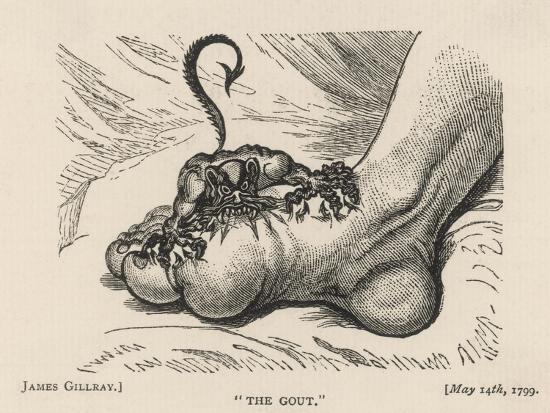 However, one day, when I happened to be in Berlin for a conference, I was suddenly attacked by gout. My father had it before me, but incomparably worse. In him, it started suddenly, like a needle pushed into the joint of his big toe. It was so painful (and he was not by any means a self-dramatizer) that he could not bear for someone to enter the room in which he was lying, in case he disturbed the air around his toe. It was exactly like the famous caricature by Gillray, of the little black devil of gout biting into the inflamed big toe of a sufferer.
My attack was more gradual, less acute. Nevertheless, I had for some days to limp around in a loose sock without a shoe, an attire in which I gave my talk, an oddness which perhaps the Germans thought was normal for the English. The attack meant, however, that there was another pill, a preventative, I would have to take daily for the rest of my life.
I was at first rather proud of my gout: it was, I thought, rather a distinguished disease to have. It used to be associated with the high living of the superior classes, but it has since been democratised: such high living is not confined any longer to the superior classes, and insofar as it is more common among the obese (which I am not), it may soon come to be associated with the lower rather than with the higher social classes.
After an interlude lasting about two years in which I had to take steroids together with two other medications to avoid the complications of taking steroids, I returned to taking only two pills daily, which was below average for my age.
But then, for various reasons, I had my blood pressure taken, which I had resisted for a long time, and it was high, and remained high, so that before long I was taking three pills a day, probably about averaged for my age, though a third (it is claimed) take five or more. No one likes to think of himself as average: everyone likes to think of himself as better or worse than average. This is not completely impossible, statistically, but very unlikely. If two people are five feet tall, and two are seven, then their average is six, but none of them is six feet tall.
Anyhow, reflections on my pill-taking career (I have omitted a few other episodes, for the sake of brevity) caused me to think of a curious fact of human existence, namely that one is only very rarely in life the age that one would like to be. The best that can be hoped is not to think about it. But as soon as one thinks of one’s age, one begins to envy somebody else.
When I was very young, I longed to be older. Older children had more freedom and more pocket money. My grandmother would give me two shillings, but my brother two shillings and sixpence. Talk about the narcissism—in the case, the wounded narcissism—of small differences! Of course, his needs were greater than mine because he did more adult things, but all the same I thought it unfair. In the event, my grandmother died before I had graduated to the larger sum.
How confident fifteen seemed to me when I was thirteen, how much more they knew of the world! My phase of wanting to be older than I was (when I thought about it) lasted until I was about thirty-three, when there started a gradual reversal and I began to envy those younger than myself.
My relationship with my age is peculiar and complicated. I envy the young but I detest them unless they are very nice, which I admit that a minority of them are. Of course, envy and detestation are not polar opposites by any means, and can easily go together. But I envy them for reasons quite different from those of my detestation of them.
When, for example, I walk along the street, as fast as I am able, the young overtake me without even trying. Where my movements are stiff, theirs are liquid. Young men do not have to concentrate in order to pass urine as I now must do, and they have difficulty neither in starting nor stopping. They have much better teeth than mine. But I detest them not for the way they take urination for granted (as I once did), or for their teeth, but for their way of talking, their refusal, or inability, to enunciate their words clearly, for the fact that they don’t read newspapers any more, that their music is ghastly, that they dress so badly, that they eat fast food all the time, that so many of them are tattooed, that they talk and laugh so loudly, as if there were no one else in the world but they, that they have no taste – or rather, that their taste is so bad.
I am, of course, even more annoyed when they stand up for me on the London Underground or Paris Métro. Obviously, they are not very good at judging a person’s age, if they think that they ought to stand up for me. Besides, they are thereby failing to fulfil their most useful function, which is to supply an older generation with one to hate or despise. They confuse matters by being so polite. If there is one thing that the mind searches for, it is not truth but the categorical.
Everyone needs someone to look down on: it is almost a fundamental human right: or if not a right, at least a psychological requirement. Some people, I know, claim to love humanity, but they are not referring to people whenever they make such a claim. Even bird-lovers don’t much care for vultures.
I have reached an age which is a kind of blank space or interregnum. I am old, but not old enough to be venerable. By the time that I am old enough to be venerable, there will be no venerability left, because ninety-year-olds, who were once regarded as extraordinary phenomena in themselves, will be regarded as common as muck. By then, I think. several jurisdictions will have changed the right to euthanasia into an obligation to demand it. Think of all those poor young people, paying taxes to pay just so that I and people like me can be helped out of bed every morning and put into it in the evening! A utilitarian argument for the killing of the elderly can easily be found (Anthony Trollope, rather surprisingly, wrote a satirical novel, The Fixed Period, on precisely this theme, making the age of compulsory euthanasia 67, which suggests how health and life expectancy have changed since 1882, when he wrote it).
I doubt, however, that I shall be very reluctant to die. The things that I have cared for, and still do, will be as mysterious to younger people as, say, the hatred of the Sunni for the Shia, or of intense concern about a particular football team, is to me now. I shall feel that I am living among alien beings, but alien beings upon who I am entirely dependent.
Even so fundamental a thing as the sense of humour has changed. When I was young, we could still laugh at scenes in Charles Dickens (surely the funniest writer who has ever lived), but I doubt that the young could now see what was funny in him, even if they were still able to read more than a screen-length at a time. Likewise, they find things screamingly funny that do not seem to me even mildly amusing; I interpret their loud laughter not as true glee, but as an attempt to persuade themselves, and perhaps others, of something of which they are not themselves convinced. It is not their light that they seek to hid under a bushel, but a hollowness, a vacancy, a despair, that they disguise by the making of much noise.
If this is the case, whose fault is it? If a generation is in a kind of existential despair, whose fault is it that no better philosophy has not been communicated to it? If it is that of the preceding generation, whose fault is it that the preceding generation failed in its duty? We are led inexorably to the Garden of Eden unless we are prepared to admit the fundamental culpability of someone or some generation of people. In my own small way, I must have contributed to the lamentable state of the world.
Table of Contents
Theodore Dalrymple’s latest books are Neither Trumpets nor Violins (with Kenneth Francis and Samuel Hux) and Ramses: A Memoir from New English Review Press.
Follow NER on Twitter @NERIconoclast









4 Responses
A bit of poetry on aging.
Actually, more of a eulogy on getting old. I envy and pity young and vigorous folks. Envy because of their youth and vigor; pity because they are not fully enjoying and appreciating it, even as I did not when I was young and vigorous. But, as to pills: lucky moi, I have made it to 85 and take but one drug, coincidentally, for hypo-active thyroid. As always, I enjoyed your writing.
After a lifetime of curmudgeonly griping about older and younger people, I now find myself in deep sympathy with their predicament. They strangely long for “a past we never lived” like mall culture and 80s music, and have created entire musical genres such as Vaporwave and Mallsoft. They feel denied a future they were implicitly promised–and arguably were, considering the airy optimism of Dot Com era Frutiger Aero digital design. We undeniably had it better in terms of culture, which we allowed to decay progressively.
Nice riff on everyman’s fate. The only thing worse than aging is the alternative.