by Lawrence Winkler (May 2026)
‘There is no gainsaying that the Solomons are a hard-bitten bunch of islands. On the other hand, there are worse places in the world. But to the new chum who has no constitutional understanding of men and life in the rough, the Solomons may indeed prove terrible.’ —Jack London, The Terrible Solomons
One place in the world had embodied (and disembodied) both headhunting and cannibalism. The Happy Isles. My Dreamtime images of the Solomons were all in living colour—sparkling tropical lagoons containing the blackest blonde-haired people in the world, paddling their tall-prow war canoes in a desperate race to rescue crews of engine oil and salt water-saturated American sailors from the next terrible shark attack, or another Jap strafing run. They were Henderson Field and Guadalcanal and thatched huts on stilts, and the castaway of the Southern Sea voted most likely to succeed. As a young boy, I remember assembling and painting the torpedo tubes and curves, on my styrene model of John F. Kennedy’s PT-109 and guiding it through the maze of volcanic British Solomon Islands in my stamp collection. But the archipelago of almost a thousand atolls of orchids and butterflies would be as elusive as seductive.
There was no way I could find to get there. All the flights were indirect and booked up, and the only response I had received from the many travel consultants on the other end of the phone, was stony silence, followed by more questions than I had.
“Where?” One said.
“Why?” Said another. But I was only interested in the How and, after a long painful search, the solution presented itself as a small agency in San Francisco, which had taken their name from one of Mitchener’s books about the South Pacific. I made the call.
“Rascals in Paradise.” She answered. “How may I help?” Maryles listened to our plan and our plight and took control.
“You need to send me all these things immediately.” She said. “There is no time to lose.” I told her where I thought I wanted to visit, but she was having none of it.
“You need to go to Uepi.” She said. I looked it up on my thousand-island map. In the Western Province of the Solomons, in the largest lagoon in the world, was a tiny dot only six hundred metres wide, dropping off two kilometres into New Georgia Sound, four major battles in which had seen some of the fiercest fighting of the war. ‘The Slot’ ended in Iron Bottom Sound, which sunk fifty ships of the allied navies and the Tokyo Express in an expanse of water so sacred, that any vessel passing through still observes strict silence.
Ten days later, the phone rang again.
“There are six bungalows on the island.” Maryles said. “I got you the last one.” We had flight tickets and a destination.
It was all bright white and dark green and turquoise from the air. From the Bougainville Strait north to Tikopia, granular streaks of coral reef shorelines radiated around and out from a thousand miles of exquisite islets, under the cotton fluff below. The view was beautiful. We began our descent over an increasing density of scattered lighter green fields and tin roof reflections and a network of earth-colored roads. A flotilla of large, rusted cargo vessels lingered offshore. Our final approach into Honiara was as fast as any other landing gear that had ever touched Guadalcanal and as pregnant with hope and anticipation.
Two immense carved brown hardwood masks, inlaid with nautilus and covered in dust, followed our slow progress through immigration, inside the terminal. Armed Australian and Pacific island police patrolled the lawlessness and ethnic tension between the resident Guadalcanal Revolutionary Army and the settler Malaita Eagle Force. A dove and the name of their operation were embroidered on their arm patches. Helpem Fren. Debate raged about whether the Solomons had been a poorly constructed state, or one that had failed.
Robyn and I loaded our packs on a trolley tormented by the same question, its only two revolving wheels becoming paralyzed by mud and gravel, on the way to the domestic terminal. We hiked by the Mother Hubbard muumuus and kaleidoscopic umbrellas of an impromptu market, under the red and purple floral genitalia of the banana trees hanging behind them. Crimson betel nut stains splattered the path to our connecting flight, like hospital passageway markers to a trauma ward. Robyn and I passed a billboard that the Ministry of Health had erected.
Stop the (7) Killer diseases
Hepatitis B- Tuberculosis- Diphtheria- Polio-
Whooping cough-Tetanus- Measles
Get immunised and enjoy life!
Of course, there was no vaccine for the other killer diseases of the Solomons—malaria, dengue, chikungunya, filariasis, Ross River and Murray Valley fevers, leptospirosis, poisonous spiders and sea snakes, headhunting and cannibalism, and boarding the Britten-Norman Island Islander, waiting on the tarmac. They had painted it like the flag, with the five white stars of the main island groups in the surrounding blue of the ocean on the tail, and the green of the land and gold of the sun on the undercarriage.
What Maryles hadn’t emphasized was that our destination in the Marovo lagoon had been one of the epicentres of headhunting activity in the archipelago. It was a five-hundred-year-old tradition, revving along in top gear when the first European to visit, Álvaro de Mendaña de Neira, following Incan legends of gold-laden islands 600 leagues to the west, arrived from Peru in 1568. The fleet of welcoming canoes that came out to meet and greet, presented him with cooked pieces of a quarter of boy garnished with taro leaves. Mendaña did discover gold in the interior rivers of Guadalcanal, still mined today, and named the islands after the mythical African king. When one of his more sadistic deputies murdered some of the locals, they massacred nine of his men in reprisal. Mendaña torched every village he could reach and left the islands in ashes. Challenged by longitude, he had also mapped them 700 leagues off their real position, and no one else would find the place for two hundred years.
Headhunting in the Solomons had evolved in culture and purpose, like in Sulawesi, as a superstitious imperative of spiritual protection and physical and metaphysical dominance. Expeditions were undertaken only after the hiama ritual specialists had received approval from tribal ancestors, and participating warriors were abstemious and purified. They converted potential victims into metaphor, ‘wild fish’ or other animals, before their slaughter, and similarities between bonito fishing and headhunting ceremonies extended to their related shrines.
Long-distance raids recruited up to fifty warriors, in up to five canoes almost fifty feet long, to kill powerful rivals, or to destroy entire hostile groups. The beauty and grace of their ocean-going tomakos astounded early European visitors to the archipelago. Their builders constructed them from hand-hewn planks attached by cane ties, lashed onto ornate internal spreading ribs, sealed with tita nut putty. They inset both the sky-high vertical prow and stern posts with inset with mother of pearl and bleu ovalum, each surmounted by a pair of spirit figures, looking out, and after the welfare of the canoe and its crew, in all four directions. No two were decorated in the same way.
The most remarkable sculpture was the nguzunguzu, a carved dog-human hybrid figurehead with protruding jaws, painted black and ornamented with inlaid nautilus shell, with either a skull or a dove in its paws, depending on the ill or goodwill of the mission. Mounted near the waterline on the prow, it dipped in and out of the water, picking up spiritual momentum, and guarding against hostile water spirits.
For the va-peza launching of a war canoe, tribes took and carried heads on the maiden voyage, to prevent any tamu garata malediction. They took others for the inauguration of a new communal house, to commemorate the death of a chief, or to release widows from confinement. Headhunting raids also captured children for work and purification sacrifices, and young women for labour, ritualized sex and marriage.
The earliest accounts of such activity began in the 1840s. The sandalwood trader, Andrew Cheyne, reported large numbers of heads taken in these raids, 93 from one attack alone. The situation calmed over the next ten years, during a period known as the ‘Great Peace,’ but headhunting would explode into another far eviler dimension, accelerated in scope, frequency and ferocity, with the destabilizing arrival of more Europeans, with iron axes and other metal tools, and shell ornaments to trade. Human heads went from icons of religious reverence to currency.
Local rivalries that had driven neighborhood brushfire conflicts within the Marovo lagoon, expanded into distant political warfare, as far as Guadalcanal and Isabel. Pressure intensified on every coastal chief to amass large amounts of nibaka war-chest shell money, to finance competitive mercenary expeditions, in an arms race of heads, slaves and human protein, and children for sacrifice. The southern coast became so depopulated and terrorized that the remaining natives built sheltered in tree forts. The supply of ‘currency’ became scarce, commodity prices inflated, and headhunting raids increased to meet demand.
Bad enough that white traffickers had provided the metallic material means for the headhunting wars to escalate, it was far worse that trading ships were involved in the taking and buying and selling of human heads. In 1868, a Scottish sailor from Stromness became a latter-day shipwrecked castaway Robinson Crusoe mascot of the offshore ‘salt-water people,’ escaping the malaria-infested jungles of Malaita. Lost to Arcadia and Orcadia, John Renton became a white headhunter of the ‘bush people’ cannibals who inhabited the main island. A blackbirding ship involved in this new kidnapping form of trade, in the Solomon arena of death and deprivation, rescued him eight years later. He landed in the New Hebrides, where he lost his head. The Queenslander ‘snatch-snatch boats’ whose cargo didn’t end up on some remote Peruvian guano island, found themselves working for a new class of white settlers, owners of vast independent plantations of rubber, vanilla, sisal, or cocoa.
The most pernicious white headhunters arrived in the mid-19th century. Approximately a hundred missionaries, Anglicans, S.S.E.M., Methodists, Catholics, and Seventh Day Adventists, came to steal the souls of these multitudes of little brown folk … the wild creatures of the woodland.
The most famous was an Anglican priest named John Coleridge Patteson, son of the niece of the poet Samuel Taylor Coleridge, author of The Rime of the Ancient Mariner. The albatross around his grand-nephew’s neck was an appointment as the first Bishop of Melanesia, a servant of God for the inhabitants of hundreds of hostile islands, scattered over an area of almost two thousand miles of ocean. He tried to be fun and went barefoot. Patteson was the founder of the Melanesian Mission on Norfolk Island. On each one of his new spiritual possessions, he swam ashore, emerging from the surf wearing only a top hat, bringing presents for his people. On one of them, finally, in Santa Cruz, the locals killed him with poisoned arrows and ate him. Some claimed that it was some form of blackbirder’s revenge, for his antislavery activities. Whatever the reason, they outlawed blackbirding and headhunting and cannibalism because of him, and the Solomons became a British protectorate in 1894.
A Gilbert and Sullivan hierarchy of clumsy colonial caricatures, as inept an administration as could be found in any other tropical outpost of the Empire, governed the Solomons. Ritual, whisky, and quinine held their miniature fantasy world of isolation, infirmity, and intense humid heat together. It was all very pukka. When Jack London visited the islands in 1908, cruising the Southern Sea on his boat, the Snark, he wrote of both the Melanesians and their masters.
‘It is true that fever and dysentery are perpetually on the walk-about, that loathsome skin diseases abound, that the air is saturated with a poison that bites into every pore, cut, or abrasion and plants malignant ulcers, and that many strong men who escape dying there return as wrecks to their own countries. It is also true that the natives of the Solomons are a wild lot, with a hearty appetite for human flesh and a fad for collecting human heads. Their highest instinct of sportsmanship is to catch a man with his back turned and to smite him a cunning blow with a tomahawk that severs the spinal column at the base of the brain. Heads are a medium of exchange, and white heads are extremely valuable. Very often a dozen villages make a jack-pot, which they fatten moon by moon, against the time when some brave warrior presents a white man’s head, fresh and gory, and claims the pot… and yet there are white men who have lived in the Solomons a score of years and who feel homesick when they go away from them. A man needs only to be careful—and lucky—to live a long time in the Solomons; but he must also be of the right sort. He must have the hallmark of the inevitable white man stamped upon his soul. He must be inevitable. He must have a certain grand carelessness of odds, a certain colossal self-satisfaction, and a racial egotism that convinces him that one white is better than a thousand niggers every day in the week, and that on Sunday he is able to clean out two thousand niggers. For such are the things that have made the white man inevitable. Oh, and one other thing–the white man who wishes to be inevitable, must not merely despise the lesser breeds and think a lot of himself; he must also fail to be too long on imagination. He must not understand too well the instincts, customs, and mental processes of the blacks, the yellows, and the browns; for it is not in such fashion that the white race has tramped its royal road around the world.’
Unfortunately for the inevitable white man, the mental processes of the yellows would trample his royal road. Over two hundred days in 1942, some of the most desperate and ferocious fighting in history took place in the Battle of Guadalcanal. Beneath our Britten Norman Islander, on the steep flanks of Bloody Ridge and the dark forested mountainous interior, the invaders killed or wounded over 3600 Americans. Of more than 36,000 Japanese soldiers that had fought on Guadalcanal, the US killed some 26,000, captured only a thousand, and left 9,000 to die of malaria or battle fatigue. Still scattered among the taro patches and banana leaves below, were the boots and bones and guns and grenades and helmets and heroism where they had fallen.
We landed at the southernmost tip of New Georgia, on an airstrip carved out of the jungle by the Americans in ten days. Welcome to Seghe. Someone had painted a shack on the side of the runway in vertical blue and white stripes to identify it as the terminal. The blue and white checkerboard shack that stood beside it had been painted to identify it as the police station. No one was home at either one. But there was no shortage of older Mother Hubbards and shirtless pikininis, porters lifting cargo onto their heads, the blackest people in the world, some with the blondest hair, motioning for Robyn and me to follow them down the hill to their canoes.
But no graceful hand-hewn tomako masterpieces, with inlaid skyscraper prows and sterns, waited there on the shore. Instead, we had two long aluminum dugouts, each equipped with a Johnson 40 outboard. We were hardly seated, before it sped off into the Marovo lagoon, throwing choppy swells of salt chuck in painful large plumes at our faces. We were soaking wet and bruised within minutes, and there was still another twelve kilometres to travel, at the speed of iron bottom sound.
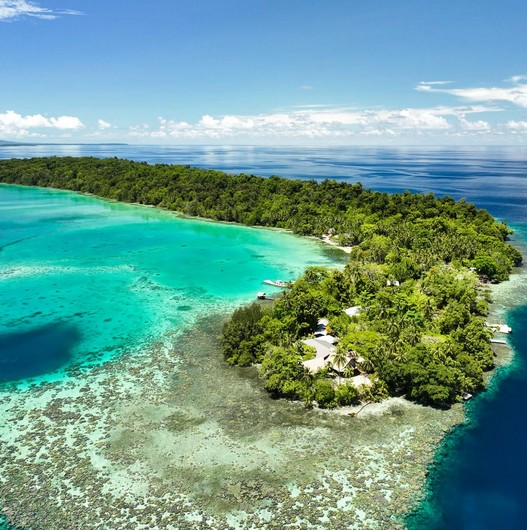
Finally, when our waterboarding wake subsided, we came to a blue and white curved sign at the end of the pier, on a curved emerald island of coconut palms. Welcome to Uepi Island. The rows of white teeth were dazzling.
Solomon time we stop to chat
Solomon breeze we try to nap.
Solomon air we have to wait
Solomon tastes are fresh and great
Solomon shores jungle like and green
Solomon seas calm or choppy and 32 degrees
Solomon locals big smiles, eyes shy
Solomon smells frangipani doesn’t lie.
—————–—Robyn Winkler, Solomon Time
***
‘If I were a king the worst punishment I could inflict on my enemies would be to banish them to the Solomons… On second thought, king or no king, I don’t think I’d have the heart to do it.‘ —Jack London, The Cruise of the Snark
Jill was at the Jetty. She didn’t seem to care much about the blacktip sharks, swarming around our canoes, as we extricated ourselves. The description from Maryles had been accurate. Sites close to the Resort are highly populated with marine life and always exciting.
Giant porcelain clam shells, filled with red hibiscus and ginger flowers and white spider orchids and rainwater and suffused alabaster light, received us onto a small tropical island of meandering paths through cultivated gardens, butterflies and flowers, the rainforest behind, and six thatched bungalows stretched out along the sandy beach of the calm lagoon. It was the only place I had ever been, where orchids lined the trails. A postcard would have combusted. It was stunning.
A torrent of abuse in sharp Australian for the porter who had contaminated Jill’s dock with a fresh blood orange splash of betel nut fractured the tranquility. She welcomed the rest of us, taking special care to make us feel at home. We sat in the open dining room, and met the other guests from our canoes, for the first time. No one had said a word on the way over, so mesmerized by the magic of the motion, and the scenery, and the spray. A quiet middle-aged British couple had come for the diving. No one who had come this far out in space was here for anything other than the diving. Except for the tall man with receding grey curls, large hands, and big round eyeglass lenses wrapped in faux turtle shell frames. He spoke with a Midwestern accent tempered by his Brussels address and intellect. What Kevin didn’t know about Melanesian art and ethnography, or Southern African cultural pieces, double bass playing, or any one of several other eclectic disciplines, would need you to abandon the rest of the sentence. His gentility and knowledge and passion for his purpose here were infectious, and I soon found myself developing my enthusiastic appreciation for the elemental aesthetic subtleties of our surroundings. He had arrived with his English wife, Anna, and their young son, Max, who would celebrate a young birthday in the Marovo lagoon, as any son of such a man should. Jill’s husband, Grant, appeared to round off our welcome, and a silent employee walked Robyn and me to our bungalow and abandoned us to our own and surrounding nature.
Like the complexion of any other island in the Southern Sea, Uepi was not a paradise without some minor blemishes. Blackish green and gold speckled Varanus indicus mangrove monitor lizards, four feet long and as big as basset hounds, protruded their long purple tongues and serrated teeth into the open door of our bungalow until we closed it. I watched one dislocate its jaw one morning, to swallow a rat the size of a rabbit, when I went out to fetch our breakfast off the veranda. The Japanese had introduced them into the Marshalls during WWII, to get rid of the rats. They did such an initially admirable job, they ran out of rats and started in on the local chicken coops. When the Americans arrived, they introduced the poisonous cane toad to get rid of the monitors. As the lizards died off, the rats came back with a vengeance, with the result that the Marshalls now have an infestation of both rats and cane toads. A similar introduction of cane toads into Palau resulted in the demise of the monitors, and an explosion of beetles that damaged the coconuts. But there were no cane toads on Uepi, and the monitors thrived on the leftover scraps from the resort when they ran out of rats. You had to get up early in the morning, to beat them to your breakfast tray, delivered under a talisman of tin foil by three lovely black ladies, in flowered lava lavas and t-shirts.
The coconuts were healthy as well and waited for unsuspecting guests to wander underneath, before releasing their lethal cargo. Sometimes they had no choice when the daily cyclonic squalls blew in and juggled them through the torrential turbulence. There were large spiders, in every available area between the boughs, Gasteracanthan spiny spiked orange-red monsters and Golden orb spinners, web silk as strong as Kevlar, and used by both the spiders and the local boys to catch fish. There weren’t enough of them, and no amount of repellent on earth, to make a dent in the biting flies and midges and mosquitoes that greeted us at dusk. But so did the musky post-coital smell of ripe and rotting papayas and tropical compost, and the black and white silhouette of curving coconut palms and pandanus huts, before it went sepia, and the colors kicked in.
Orange smoke and purple cloud sunsets would follow us to the dining room, after I encountered Kevin down at the shore, to admire the clear lagoon and mountainous island backdrop beyond. The Soltai No 3, a rust bucket oil-streaked trawler, held together with iron oxide and humidity, rumbled past, like a Solomonian Heart of Darkness version of the El Caleuche ghost ship of Chiloé. He asked if Robyn and I wanted to join him next morning, on a tour of the lagoon in a quest for experience and artifacts. I formed a mental image of a nguzunguzu, mounted near the waterline on the prow so that it was dipping in and out of the water, picking up spiritual momentum, and guarding against hostile spirits, with each stroke of twenty paddles.
“Headhunting.” I said. Kevin nodded, and we went for mud crab. Before the moon began its ascent over the lagoon, the stars had already lit up the night sky.
They were feeding the sharks off the welcome landing next morning. I asked one of the bucket boys where we could go for a swim.
“Here.” He said. “But later.” Kevin and Robyn and I motored off into the deep aquamarine and turquoise Venetian glass of the lagoon, between arches and spumes of salt spray, fanning high above the gunnels behind us. Mountains loomed on the horizon, and islets of white sand circumferences and green interiors danced out of our way until one of them didn’t.
Sago palm leaf huts with double-sloped roofs, rising off stilts on coral foundations, with square thatched shutters held ajar by sticks, faced the lagoon to catch the air. Among patches of taro and yam and cassava, hard-won from ancient Melanesian rainforest, giant trees ran up the slopes, in exchange for the children of the village running down. Coconut trees waved to us from the top of the island above the church. Three girls in identical purple clothing hoisted the paddles of their canoe in greeting, and another thirteen villagers went by with the same enthusiasm, crammed into a vessel half that size, but blessed with antique two-stroke propulsion.
As the shoreline approached, I looked down into water so clear, it appeared like we were hanging in space, and I gripped the gunnels tight until the vertigo gave way to more shallow marvels. The range and diversity of the corals were astonishing- staghorn, huge rust-coloured tabletops, spikes radiations of Acropora, crusted spheres of Fuschia and green, and rippled brains, on the prow of the canoe. A flashball of blazing yellow fish discharged through another group of metallic blue lightning, both pausing beside us, to consider what had happened. Out of the corner of my eye, I caught a similar stampeding chaos of dark children on land, dancing limbs and blond and black hair, laughing and shouting and rampaging down the beach, pale soles shooting sprays of white sand in every direction.
Between a jagged cut in the world’s largest tropical aquarium, we glided onto the grinding crunch of sand, and looked up to rows of little black feet, white toes underneath, greeting us on the dock. Kevin wiped the salt from his glasses.
“It’s amazing how the blackest children can have lemon cotton candy for hair.” Said Robyn.
“They have more melatonin than anyone else in the world.” I said. “But about ten percent of them have this strange TYRP1 gene which gives them blond hair. It’s completely indigenous, and has nothing to do with any European contact.” A very young girl with flaxen frizz, sat under a nearby tree, holding a snot-nosed baby wearing a single sock. Both were chewing sugarcane. A quintet of older boys, led by one with obvious Chinese ancestors, guided us along village paths lined with thatched huts, up the hill to the church. The lines of laundry were as colourful as the flowers. One particularly long string of suspended singlets was as bright white as the teeth of their owners. We passed a fresh raised bed with black soil, lined with coral rocks and coconut wood, and decorated with bouquets of birds of paradise, ginger, and orchids.
“Dead.” Said the small Chinese boy.
“Dead.” We agreed. The boys pointed out a small wooden shed, painted with English letters. Neuclear Power Station four stroke power and intake.
“Generator.” Said the small Chinese boy.
“Generator.” We agreed. At the top of the hill, a small pikinini with buck teeth and checkered shorts played his ukulele for Robyn. She played it back to him, to his surprise and delight. Our guides took us into the church and leapt onto the benches lining tables covered with mauve plastic tablecloths and matching plastic flower bouquets. Kevin found a bass guitar and a groove. When he found the conch and its high note, the rest of the village children appeared. One young girl, wearing pink jodhpurs and carrying a red flower as big as she was, stole Robyn’s heart. Her younger brother stood naked on a vast expanse of sage green moss, almost Florentine in the Michaelangelic majesty of his pose.
We walked along other paths, of other lives. A small puppy was busy eating the last dried strands of sinew, deep inside and out of an overturned turtle shell that dwarfed his shadow. The old woman sitting cross-legged on her dirt floor, sewed leaves into a wall panel between her pendulous breasts, punctuated by grim-faced puffs on her pipe, between stitches.
Kevin’s networking, by now, had unearthed several finds. He peered with intent through his thick goggles, a kultural Keplermaniac, studying the surfaces of heavenly objects. We looked with him but failed to see the nuances that a lifetime of passion and brilliance could discern. He considered a blackened model of a skull house, and a volcanic stone mortar cut in half by the strong shadows of the afternoon sun, before rejecting them both as less worthy. Then, the chief arrived, all skinny with an oil-stained red T-shirt and sunglasses, and something more special. It was a black head, inlaid with nautilus, holding a dove underneath.
“The village nguzunguzu.” Kevin said. “Not that old, but a lovely piece of folk art.” He said it would be a good start to a collection and, if it interested me, he would help with the negotiations. I looked at Robyn. She was quiet. I nodded. The bargaining began and ended in less than a minute, for more than I thought I would pay. But Kevin reassured me that the price was fair, and going to a good cause, and there was no going back. We returned to our canoe, suspended in the air on the lagoon, and waved back to Uepi.
Grant joined us for dinner that evening and provided his insights on running a resort in Marovo lagoon, the bizarre corrupt politics of the Solomons, and how Japanese logging companies had been barging in white vinyl-sided plastic houses to give to local chiefs, in exchange for entire rainforests.
“The timber trade is brisk.” He said. When Kevin asked about wild pigs, Grant told us that he would be sending out several men and dogs the next day, on a hunt. I indicated that I would appreciate an opportunity to go with them.
“It’s a young man’s sport.” He said. And that was that.
The next morning, after beating the monitors to breakfast, Robyn and I decided to find the beach side of Uepi. The trail began at the sign beyond the last bungalow, and the last incident light. Forest. The arrow underneath seemed a bit superfluous.
We soon found ourselves in near darkness, under a large canopy of unpronounceable hardwoods, although I recognized the walking palms and rocket fin roots of buttressed figs. Their bark patterns were fantastic and varied, from horizontal lines to splotches to convolutions, some streaked with powdered termite tunnels, reducing the forest, and the houses made from it to dust. There were orchids and fungi, and ant plants, spiked greenish grey hedgehogs, with leaves growing out of their noses, dangling from some of the trees. In exchange for a safe home in small purple high-rise rooms in the sky, some species of ants act as undertakers, making nocturnal forays to the forest floor, returning with the carcasses of other insects, and dropping them into other spaces to rot. Mushrooms growing inside the ant plants, release nutrients that nourish the internal rootlets of the epiphytes. The ants get a home, the plants get their daily bread, and the mushrooms get another generation. It’s a three-way symbiotic win, soon to disappear with the last white plastic house delivered to the last black chief.
But until then, Robyn and I felt at home in the forest, watching golden whistlers and olive-green white-eyes and honeyeaters in the canopy. A raucous commotion broke out above us, in a flock of emerald male Eclectus parrots, red flashing under their wings, as they flew among their blue and crimson female partners. A birdwing butterfly the size of my hand flew random tremors in the high branches, in a search for nectar. The beach and snorkelling on the coral shelf on the other side of the island were in the clearest water in the world, with lionfish and white and black banded sea snakes, far too many sharks, and magical.
The sunset turned the bottle of chardonnay more golden. Robyn wore a blue dress and a frangipani behind her ear. It was Christmas Eve, and the turkey came with stuffing, and the stuffing came with more stories from Grant.
I went diving with the British couple next day, while Robyn lazed in the hammock. Before my faulty regulator ran me out of air, fifty feet down, I floated in awe of the reef jewelry but, again, especially the sharks. The islanders believed that their dead ancestors lived in their sharks, as did the descendants of American sailors before they could be rescued. But in the Solomons, there were more people killed by pigs than sharks.
Kevin’s son Max’s ate birthday cake that night topped with seven candles surrounded by an orchid and frangipani heart, and guitar accompaniment.
We left Uepi next morning. I could sense the nguzunguzu in our pack, wanting release onto the prow and into the water, but Robyn and I were picking up enough picking up enough spray and spiritual momentum, for the three of us. We arrived at the Seghe airfield early enough to work up a thirst, sitting beside the fat women with the umbrella. Her two pikininis climbed into the trees to get us green coconuts, after they had tired of tormenting the huge ground boa they had found lying in the grass behind us. It was so hot even the green skinks were slow enough to catch. When the old twin otter with completely bald tires finally landed, we were more than ready for airborne. The biggest sign in the cabin didn’t have much to do with safety. It is forbidden to remove life jackets from this aircraft. But we couldn’t see much of it, for the fumes. Every so often the smoke would clear, and we could see the hundreds of turquoise gems below us, in The Slot.
A little over a year after we left Uepi, a major 8.0 Richter magnitude earthquake struck the Solomons, causing forty-four aftershocks, the death of 52 people, the loss of thousands of homes, and a thirty-foot tsunami. Mounted near the waterline on the prow, it picked up momentum and left many once pristine coral reefs exposed on newly formed beaches.
***
‘Honiara, as I quickly discovered, is the unsightly boil in the navel of an otherwise dazzling, seductively beautiful Solomon Islands.’ —Will Randall, Solomon Time
It was born in war and sustained by violence. The airport we returned to had been wrestled from the murderous Battle of Henderson Field, a grenade’s throw from the other extremes of the Guadalcanal campaign. It was an appropriate description. The big boom box in the back of our station wagon taxi announced our arrival, past the storefronts of Xtreme Meats and Xtreme Haircuts, on the way to our hotel. Cannibals and headhunters. We were grateful for the big red air freshener, dangling from the mirror.
The name of the capital sounded so musical and mellifluous, it was forgivable to think of it as a Southern Sea idyll. But Honiara, christened either from Álvaro de Mendaña’s hometown, Wadi el Ganar, or derived from Nagho ni ara, ‘Place of the East Wind,’ in one of the Guadalcanal languages, was no palm tree paradise. What had been a small village, not fifty years earlier, not only was one of the few places not liberated by all it had sacrificed during World War II, but it had also continued to paddle itself through a sequence of cyclones, and into other turbulent backwater vortices of political unrest and ethnic bloodshed and rioting. Fighting between the Malaitans and Guadalcanal natives resulted in a coup attempt less than five years before Robyn and I appeared, the murder of two New Zealand diplomats and several others, and the consequent need for Australian military and police intervention, just to restore order.
Our rap-thumping boombox bounced in and out of betel-stained potholes through blocks of tumbledown decay, past the wildest-looking people on the planet. They looked fierce, feral, ferocious, with chaotic hair on top, immense bare feet on the bottom, and tattoos and trauma and torn threads, in the middle. They were dirt floor poor, but in their world, between the fighting and drinking, there were still large remnants of small village kindness.
“Yu orait?” They would ask. And mean it.
Our boombox pulled up at the big Welkam sign, at the wide-open entrance of the King Solomon Hotel. Beautifully carved poles supported the Leaf Haus thatched foyer ceiling foyer. The staff greeted us with welkam drinks and the reassurance of a 24-hour reception and security desk and our location across from the Police station and the Australian Consulate. The logo was encouraging. Home away from Home.
It wasn’t quite like home. The mosquitoes from the tiny pool were fierce, feral, and ferocious. The security guards doubled as bellboys. Larger-than-life-size painted kitsch concrete fantasy figures occupied every nook and cranny—Donald Duck by the pool, and then an angelfish, a clownfish, a mermaid, and an orchid, each more garish than the other. Breakfast would be flyblown and inedible, and the instant coffee was an archeological dig of fused ancient bricks. The wooden funicular fastened to the hillside and built to take us to our room, didn’t. The lock on our door had seen too many surgical interventions, the nonfunctional air conditioner was as loud as a lawnmower, and in place of a toilet seat or toilet paper, the toilet had a sign. Gud wata toelet helt. Another notice on the bathroom mirror advised against drinking the water.
But the water outside was Iron Bottom Sound, containing sixty ships and thirty thousand dead sailors, and we were doing fine. The Bamboo Hut downstairs did a mean poison in buerre blanc and crayfish Mornay, with tomatoes carved in the shape of roses.
I shook the hand of the security guard, far too thin for his uniform. He wore a banana-colored shirt and brown tie, banana-striped brown pants, and brown and yellow striped Aussie bush hat. He couldn’t see out from under the size of it. Robyn and I left for the market and made the mistake of walking along the sound, to the sign on a nearby movie theatre marquis. Showtime. The show hadn’t changed much in half a century. The shoreline was all damp shadows- people defecating near the waterline, dead bloated pigs washed up on the beach, mosquitoes, and rubbish and untreated sewage. Sitting at anchor was the thick blue paint and rust of the Hamakyo Maru and Arrow Endeavour, less heroic spawn from the wreckage beneath them.
As we approached the market, pijin billboards advertised soda, Hem nao diringi coca Cola Distaem, and cigarettes. Simoka save spoelem lang bilong iu- Gafman helt woning. There should have been a government health warning at the central market entrance, to give a wide berth to the scary muscle-bound monster with the wild frizz hair and beard-framed face carved out of briarwood, the one wearing the open snakeskin shirt with the bright pink towel around his neck, the one who glared. We moved away to patches of red yams and green plantains, little piles of ngali nuts and crab claws, and mountains of watermelons. The women waved cloth whisks, keeping the flies off the fish, and the absolute need to be there, keeping the smiles off the women. But the depression and oppression of the market soon lifted, as we arrived on the market streets of Chinatown.
Here were quiet lanes of small shops, their frontier facades painted with amateur renditions of the goods for sale within. There was hardware and electronic goods and items of clothing in primary colours, and the names were almost enchanting.
Happy Day Shop… Beautiful Shop… New World… Red Sun shop… Abundant Life- fresh meat and Christian books… H.Q. Shop… Six Plus Enterprises…Baby Blue Store…Chase Wholesale…Ox and Palm…John Tom & Sons, exporters and buyers of wet and dry cocoa… Bridal Corner… Please Babe give me a chance… Buyers of: bech de mer & shark fin… Oriental Cuisine-licensed to retail fermented and spirituous liquor for consumption on the premises with meals. Something not quite tame, not the same as wild, hung on the air here. Anything you needed for fine Guadalcanal living was available- aluminum cookware and kerosene lamps, spam and corned beef, dried shark fin and tinned lychees, and laundry soap and plastic buckets. Robyn and I stopped into an air-conditioned teahouse, near Lydia’s Christian Academy (Thank you and God bless us), for the air-conditioning.
The Japanese shop across the street was offering to buy endangered dolphin teeth or giant clams or turtle shell. The harshness of what Admiral Halsey ordered painted on the rocks above Tulaghi harbour seemed to echo in the heat. Kill Japs, Kill Japs, Kill More Japs.
But it was the Chinese that were about to lose everything. Four months after Robyn and I left Honiara, the natives razed the Chinatown we had found so beguiling to the ground. They reduced the commercial heart of Honiara to rubble and ashes. They accused the newly elected Prime Minister, Snyder Rini, of using bribes from Chinese businessmen to buy votes from members of Parliament. Two days of rioting displaced a thousand Chinese residents, who lost everything. Housed in Honiara’s main police station, China sent in chartered plane to evacuate them from the Happy Isles. Jack London, for all his punch-drunk racist views about the ‘yellow peril,’ may have provided them a warning about the echo in the heat…to the new chum who has no constitutional understanding of men and life in the rough, the Solomons may indeed prove terrible.
‘I was just telling Mr. Arkwright that there are no antidotes for native poisons.’
‘Except gin.’ said Brown. —Jack London, The Terrible Solomons.
Table of Contents
Lawrence Winkler is a retired physician, traveler, and natural philosopher. His métier has morphed from medicine to manuscript. He lives with Robyn on Vancouver Island and in New Zealand, tending their gardens and vineyards, and dreams. His writings have previously been published in The Montreal Review and many other literary journals. His books can be found online at www.lawrencewinkler.com.
Follow NER on Twitter @NERIconoclast









One Response
My uncle, Stewart McLean was killed in the Solomon Islands while serving with the US Marines. I have his war metals. Thank you for the vivid description of where he now lays. I knew of you in NRGH Keep livin’ the dream Wink 🍷