By Rabbi Yehoshua Mizrachi
As the details of the Memorandum of Understanding (MoU) between the United States and Iran emerge, it has many of the hallmarks of the Oslo Accords.
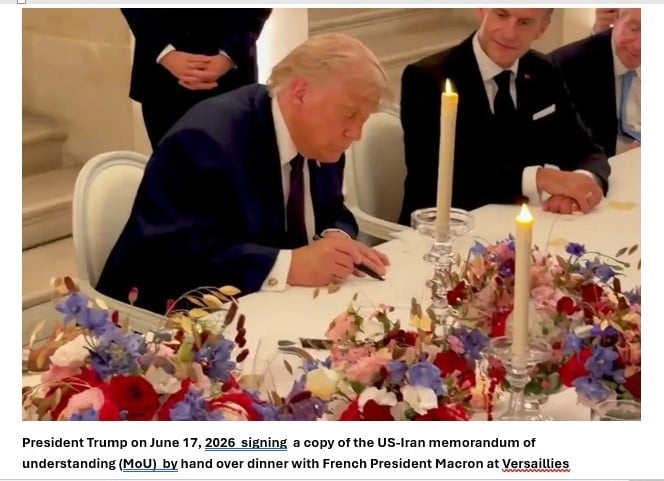
After months of haggling, the sides can only agree to disagree, just like Oslo. The solution? The “Zipper Theory. “
Imagine trying to wiggle into your tight jeans. You lay on the bed, suck in your gut, and get the first two teeth of the zipper to lock. Once the first tooth engages, it pulls the zipper edges a drop closer, making it easier to get the next tooth locked. And so on until the zipper is closed.
In 1993, the PLO and Israel could agree on nothing, the positions were too far apart. So, they agreed on the zipper theory: de-escalate tensions, sweeten the pie with financial incentives for compliance, and put off the thorny issues for a later time.
Ask the 1500 Israelis who were murdered during the Arab Uprisings 1993-2010 how the Oslo Accords worked out for them. The zipper never zipped.
The Memorandum of Understanding is structured the same way. There are no concessions on the part of the Iranians. To the contrary, they are defiant, insulting, and unbroken, to the point of claiming victory over the United States. Yet, like the Oslo Accords, the MoU incentivizes their recalcitrance by lifting the blockade, sanctions relief, and the releasing of Iranian assets in UAE and Qatari banks – all of this before substantive negotiations begin. It is a formula for disaster.
Mr. Trump, facing an unpopular war and limited congressional support, was desperate for an easy “off-ramp,” and this MoU was the best deal he could get, which is to say, no deal at all.
It did not have to end this way. Mr. Trump made three catastrophic errors in the prosecution of his war against Iran.
First, he failed to make the case for war to the American public. There should have been a “My Fellow Americans” speech, televised nationally from the Oval Office. In that address, Mr. Trump should have made the case directly to the American people that Iran was the 21st century equivalent of the Nazis.
He could have educated the American people that Iran, like Hitler’s Germany, has a charismatic dictator who enjoys the unquestioned devotion of hundreds of thousands.
- Like the SS, Hitler’s Praetorian Guards, the Iranian regime has the IRGC.
- Like the Nazis, the regime questions the ideological purity of its standing army and sidelines them.
- Like the Nazis, the Iranian regime has murdered tens of thousands of dissidents and incarcerated tens of thousands more.
- Like the Nazis, the Iranians are determined to finish what Hitler began and wipe the Jewish people from the face of the earth.
- Like the Nazis, the Iranian regime is developing longer range and more accurate ballistic missiles, which will eventually have the range to reach all of Europe and the US.
- Like the Nazis, the Iranian regime is determined to develop the ultimate weapon of Jihad, a nuclear bomb with which to blackmail the world.
- And like the Nazis, the Iranian regime is prepared to die to the last man for their apocalyptic vision – in this case, of a world subject to Sharia Law and the coming of the Twelfth Imam.
The parallels between Nazi Germany in the 20th century and the Iranian regime in the 21st are extraordinarily strong, yet the contrast between popular American support for war against the Nazis and the war against Iran could not be starker. One can imagine that if Mr. Trump had made a compelling case for war, he might have had more support for temporarily higher fuel prices and more freedom of military action to see the war to its conclusion. Mr. Trump may be many things, but a consensus builder he is not.
Second, he conceded the Strait of Hormuz to the Iranians.
The United Nations Convention on the Law of the Sea (UNCLOS), a convention to which Iran is a signatory, designates five key maritime zones, including a 12 nautical mile territorial sea limit. In a nation’s territorial sea, it has sovereignty over the airspace, water column, seabed, and subsoil, though foreign ships are granted the right of “innocent passage.”
The Strait of Hormuz is bounded on the north by Iran, on the south by Oman and the UAE. At its narrowest, the Strait is only 21 miles wide, too narrow for all three countries to claim their 12-mile territorial sea rights. UNCLOS contains a mechanism for addressing these disputes.
International law uses the median line principle, where the demarcation line is exactly equal in distance from the nearest coastlines of both countries. According to international law, then, Iran can only claim the northern 10.5 miles of the Strait as its territorial waters, while Oman can claim the southern 10.5 miles at the narrowest point of the Strait.
The are only two exceptions to this rule: (1) if one country claims historic title to the entire waterway without objection of the other nation; (2) or if unusual geographic features (like tiny islands, jagged coastlines, or critical shipping channels) make a strict middle line unfair or impractical.
Neither of these specific exceptions apply to the Strait of Hormuz. The Strait of Hormuz has a depth ranging from 200 to 330 feet (60 to 100 meters) across much of its width, with the deepest sections dropping to over 650 feet (200 meters) near the Omani coast.
All the foregoing begs the question: on what basis does Iran consider the entire Strait to be its exclusive territorial waters? Why are the UAE and Oman not defending and protecting their territorial rights to the lower half of the Strait?
As a mariner experienced in international maritime travel, one must ask: why were the bottled-up ships not transiting through UAE and Omani-controlled waters to the south of the Strait, outside of Iran’s legitimate territorial demarcation, the median line between in the Strait?
It is most remarkable that Iran claims to be blocking innocent passage of international maritime traffic through the entire Strait, in direct contravention of international law, and without objection from the affected countries, including the United States.
By conceding the entire Strait as Iranian territorial waters, without a basis in international law, the United States handed Iran a major leverage point. Had the United States routed international shipping under military escort through the southern Strait, Iran would have been stripped of its ability to control international traffic in the Strait.
Lastly, Mr. Trump and his administration have made much of the fact that the MoU is performance-based, and that the United States will not be duped like the Obama administration with the JCPOA in 2015.
Iran has one strategic goal: to survive the Trump administration. Therefore, performance benchmarks are exactly what the Iranians want, because they now control the progress of future discussions. Dragging out the discussions for years gives the regime coverage to achieve nuclear breakout. Just like the PLO and the Oslo Accords, the Iranians are now in the driver’s seat. The world will come begging for them for compliance to avoid another war.
The Iranians have us right where they want us. Mr. Trump has fallen into Iran’s obfuscatory trap.
The Western democracies had the ability to stop Hitler in 1935 and again in 1938 and prevent World War II. They failed to act.
Mr. Trump had the opportunity to be remembered by history as the president who stopped the 21st century Nazis and prevent World War III. In this he failed.
“You were given the choice between war and dishonour. You chose dishonour, and you will have war.” Winston Churchill to Neville Chamberlain.
__________________________________________________________
Rabbi Mizrachi is the Rav of B’nai Israel Synagogue in Pensacola, Florida, and the author of Holistic Judaism: A Radical Rethinking of Our Service to Gcd and our Fellow Man in the Messianic Age. Available on Amazon.com and Kindle. He can be reached at [email protected]. (The views expressed above are only the author’s.)







One Response
With all due respect to the rabbi, 2026 is not 1935 or 1938 and Trump is not either Hitler nor Chamberlain.
Trump had a stark choice: continue the war with Iran and drive the planet to a global economic depression. Such an economic catastrophe would certainly have resulted in more wars. A global depression could not be allowed – So Trump ended the war.
The US war aims were to destroy the nuclear program and capability of the Iranian regime and then negotiate with those threats nullified. It was also to help Israel with their completely legitimate defense requirements.
The idea is for the Iranian people themselves to do regime change, not the United States. The United States will not invade Iran – the Iran/Iraq war of the 1980s determined that.
Trump also exposed our fake allies as almost universally pathetic and useless with only the extraordinary exception of Israel.
Trump exposed NATO as a pathetic shell, an empty useless money hole for the United States to ensure the security of our fake allies as they spend gazillions on socialist, commie, anti-American, antisemitic governments and projects. Those days are done.
Trump is an innovator; Israel and the region and the world need a new approach with horrible countries like Iran. The old ways of dealing with them have been unsuccessful and exceedingly painful for Israel and the West in general. Those days are done.
Now that Hormuz is open it is clear that the value of Hormuz is now ZERO.
Another method of moving oil from that region – a method and path that is not under threat of interdiction and attack from Iran must now be created. Hormuz is the only leverage of the Iran regime ; when an alternative is built and Hormuz is nullified then they will have none.
This conflict has been difficult to follow and difficult to deal with because there is no definitive end.
It should be repeated that the nuclear project of Iran is no more; the leadership cadre of Iran is no more; their air force, navy, and anti-aircraft defenses also are gone.
China and Russia stayed neutral because Trump requested that they do so.
This is a completely different geopolitics/realpolitik – it’s fundamentally pragmatic and has long-term goals.
I say, with great respect, to the esteemed rabbi, sir, please be patient.