By G Murphy Donovan
“God created war so that Americans would learn geography. “ – Mark Twain
A previous Artificial Intelligence supported assessment on these pages re Hormuz Strait security requirements by @GMmurphyDonovan1 may have been a tad optimistic.
Now that Hormuz Strait oil/gas tanker traffic has come under direct fire by Tehran; it’s clear that sea and ground operations, a cordon sanitaire, of some sort, on the Persian side of the strait is likely to be under consideration, or forthcoming, by allied joint forces.
Forces to secure the strait on the Persian side, at a minimum, would include: special operations, airborne/amphibious operations, 24/7 close air support, helicopter and fixed wing, or some combination of all of the above.
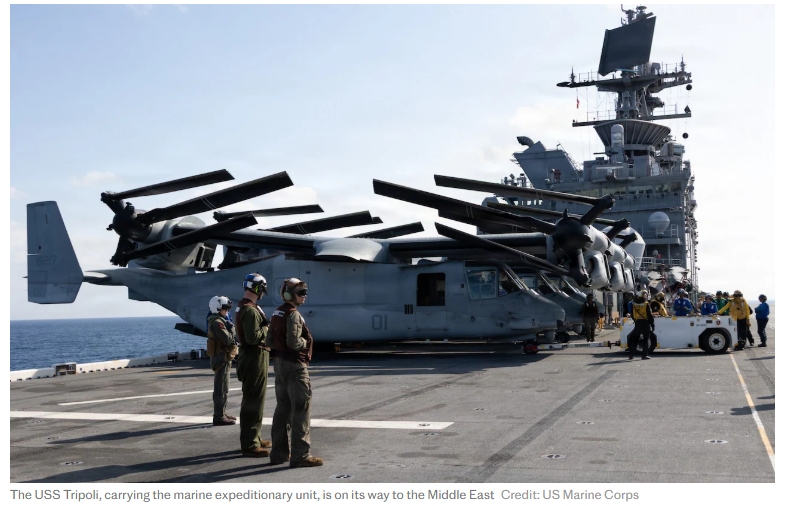
To that end, the big story today is the Tripoli Amphibious Ready Group (USS Tripoli LHA-7, plus USS San Diego LPD-22 and USS New Orleans LPD-18) with the 31st MEU embarked (around 2,200 Marines, F-35Bs, Ospreys, etc.). This group was recently in the Philippine Sea/7th Fleet AOR after exercises with Japan, but reports indicate it’s now being redirected to the Middle East amid the ongoing Iran conflict.
Multiple sources mention this as a rapid response deployment ordered in the last few days for potential operations in/around the Strait of Hormuz (e.g. escorting tankers, amphibious options, or ‘boots on the ground’ on the Persian side of the Strait.
The US Army’s 18th Airborne Corps (XVIII Abn Corps, often at Fort Bragg/Liberty) and the 101st Airborne Division (Air Assault, “Screaming Eagles” at Fort Campbell) seem to be still engaged with routine training in the US.
Overall, the standout signal for the moment is the Tripoli ARG redirected to CENTCOM/Middle East midst the battle with Iran, which might tie into plans for amphibious operations to secure the Hormuz Strait.
Iran may be playing the Hormuz Strait as their final if only ‘trump card.’ If that key waterway is to be secured, it looks like round one will be a Special Forces, US Navy, and US Marine show with the USAF and IAF flying top cover. To be continued….
Fair winds, following seas, and good luck, mates.
—————————-
Land based support assets already in theater:
Reports from open-source tracking and defense outlets confirm A-10 Warthog close air support (CAS) deployments to Jordan as part of the escalation, with the base serving as a central location for CAS missions over lower-threat or asymmetric targets in the campaign.
Some assets may rotate through or stage from other regional bases like Al Udeid Air Base in Qatar, the main CENTCOM hub with broader air operations, but Jordan’s Muwaffaq Salti AB stands out specifically for the A-10s’ potential role in sustained watch or ground support operations.
There are no indications of allied air asset basing at Incirlik AB, Turkey, for these operations. Turkey, a NATO “ally” has apparently decided to wait-and-see or sit this one out.
Exact CAS figures are not publicly detailed by CENTCOM for operational security reasons, but reliable reporting from late February 2026 ,just before Epic Fury launched, puts around 12 A-10C Thunderbolts in theater. This aligns with a squadron-level deployment, typically 12-18 aircraft for an expeditionary fighter squadron like the 75th Expeditionary Fighter Squadron, which has been associated with A-10 ops in the region.
This is part of a larger force of over 330 U.S. military aircraft in the Middle East at the moment, including dozens of fighters and support platforms.
The A-10s have been actively used since the first 48 hours of the operation for close air support, armed overwatch, and hitting dispersed/mobile Iranian targets (e.g., proxies, small naval assets, or ground forces), leveraging their loiter time, durability, and cannon firepower.
———————–
OTHER THEATEFR BASED US FORCES hosting fighters, tankers, helicopters, drones, and support operations against Iran.
Many of these airbases have faced Iranian retaliatory strikes (missiles/drones), yet remain operational:
Al Udeid Air Base (Qatar) — Largest U.S. base in the Middle East (~10,000 personnel), CENTCOM forward HQ, major hub for fighters (F-35s, F-15s, etc.), tankers, and command. Southwest of Doha; critical for Gulf operations.
Al Dhafra Air Base (UAE) — Key U.S. Air Force hub south of Abu Dhabi, hosts reconnaissance, fighters, and allied assets (including UAE Apache helios). Closest to the Strait of Hormuz entrance. Now targeted in Iranian strikes.
Prince Sultan Air Base (Saudi Arabia) — Hosts U.S. fighters, Patriots/THAAD defenses; used for air defense and strikes. Further inland but supports Gulf theater.
Ali Al Salem Air Base (Kuwait) — Major U.S. air logistics/transit hub (“The Rock”), near Iraqi border but supports Gulf rotations.
Naval Support Activity Bahrain (Bahrain) — Primarily naval (Fifth Fleet HQ), but supports air ops nearby; vessels often stage in/near Hormuz.
Other nearby/supporting sites — Duqm Port (Oman) for logistics; various UAE/Saudi airfields for allied (e.g., UAE Apaches defending against drones).
These form a chain along the Arab (southern) side of the Persian Gulf, with Al Dhafra and UAE facilities closest to the Strait of Hormuz where Iran has attempted to disrupt/control/blockade in retaliation for USAF/IAF air strikes inland.
(See https://www.visualcapitalist.com/mapped-every-us-military-base-in-the-middle-east for Epic Fury support bases.)
——————————–
- Murphy Donovan writes about the politics of Intelligence and national security. Hat tip to @Grok and @elonmusk









One Response
My goodness. Your reports are a good antidote to all the media speculations. That is, incredible expertise and planning are in use.