By Janice Fiamengo
The re-release this month of director Mary Harron’s movie I Shot Andy Warhol (1996) demonstrates once again the enduring feminist fascination with violent, man-hating women
1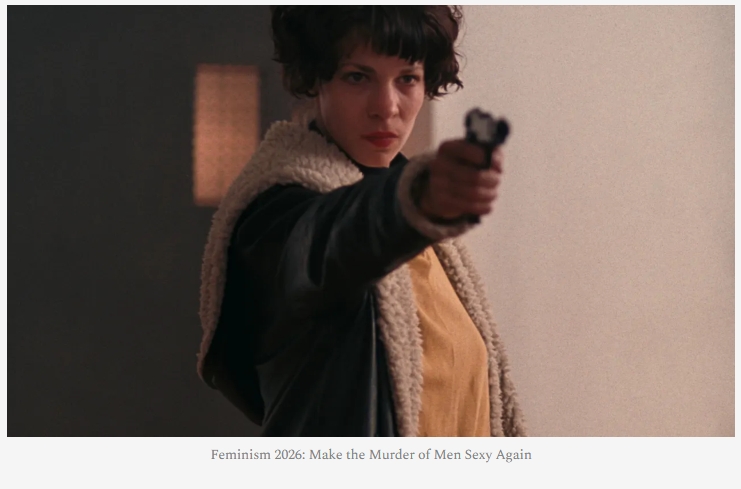
Feminists’ excuse for their anti-male hatred has always been disingenuous. When women hate men, feminists claim, it merely hurts men’s feelings. Men’s hatred of women, on the other hand, can be lethal. When men hate women, they kill them.
This would be nonsense even if men were the only sex that kills. Hatred has many damaging effects aside from bloodshed. Politicized hatred hurts its victims through social stigma, discrimination, and unjust laws and policies.
Women do kill and harm men in significant numbers (see my previous Substack).
Yet when feminist hatred leads to violence against men, feminists are unashamed. They shrug their shoulders, claiming that the violence was not representative of feminism in general. Or they justify the violence, casting the killer as a would-be liberator.
The latter is what we get from Mary Harron, the co-writer and director of I Shot Andy Warhol, a 1996 bio-pic about radical feminist Valerie Solanas, who became famous for trying to murder pop artist Andy Warhol just months after completing her man-hating treatise, the SCUM Manifesto. SCUM referred to the Society for Cutting Up Men.

Interviewed by The Guardian about the re-release of her movie on June 12, Harron was pleased that Solanas would be receiving renewed attention. She claimed that our present moment, allegedly rife with “male dominance and authoritarian regimes”—which Solanas was allegedly “fighting against”—makes her film more pertinent than ever.
In fact, Solanas didn’t “fight against” anything in particular, lacking any coherent program or even a single useful strategy for social change. But Harron and The Guardian are invested in making Solanas more interesting and admirable than she actually was.
Anyone expecting at least pro forma expressions of dismay over Solanas’s violence will be disappointed by The Guardian feature, which touts the movie’s “triumphant return.” While confessing that Solanas had “deeply held prejudices” against trans women, Harron says not a word about Solanas’s overriding anti-male hatred.
In fact, Harron expresses sympathy for Solanas and praises her “comical precision and icy literary voice,” which she says hit her “like a lightning bolt” when she first read Solanas’s SCUM Manifesto in the 1980s. Harron, who was then working as a music journalist, claims that she immediately felt a connection to Solanas because of “all my years catering to the pathetic male ego.”
The Guardian guides readers to adopt Harron’s feminist view, describing Solanas’s “righteous anger towards patriarchal social control” and quoting Harron’s words: “I love Valerie, but you don’t have to turn her into a 100% hero.”
There’s moral rectitude for you. Do not sanctify the would-be murderer—at least, not entirely.
I Shot Andy Warhol made Solanas, instead, into an attractive anti-hero, a brilliant but troubled woman whose fanaticism is softened by vulnerability (scenes of her sleeping rough and selling her body for money), and whose mawkish writings are framed as counter-cultural art.
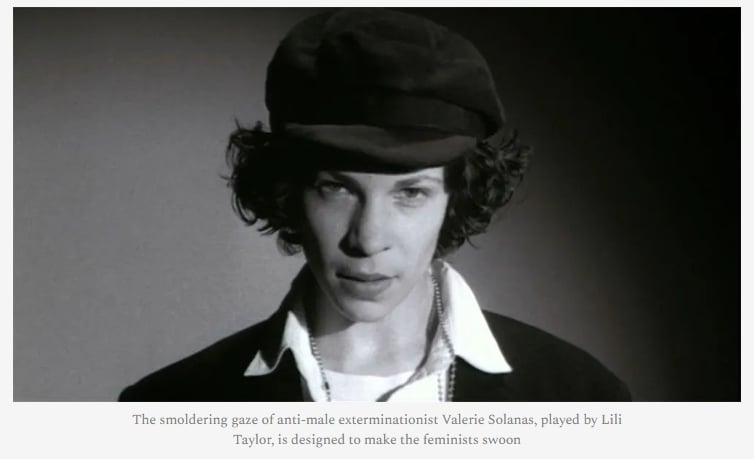
Many of the movie’s most memorable scenes depict Solanas, pugnacious and self-possessed in actor Lili Taylor’s rendering, reciting short SCUM passages. In these sepia-tinged tableaux, Solanas seems lifted out of the film’s present, her pithy and piquant words immortalized. Other romanticized scenes show her at the typewriter, cigarette on lip, undaunted by dingy circumstances; or hawking her mimeographed booklet like a one-woman standup routine on the streets of Greenwich Village.
Solanas’s murder attempt, in the opening and closing frames of the movie, is stylized and bloodless, with the camera focused mainly on Solanas’s compelling, defiant face. Warhol’s suffering is not depicted at all.
Eaten Up with Hate
In reality, Valerie Solanas was a misanthrope and misfit whose attempt to kill an innocent man was the only notable thing about her. Her SCUM Manifesto is worth reading only as a window into the black heart of her pathological narcissism.

The book anticipates many feminist claims about male violence and male inadequacy. Solanas wrote that “To be male is to be deficient” (p. 35). “To call a man an animal is to flatter him; he’s a machine, a walking dildo” (p. 37). Women didn’t have penis envy, she asserted: “men have pussy envy” (p. 38). “Every man, deep down, knows he’s a worthless piece of shit” (p. 39).
Men reduce women to objects, Solanas claimed, because “the male is a mere member of the species, interchangeable with every other male. He has no deep-seated individuality” (p. 46). “The male is just a bunch of conditioned reflexes, incapable of a mentally free response” (p. 45). “Although he wants to be an individual, the male is scared of anything in himself that is the slightest bit different from other men” (p. 50).
And on and on and on, relentless in accusatory iteration.
Solanas’s fundamental claim about men was that they hated themselves and wanted to be women, but knew they never could be. She described the male as “eaten up with frustration at not being female” and “eaten up with hate—not rational hate that is directed at those who abuse or insult you—but irrational, indiscriminate hate … hatred, at bottom, of his own worthless self” (p. 64).
Here was the enduring feminist tenet that women are right to hate men, who allegedly abuse and insult them, while men who hate women are reacting to their own awfulness. Men’s only reasonable response to their condition, according to Solanas, was to resign themselves to oblivion.
Some of Solanas’s SCUM writing, despite its banal content, has a certain aphoristic effectiveness. “Just as humans have a prior right to existence over dogs by virtue of being more highly evolved and having a superior consciousness,” Solanas declared, “so women have a prior right to existence over men” (p. 67). But even if one were to accept the double syllogism, her conclusion—“The elimination of any male is, therefore, a righteous and good act” (p. 67)—does not follow. It is not righteous to destroy a living being simply because it is not highly evolved.
Most of SCUM is dull and repetitive, showcasing a limited vocabulary, clichéd utterances, and vague vulgarities. Solanas’s radical vision for a better society, if it can be called that, was no more complicated than the childish desire, repeated ad nauseum, to “overthrow the government, eliminate the money system, institute complete automation and destroy the male sex” (p. 35).
How that was to be achieved, Solanas would say no more than that SCUM women “could acquire complete control of this country within a few weeks simply by withdrawing from the labor force, thereby paralyzing the entire nation. Additional measures, any one of which would be sufficient to completely disrupt the economy and everything else, would be for women to declare themselves off the money system, stop buying, just loot and simply refuse to obey all laws they don’t care to obey” (p. 69).
Such puerile pap might be attractive to a rebellious fifteen-year-old mind (and was certainly attractive to Mary Harron, who compared Solanas to Malcolm X and said her analysis of society was “really quite brilliant”), but it is embarrassing when presented as a quasi-serious, or rhetorical, call for revolution.
The reasons for Solanas’s obsessive hatred of men are never made clear, with various accusations and judgements appearing throughout. Early on, she described men as “psychically passive” because “completely egocentric, unable to relate, empathize or identify, and filled with a vast, pervasive, diffuse sexuality” (p. 37).
But she also expressed disgust at man’s invention of philosophy and religion, systems of moral thought she claims were created because “Being empty, he looks outward, not only for guidance and control, but for salvation and for the meaning of life” (p. 52). Surely “egocentric” people tend to look inward rather than outward, and “psychically passive” people are not the type to be fascinated by complex religious and philosophical structures, let alone to spend lifetimes elaborating, refining, and debating them, as men have done? The simple-mindedness of Solanas’s own thought, in contrast, is glaringly evident.
Even women, the superior beings who will inherit the earth, are not consistently portrayed. Woman is said to “know instinctively that the only wrong is to hurt others, and that the meaning of life is love” (p. 53). The sentimentality is cloying. Yet Solanas also railed against “Daddy’s Girls,” women who love and venerate men (p. 55), declaring that “All women have a fink streak in them, to a greater or lesser degree” (p. 74). In contrast to her point about women’s knowledge of love, she praised “hateful, violent bitches given to slamming those who unduly irritate them in the teeth, who’d sink a shiv into a man’s chest or ram an ice pick up his asshole as soon as look at him” (p. 61).
Many an angry fifteen-year-old could do as well as that.
There is no use in seeking a thought-provoking insight or pattern of themes. SCUM Manifesto does not deserve to be venerated for its audacity or wit, and certainly not for its word-smithing. Filled with bitter ravings, it is perhaps best understood as feminism’s junior Mein Kampf, especially Solanas’s excoriation of man for “needing scapegoats onto whom he can project his failings and inadequacies” (p. 53). Scapegoat-creator, heal thyself.
Feminists Justify Attempted Murder
As it happened, nobody on the funky streets of New York City was interested in joining SCUM or reading about its proposed exploits. Solanas was unable to sell many copies of the book or to find acolytes to listen to her ravings. Her focus turned to paranoia-inspired violence. On June 3, 1968, Solanas walked into Andy Warhol’s studio, The Factory, and shot him three times at point-blank range with a .32 caliber Beretta handgun, reportedly because she believed he was planning to steal the contents of a play she had been pestering him to produce.
She also shot art critic Mario Amaya, who was not seriously wounded, and attempted to shoot Warhol’s manager, Fred Hughes, who was saved by the gun’s not firing.
The book anticipates many feminist claims about male violence and male inadequacy. Solanas wrote that “To be male is to be deficient” (p. 35). “To call a man an animal is to flatter him; he’s a machine, a walking dildo” (p. 37). Women didn’t have penis envy, she asserted: “men have pussy envy” (p. 38). “Every man, deep down, knows he’s a worthless piece of shit” (p. 39).
Men reduce women to objects, Solanas claimed, because “the male is a mere member of the species, interchangeable with every other male. He has no deep-seated individuality” (p. 46). “The male is just a bunch of conditioned reflexes, incapable of a mentally free response” (p. 45). “Although he wants to be an individual, the male is scared of anything in himself that is the slightest bit different from other men” (p. 50).
And on and on and on, relentless in accusatory iteration.
Solanas’s fundamental claim about men was that they hated themselves and wanted to be women, but knew they never could be. She described the male as “eaten up with frustration at not being female” and “eaten up with hate—not rational hate that is directed at those who abuse or insult you—but irrational, indiscriminate hate … hatred, at bottom, of his own worthless self” (p. 64).
Here was the enduring feminist tenet that women are right to hate men, who allegedly abuse and insult them, while men who hate women are reacting to their own awfulness. Men’s only reasonable response to their condition, according to Solanas, was to resign themselves to oblivion.
Some of Solanas’s SCUM writing, despite its banal content, has a certain aphoristic effectiveness. “Just as humans have a prior right to existence over dogs by virtue of being more highly evolved and having a superior consciousness,” Solanas declared, “so women have a prior right to existence over men” (p. 67). But even if one were to accept the double syllogism, her conclusion—“The elimination of any male is, therefore, a righteous and good act” (p. 67)—does not follow. It is not righteous to destroy a living being simply because it is not highly evolved.
Most of SCUM is dull and repetitive, showcasing a limited vocabulary, clichéd utterances, and vague vulgarities. Solanas’s radical vision for a better society, if it can be called that, was no more complicated than the childish desire, repeated ad nauseum, to “overthrow the government, eliminate the money system, institute complete automation and destroy the male sex” (p. 35).
How that was to be achieved, Solanas would say no more than that SCUM women “could acquire complete control of this country within a few weeks simply by withdrawing from the labor force, thereby paralyzing the entire nation. Additional measures, any one of which would be sufficient to completely disrupt the economy and everything else, would be for women to declare themselves off the money system, stop buying, just loot and simply refuse to obey all laws they don’t care to obey” (p. 69).
Such puerile pap might be attractive to a rebellious fifteen-year-old mind (and was certainly attractive to Mary Harron, who compared Solanas to Malcolm X and said her analysis of society was “really quite brilliant”), but it is embarrassing when presented as a quasi-serious, or rhetorical, call for revolution.
The reasons for Solanas’s obsessive hatred of men are never made clear, with various accusations and judgements appearing throughout. Early on, she described men as “psychically passive” because “completely egocentric, unable to relate, empathize or identify, and filled with a vast, pervasive, diffuse sexuality” (p. 37).
But she also expressed disgust at man’s invention of philosophy and religion, systems of moral thought she claims were created because “Being empty, he looks outward, not only for guidance and control, but for salvation and for the meaning of life” (p. 52). Surely “egocentric” people tend to look inward rather than outward, and “psychically passive” people are not the type to be fascinated by complex religious and philosophical structures, let alone to spend lifetimes elaborating, refining, and debating them, as men have done? The simple-mindedness of Solanas’s own thought, in contrast, is glaringly evident.
Even women, the superior beings who will inherit the earth, are not consistently portrayed. Woman is said to “know instinctively that the only wrong is to hurt others, and that the meaning of life is love” (p. 53). The sentimentality is cloying. Yet Solanas also railed against “Daddy’s Girls,” women who love and venerate men (p. 55), declaring that “All women have a fink streak in them, to a greater or lesser degree” (p. 74). In contrast to her point about women’s knowledge of love, she praised “hateful, violent bitches given to slamming those who unduly irritate them in the teeth, who’d sink a shiv into a man’s chest or ram an ice pick up his asshole as soon as look at him” (p. 61).
Many an angry fifteen-year-old could do as well as that.
There is no use in seeking a thought-provoking insight or pattern of themes. SCUM Manifesto does not deserve to be venerated for its audacity or wit, and certainly not for its word-smithing. Filled with bitter ravings, it is perhaps best understood as feminism’s junior Mein Kampf, especially Solanas’s excoriation of man for “needing scapegoats onto whom he can project his failings and inadequacies” (p. 53). Scapegoat-creator, heal thyself.
Feminists Justify Attempted Murder
As it happened, nobody on the funky streets of New York City was interested in joining SCUM or reading about its proposed exploits. Solanas was unable to sell many copies of the book or to find acolytes to listen to her ravings. Her focus turned to paranoia-inspired violence. On June 3, 1968, Solanas walked into Andy Warhol’s studio, The Factory, and shot him three times at point-blank range with a .32 caliber Beretta handgun, reportedly because she believed he was planning to steal the contents of a play she had been pestering him to produce.
She also shot art critic Mario Amaya, who was not seriously wounded, and attempted to shoot Warhol’s manager, Fred Hughes, who was saved by the gun’s not firing.

Warhol suffered near-fatal injuries, and never fully recovered. Two bullets pierced his stomach, liver, spleen, esophagus, and both lungs. He was briefly declared dead on the operating table, had to undergo various surgeries, and had to wear a surgical corset for the rest of his life to hold his organs in place.
His recovery was painful and traumatic. He became terrified of hospitals and eccentric people, preoccupied with thoughts of death. His art changed, becoming less playful, more macabre, and his open-door policy at The Factory was rescinded. He sought security through body guards and surveillance systems.
It’s possible to downplay Solanas’s murder attempts on the basis that she was mentally ill. Solanas was diagnosed as suffering from paranoid schizophrenia and spent months in a psychiatric institution.
But the reaction to what Solanas did by allegedly sane feminist ideologues and advocates, including Mary Harron, is a different story. On the whole, feminists have been undisturbed—nay, gratified—by the obvious parallels between Solanas’s written justification for the murder of men as “a righteous and good act,” and her actual shootings of men.
The then-president of the National Organization of Women’s New York chapter, Ti-Grace Atkinson, championed Solanas at the time of the shootings as a symbol of women’s justified rage and enlisted a prominent attorney to handle her defense. One of Andy Warhol’s film stars (known as Ultra Violet) wrote a memoir (Famous for 15 Minutes: My Years with Andy Warhol) in which she praised Solanas as a visionary, saying “For in the beginning, beyond her overheated rhetoric, she had a truly revolutionary vision of a better world run by and for the benefit of women.”
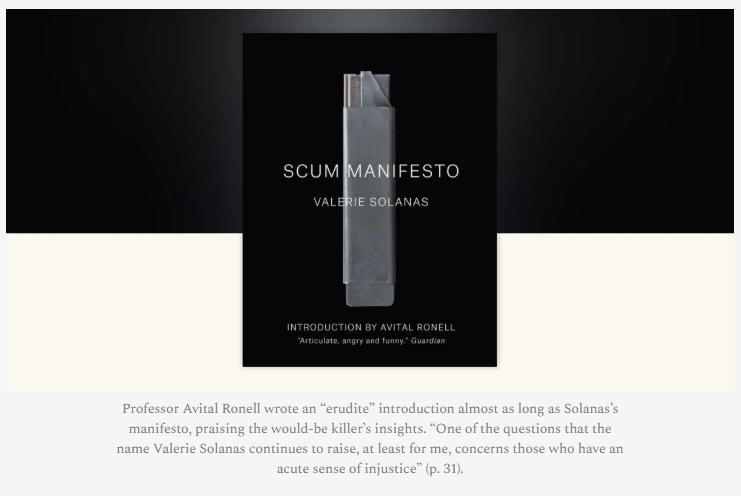
The SCUM Manifesto took off, first published by Olympia Press shortly after Solanas’s arrest and eventually translated into a dozen languages. It has been widely taught in women’s studies courses, excerpted in feminist anthologies such as Robin Morgan’s Sisterhood is Powerful (1970), and reprinted by Verso Books, a boutique press, in 2004 with a lengthy, bombastic introduction by New York University philosophy professor Avital Ronell, later found guilty of sexually harassing a male graduate student. Ronell praised the book’s alleged prescience, stating of Solanas that “Maybe she was put here to speak the unspeakable or, less dramatically, to sound the wake-up call […] to encourage the dialectics of female empowerment” (24).
In 2014, Breanna Fahs published an admiring biography that cast Solanas as both abused innocent and resistance warrior. Fahs records an exchange between Solanas and friend Jeremiah Newton, who asked her if her manifesto was to be taken literally. “I don’t want to kill all men,” she had allegedly replied. “I think males should be neutered or castrated so they can’t mess up any more lives.”
In 2018, Julie Bindel gushed, “What I love about this book [SCUM Manifesto] is how it promotes straightforward man-hating.”
In 2020, a celebratory article calling Solanas “an important LGBTQ figure,” was published in The New York Times as part of a series called Overlooked, about “remarkable” people whose deaths had not been (but should have been) reported in the Times. The article noted her “daring arguments in SCUM Manifesto, her case for a world without men” and seemed to regret that the attack on Warhol had come to “define her life.”
It’s impossible to imagine the online manifesto of Elliot Rodger, who killed six people in Isla Vista, California, being read in university classrooms and published with a glowing introduction by a super-star academic.
**
Solanas is not alone, of course. Many other well-known feminist figures—including tenured academics, successful writers, and legal theorists—have either openly fantasized about or seriously recommended the murder of men or the significant reduction in their numbers. Such pronouncements have not damaged their reputations or led to their loss of employment.

San Francisco State University Professor of Women’s Studies Sally Miller Gearhart recommended the non-violent culling of men through new reproductive technologies. She proposed in her 1982 essay, “The Future—If There Is One—Is Female” (published in a volume ostensibly about feminism and non-violence!) that “The ratio of men to women must be radically reduced so that men approximate only ten percent of the total population” (p. 280).
Boston College Professor Mary Daly, asked about Gearhart’s contention in a 1999 interview for What is Enlightenment magazine, was enthusiastic in her agreement, prophesying an upcoming “decontamination of the earth” that would result in a “drastic reduction of the population of males.”

University of Miami Law Professor Mary Anne Franks has more recently argued for what she calls a “redistribution of violence,” alleging that “Society would be better off as a whole if more women were willing to engage in justified violence against men” and proposing that “To that end, women’s justified violence against men should be encouraged, protected, and publicized.”
Egyptian-American author Mona Eltahawy published The Seven Necessary Sins For Women and Girls in 2019, fantasizing about vigilante killings of men in order to bring “the patriarchy” to its knees. In interview with the Canadian Broadcasting Corporation, she outlined her feminist-Jacobin program: “I ask people to imagine—now I’m using this word imagine, and I’m underlining it three times—a scenario in which we kill a certain number of men every week. How many men must we kill until patriarchy sits across the table from us and says, ‘Ok, stop.’”
These and more like them are celebrated throughout the west for their alleged commitment to women’s equality.
Feminism as Death Cult

Perhaps it is possible to find, somewhere on the internet, a lone voice or two advocating the random killing of women, or the near-elimination of the female sex.
But it is impossible to imagine a group of thought leaders in our society not only tolerating but in many cases actively promoting and praising the killing of women—for the good of the earth and of men.
The proposed killing of men is fully tolerated and praised. When confronted with the evidence, feminist advocates are disbelieving, defensive, and dismissive—ultimately annoyed, even outraged, to have the extremist tenets of their professed faith read back to them. Their belief in their own righteousness is unshaken.
21st-century feminism remains one of the most popular death cults in the world, and Valerie Solanas will be its standard-bearer this summer.
First published in the Fiamengo File