by G. Tod Slone (March 2026)
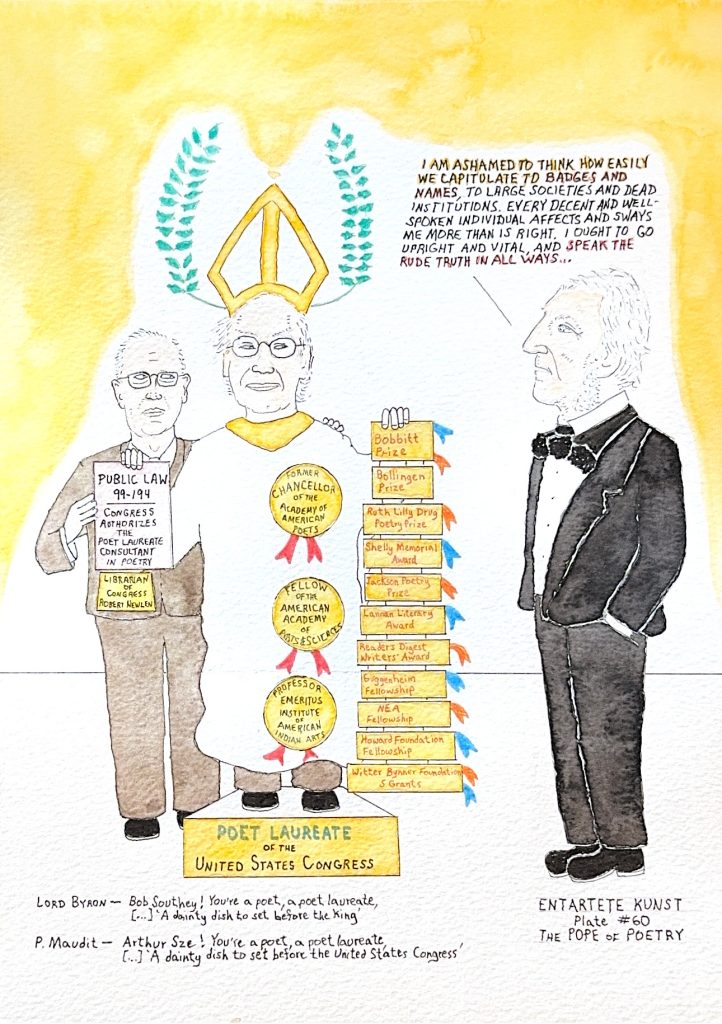
Bob Southey! You’re a poet, a poet laureate,
[…] ‘A dainty dish to set before the King’
__________—Lord Byron, Poet and Former Member of the House of Lords of the United Kingdom
y
Arthur Sze! You’re a poet, a poet laureate,
[…] ‘A dainty dish to set before the United States Congress
__________—P. Maudit, Poet and Ostracized by the American Academic/Literary Establishment
In a purported democracy, a citizen should be able to criticize organizations, leaders, procedures, etc. without ending up ostracized for doing so. Punished speech is not free speech. It is sad that in the realm of poetry, criticism seems to be taboo. It is sad, for example, that nothing but blind praise tends to be accorded to the Poets Laureate of the United States. So, bravo to Lord Byron for breaking that unwritten m.o. centuries ago! Like Byron, I too have broken it. Yes, I had the audacity, for example, to challenge the high and mighty Librarian of Congress, especially regarding the undemocratic selection process of poets laureate. Yes, the Librarian alone makes the selection.
A question I have been posing now for a number of years arises: should poetry be restricted to highbrow intellectual entertainment and within ideological boundaries. In that sense, the genre becomes, as often I’ve stated, castrated, coopted and corralled. Imagine a poet laureate who would actually dare question and challenge the very process of his/her anointment and that of the prizes and awards received. Well, has there ever been one like that?
“Library of Congress Names Arthur Sze the Nation’s 25th U.S. Poet Laureate” was the announcement issued by the Library of Congress Newsroom last September. A large photo precedes the write-up depicting Sze standing like a demigod before the said Library. The only thing missing from the image was the usual laurels on the noggin, which I added in my satirical depiction. “Last fall the Library of Congress honored Arthur Sze with our Bobbitt Prize, for lifetime achievement in poetry; this fall we are thrilled to bring him back to the Library as the nation’s poet laureate,” noted Acting Librarian of Congress Robert Randolph Newlen.
Now, who might “we all” include? Am I part of the “we all”? Certainly not! Such generalities are far too often made, especially by political (and cultural) hacks, as in “the folks want” or “Americans think that.”
The article is replete with hackneyed vapidity, including “Like Emily Dickinson and Walt Whitman, Sze forges something new from a range of traditions and influences—and the result is a poetry that moves freely throughout time and space.” New, or rather the same old, same old? Newlen ought to have included an example of Sze’s verse to illustrate what the hell moving “freely through time and space” might encompass. Might it be poetry about astronauts writing poetry? Well, what it certainly wouldn’t be is verse critical of the poetry establishment (e.g., the Library of Congress and Newlen himself).
“What an amazing honor to be named the 25th Poet Laureate of the United States,” declared Sze. “As the son of Chinese immigrants, and as a sophomore who decided to leave MIT to pursue a dream of becoming a poet, I never would have guessed that so many decades later I would receive this recognition.” Recognition, yes, but by whom? Well, by an organization formed by political hacks and promoted largely by in-lockstep academic hacks, uh, “distinguished poets,” most of whom I’d had the audacity to question and challenge over the years. Is that permitted in the realm of the “distinguished”? Well, not one of those criticized deigned to respond to my poetic heresy![*]
“Sze joins a long line of distinguished poets who have served in the position, including Ada Limón, who recently completed a two-year second term, as well as Joy Harjo, Tracy K. Smith, Juan Felipe Herrera, Charles Wright, Natasha Trethewey, Philip Levine, W.S. Merwin, Kay Ryan, Charles Simic, Donald Hall, Ted Kooser, Louise Glück, Billy Collins, Stanley Kunitz, Robert Pinsky, Robert Hass and Rita Dove,” noted the anonymous newsroom scribouilleur.
Sze argues as to his anointment: “It’s a recognition that belongs to teachers, librarians, editors, poets, readers—everyone who works tirelessly on behalf of poetry. As laureate I feel a great responsibility to promote the ways poetry, especially poetry in translation, can impact our daily lives. We live in such a fast-paced world: poetry helps us slow down, deepen our attention, connect and live more fully.” The terms “we” and “everyone” echo DEI hypocrisy, where inclusion really means exclusion. I and other poets no doubt are certainly not included in those terms.
Why not open the doors to poetry that not only “moves freely throughout time and space,” but also questions and challenges establishment restrictions, including the prime one: thou shalt NOT criticize the poetry establishment—its organizations, its icons, its magazines, its foundations, its prizes, etc.? Once upon a time the Academy of American Poets actually had a space on its website for unrecognized poets to post comments. And so I’d commented. And so, my comments were removed (i.e., censored). Examine the censored comments et al. In vain, I’d attempted to get the Academy apparatchiks to uncensor them. Examine the brief dialogue de sourds I had with one of the Academy chancellors, as well as other individuals. Soon after that, the Academy eliminated its comments section altogether. Not one of the high-and-mighty chancellors protested!
Sze’s establishment credentials listed in the newsletter are lengthy to say the least. But not a single credential included questioning and challenging the machine. When will there be a poet laureate with credentials for bucking the elitist system, going against its in-lockstep grain, and making waves in the academic/literary establishment? Perhaps poets ought not strive for recognition and fame, but instead for truth, especially the kind apt to upset establishment apparatchiks. But if they were to do that they would become critical outliers, certainly not poet laureates swimming in grant money and prizes.
Over the years, I have been quite critical of the Library of Congress, which simply refused to include the journal I publish on its shelves, and yet “The Library of Congress is the world’s largest library, offering access to the creative record of the United States—and extensive materials from around the world—both on site and online.” Why then is the journal I publish and poets published in it not included in that “creative record”? In my “Open Letter to Beacher Wiggins, Director for Acquisitions,” I posed a prohibited question: “Should public servants be in the business of determining what literature should be accepted and what literature should be rejected at the publicly-funded Library of Congress? Should they be serving as Gatekeepers of Propriety—Grand Censors and Banners of Books and Periodicals? How can such activity possibly conform with the principles of democracy, especially free expression and vigorous debate? Wiggins never responded to the letter. I’d also sent an email with that regard to Director Rob Casper and another one to Librarian of Congress Carla Hayden, both of whom deigned not to respond:
To Rob Casper, Director of the Poetry and Literature Center, Library of Congress:
What precisely is the criteria for your subscribing to a 501c3 nonprofit journal of poetry and literature? Beecher Wiggins, Director of Acquisitions and Bibliographic Access, simply refused to respond to that question last year when I posed it. Will you?
The Library of Congress seems to be run like an autocratic government entity, quite shameful indeed for a democracy. BTW, you are featured in a new P. Maudit cartoon with that regard et al. You were also featured in a cartoon sketched in 2014. Both cartoons will appear inThe American Dissident.
In a democracy like ours, the Library of Congress should be INCLUSIVE and that means INCLUSIVE of criticism lodged against the Library of Congress and its diverse apparatchiks. Evidently, it has failed in that area.
To Carla Hayden, Librarian of Congress,
I just wrote the following vis-a-vis your NYTimes interview, “Unchecked Self-Aggrandizement—A Review of an Interview.” Is there anything at all in it that you might consider to be “fake news”? I have reread it over and again and have not noticed anything in it to be “fake news.” Thank you for your hopeful, though doubtful, response.
Finally, poet idolators of prize-winners, grant-receivers, and anointed laureates never seem to wonder who the faceless decision makers are and what their biases might be. Should they not be more curious, instead of simply opening wide and swallowing? And is it not mind-boggling that there is actually a law, Public Law 99-194 (Dec. 20, 1985) pertaining to poetry? Yes, it seems our political hacks have passed laws for just about everything, which is likely one of the main reasons why the nation is in such a sad state today. The following constitutes the first paragraph of the law relating to the poet laureate:
TITLE VI—POET LAUREATE CONSULTANT IN POETRY
SEC. 601. AUTHORITY FOR POET LAUREATE CONSULTANT IN POETRY. 2 USC 177.
(a) RECOGNITION OF THE CONSULTANT IN POETRY.—The Congress recognizes that the Consultant in Poetry to the Library of Congress Library of Congress has for some time occupied a position of prominence in the life of the Nation, has spoken effectively for literary causes, and has occasionally performed duties and functions sometimes associated with the position of poet laureate in other nations and societies. Individuals are appointed to the position of Consultant in Poetry by the Librarian of Congress for one- or two-year terms solely on the basis of literary merit, and are compensated from endowment funds administered by the Library of Congress Trust Fund Board. The Congress further recognizes this position is equivalent to that of Poet Laureate of the United States.
[*] Below are links to some of those heretical challenges. All but the first one concern Poets Laureate of the United States. Check them out. Be curious! Curiosity didn’t kill the cat; it killed the poet!
—Carla Hayden, former director of Library of Congress
—Robert Pinsky
—Robert Hass
—Rita Dove
—Joy Harjo
—Juan Felipe Herrera
—Natasha Trethewey
—Charles Simic
—Donald Hall
—Billy Collins
—Tracy K. Smith
Table of Contents
G. Tod Slone, PhD, lives on Cape Cod, where he was permanently banned in 2012 without warning or due process from Sturgis Library, one of the very oldest in the country. His civil rights were being denied because he was not permitted to attend any cultural or political events held at his neighborhood library. The only stated reason for the banning was “for the safety of the staff and public,” yet he has no criminal record and has never made a threat. His real crime was that he challenged, in writing, the library’s “collection development” mission that stated “libraries should provide materials and information presenting all points of view.” His point of view was somehow not part of “all points of view.” In November 2022, he requested the library rescind its banning decree, which it finally did. He is a dissident poet/writer/cartoonist and editor of The American Dissident.
Follow NER on Twitter @NERIconoclast








One Response
If I found my poetry “moving freely between time and space”, I’d have it chipped.